 Brooke Larsen
Utah’s abnormally hot and dry winter will create hardships for water managers, cities and farmers across the state this summer. But it’s not just humans who might suffer: pikas, a small alpine-dwelling rabbit relative, may also feel stress.
And since pikas are considered a “climate indicator species” — sensitive to changes — their health can signal what’s ahead for everyone. “Pika problems can very quickly become people problems,” said Johanna Varner, biology professor at Colorado Mesa University.
New research from Varner, her undergraduate students and other scientists across Utah and Colorado found that American pikas in the La Sal Mountains near Moab experience more stress during years with less snow and higher temperatures.
Snow provides pikas with an insulated blanket to burrow under and munch on their haypiles — feasts of grasses, leaves and other plants — during frigid winters at Utah’s high elevations, said Karli Weatherill, a lead author on the paper and Varner’s former student.
Snow melt also nourishes the grasses that pikas eat throughout the year. Less snow means less food — and less water in the vegetation that does grow.
“The impacts from this year’s weather won’t be seen until late in the summer and fall,” Adam Brewerton, conservation biologist with Utah’s Division of Wildlife Resource, said in an email. “As long as there is enough growth in the high-elevation meadows, they should be able to store enough food. But with limited snow, we might be looking at a drier season.”
Scientists study pikas to gain insight into the impact of climate changes, Weatherill said. “You can understand a lot about the environment around them based off of how they’re doing,” she explained, “because they’re a little bit more sensitive to the types of threats that the ecosystem may face.”
(Johanna Varner) Karli Weatherill releases a pika in the La Sal Mountains near Moab, Utah on July 30, 2023.
Other research has found that climate change may particularly affect pikas in isolated, southern mountain ranges like the La Sals, so Varner, also known as “Pika Jo,” thought it would be an ideal place to study.
“If you think about mountains as kind of like an island in the sky, the La Sals are kind of like a Fiji, right?” Varner said. “They’re way out there in the middle of nowhere. They’re surrounded by low elevation redrock desert in all directions for about 40 miles.”
‘They’re cute, and they’re fun to watch’
Since 2018, Varner, her students and research partners have hiked among the talus slopes beneath the La Sal’s tall peaks during the first two weeks of August to find pikas.
“Pikas bring you to these places that are so much larger than you, and it puts in perspective how small we are compared to the whole ecosystem,” Weatherill said.
They’re also “just adorable, and they’re cute and they’re fun to watch,” she added.
To study the pikas, the scientists carefully captured them in wire mesh traps placed among the rocks, hidden from predators and the hot sun. They opened the traps for a few hours during cool mornings and filled them with grasses and apple slices to lure the pikas inside.
Once caught, scientists administered anesthesia and punched different color tags on each ear, like dangling earrings, to identify each one.
(Stephanie Matlock) Karli Weatherill, left, and Johanna Varner, right, handle a pika in the field in the La Sal Mountains near Moab, Utah on Aug. 9, 2025.
They also set up monitors to capture the temperature of the ambient air and the air under the rocks where pikas live. They documented what grasses and other vegetation grow across the area. And they collected pika poop, which looks like black peppercorns, to test for stress hormones.
Then, in each consecutive year, the scientists pulled out their binoculars and searched for each pika they tagged and collected poop again.
Of the 74 pikas tagged, only one was seen each of the six years of the study. “Every year we would go back and there was white, yellow, white, red,” Varner said, referring to the pika’s ear tag colors.
Seeing that same pika each year was a “profound experience” for Varner. Pikas typically only live to seven years old, and some of Varner’s collaborators have found that climate may be shortening pikas’ lifespans.
“I think back to what my life and what the world was like in 2018, and it feels like sort of a lifetime ago,” she said. “It was before the pandemic. It was before a lot of major life events for me, and a lot of major changes in the world. And that pika was up there in that same territory every year, collecting food and not getting eaten.”
A ‘cool’ result
Abundant grasses in the alpine meadows of the La Sals may have helped that one pika stay alive.
While the study found that hot temperatures and poor snowpack stress out pikas in the La Sals, they also found that high grass cover was consistently associated with lower stress.
(Johanna Varner) A pika building its haypile in the La Sal Mountains near Moab, Utah on Aug. 9, 2020.
“I think what’s really cool about that result is that grass cover is something that could hypothetically be managed for, right?” Varner said.
Climate change, while important to address, is more difficult for local land managers to tackle, Varner added. A future study on the effects of livestock grazing on pikas may further help land managers protect the species.
The division doesn’t currently have specific data on grazing and pikas, Brewerton said. “We have not seen any significant impacts from livestock grazing in pika habitat because of the high-elevation areas where pikas are found,” he added.
How Utahns can help scientists learn more
The division currently conducts pika surveys every three years, Brewerton said. Soon, Utahns — with science degrees or without — can help the state and researchers fill data gaps.
Utah’s Hogle Zoo, in partnership with Varner and the division, is launching a new program this spring called Utah Pika Watch that will teach Utahns how to collect observations on pikas and enter data into an online form.
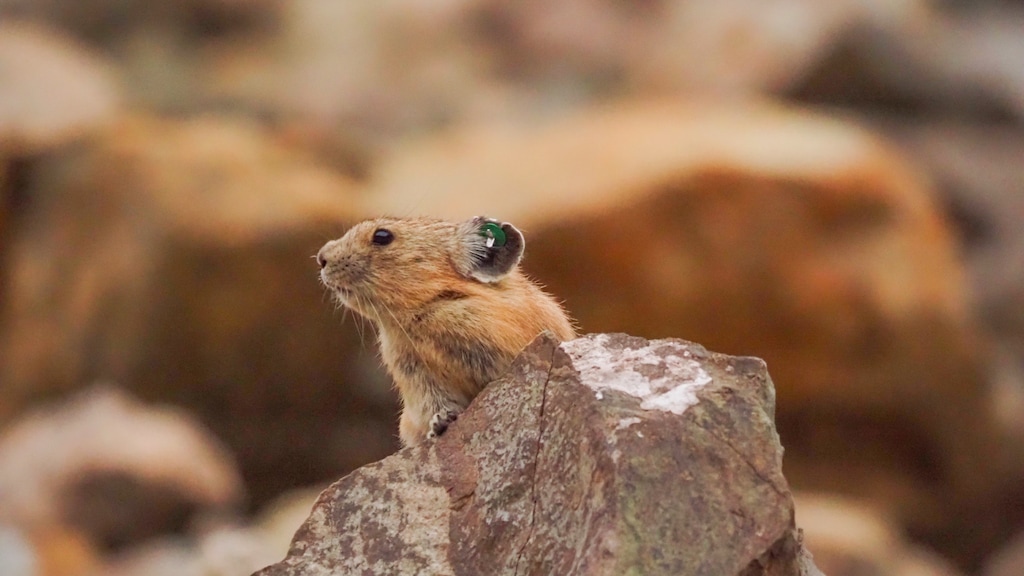
(Karli Weatherill) A pika with an ear tag in the La Sal Mountains near Moab, Utah on Aug. 8, 2025.
“Pika Jo says [pikas] are the perfect community science study animal,” said Tori Bird, community conservation and impact specialist at the zoo. “They’re so cute, they’re in accessible places and you can do this study without really having an impact on the pika or their habitat.”
The program will focus on 10 sites across the state, including six in the Wasatch Mountains, two in the Manti Range in central Utah and two on the Markagunt Plateau east of Cedar City.
The zoo is hosting two in-person training sessions this spring on May 23 and June 4, and it will also offer an online training.