 Brooke Larsen
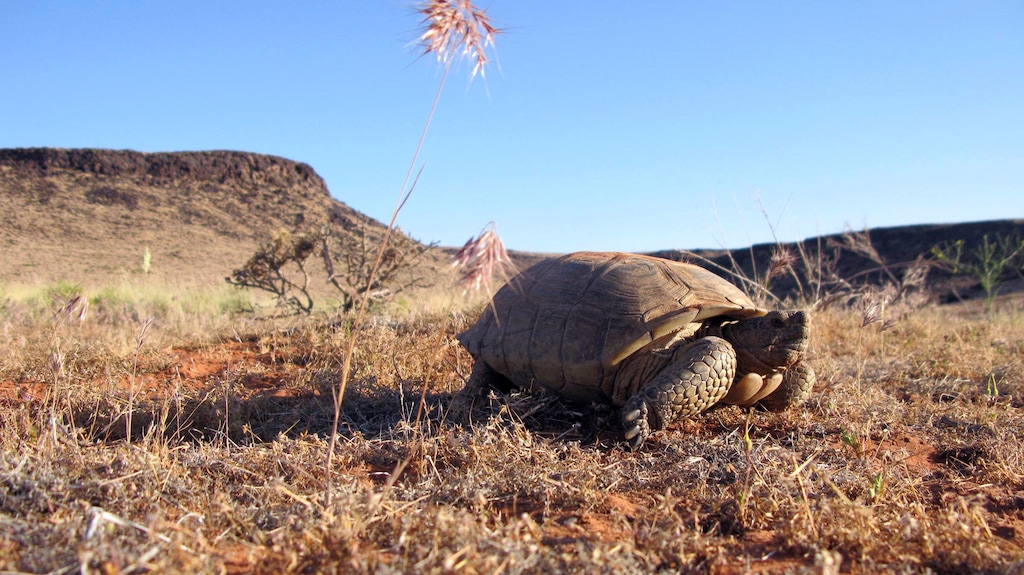
St. George • Cars killed at least two Mojave desert tortoises in southwest Utah last year. The slow-moving reptiles crawled out of a protected area, past a damaged fence and into the path of much faster moving tires.
In the months leading up to their death, the Division of Wildlife Resource had translocated the tortoises from urban areas in Washington County to the Grapevine Wash. The slow-moving reptiles walked over two miles across orange sand and red rock until vehicles squashed them on I-15.
“We found two tortoises that have been hit on I-15. We don’t know, maybe there’s others that are getting killed that we just haven’t found,” Mike Schijf, county biologist, said during a meeting earlier this year.
Since then, the county has been “extra proactive” to ensure the tortoise fencing along the highway is in good shape, Schijf told The Tribune. The county has also put forward money towards a study that may help land managers better understand how translocated tortoises are adapting to their new home.
Starting this April, the division will begin putting GPS transmitters on the shells of up to 10 tortoises translocated in the Grapevine and Cottonwood Wash areas of the Red Cliffs Desert Reserve, according to a plan from the division. Over the next three years, the division will collect and analyze data on the tortoises’ movements and use that information to shape its efforts to help the threatened species recover.
“It’ll help us understand when we move the tortoise, how long does it take them to find shelters and burrows and find food and water and everything they need to be able to survive,” Kevin Bunnell, the division’s recovery program manager, told The Tribune. “As we learn more about that, it’ll make us better at being able to successfully translocate them in the future.”
The trackers will provide the division with more frequent and superior data than it has previously collected, Bunnell added. Before, the division attached radio transmitters to the tortoises, and to find the tortoises, scientists had to walk the land with an antenna tuned to a specific frequency.
“Now we can get that data almost in real time,” Bunnell said. “And so instead of a tortoise maybe being located a half a dozen times, or maybe even 10 times a year, we can get multiple locations every day.”
The county will provide funding and technical support for this effort. The Washington County Commission passed a resolution on Feb. 17 to form a cooperative agreement with the division for the monitoring, including providing $20,000 for the study. The division will contribute $24,127, according to the project summary.
The county will also contribute $4,751 to the division’s eventual work to relocate desert tortoises in the path of the approved Northern Corridor highway if the Utah Department of Transportation begins fencing off the right-of-way through the national conservation area. That work has been halted for the time being though as a U.S. District Court considers a lawsuit brought by conservation groups opposed to the highway.
(Chris Caldwell | Special to The Tribune) The Red Cliffs Desert Reserve protects habitat for the threatened Mojave desert tortoise on Tuesday, Feb. 3, 2026.
The threatened tortoise
As Washington County’s population has boomed, development has increasingly encroached on the Mojave desert tortoise’s critical habitat.
The federal government listed the reptile as a threatened species under the Endangered Species Act in 1990.
“The county was basically in a position where we had to come up with some type of a plan to protect the tortoise in order for growth and development to continue,” Schijf said. “What was decided on was to protect the Red Cliffs Desert Reserve, and in exchange that opened up growth and development elsewhere in the county.”
Today the reserve encompasses over 60,000 acres, including the national conservation area and Snow Canyon State Park.
Tortoises still face several threats, though, including development, drought and wildfire. In 2025, observed tortoise mortality in the reserve was almost double that of the previous four years combined, according to data from the division.
The increased deaths were likely due to the extreme drought plaguing the region, Bunnell said.
Tortoises particularly struggled in Zone 3 of the Red Cliffs Desert Reserve, the same zone that the Northern Corridor highway is slated to be built. “They just weren’t able to meet their needs in terms of energy and water and didn’t make it through a couple of these really hot, dry summers,” Bunnell said.
Development has also been an ongoing threat facing tortoises in the region. Since 1999, the division has translocated over 600 tortoises as construction sites and sprawl have consumed the reptile’s habitat.
(Utah Division of Wildlife Resources) The Division of Wildlife Resources translocates a Mojave desert tortoise in the Red Cliffs Desert Reserve on Tuesday, May 14, 2024.
After years of successfully translocating hundreds of tortoises to a section of the Red Cliffs National Conservation Area between Leeds and Hurricane, the division decided to try out a new spot, Grapevine Wash, a couple years ago. Since 2023, the division has released 50 tortoises in this area.
The study the division will launch this spring will help state and county scientists assess how the tortoise is adapting to this and another nearby site.
“You can release a tortoise out in the wild after it comes from a construction area and … you can feel good about that,” Schijf said. “But then without actually knowing for sure what happens with that tortoise, it definitely leaves a little bit of uncertainty.”
The program may even help scientists learn something new about this old species.
“The resolution of the data will be at a scale we’ll probably learn things that we don’t expect to learn,” Bunnell said. “One of the things with wildlife management is you get surprised. Animals don’t always do what you expect them to, and sometimes what we learn is we don’t know as much as we thought we knew.”