 Julie Jag
Garden City • The snow groomers at Beaver Mountain have a secret stash they turn to when the ski area’s slopes get thin. Well, “secret” may be a bit of a misnomer. Not only is it out in the open — it’s printed on a sweatshirt.
“Parking lot powder,” the sweatshirts say. ”Steal from Heaven, not from hoses.”
This year, though, Heaven had the snow on lockdown.
Utah’s winter was the warmest in more than 150 years, according to National Weather Service data. When moisture fell, it came as rain as often as snow. Resort operators across the state struggled to get enough snow to open, then gave themselves ulcers wondering how long it would hold up and when the next storm would come.
It was no different at Beaver Mountain — except it was: It’s the only Utah ski area that cannot make snow.
And yet, the small, mom-and-pop-and-grandma-owned resort arguably had one of the most successful winters of any of Utah’s 15 chairlift-served ski areas.
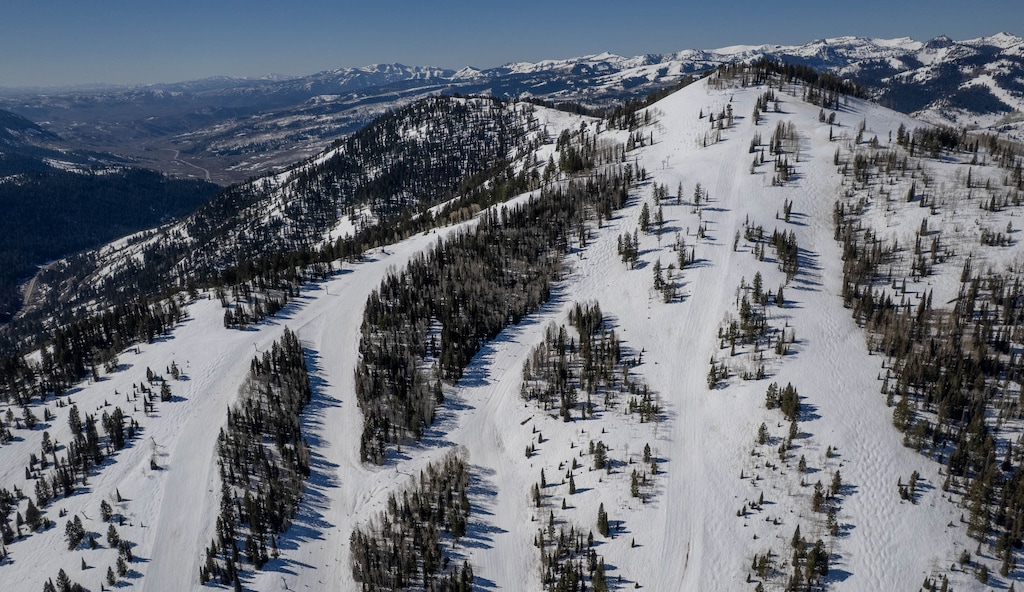
At 60 inches, Beaver boasted one of the deepest bases in the state as of March 19. It stayed open until the last weekend in March — which is as late or later than all but seven other Utah resorts, all of which are corporate-owned. And even though it saw its typically lucrative holiday season washed away by rains, its owners say they finished the season in the black.
How did the Seeholzer family — which has owned Beaver Mountain for more than 80 years and three generations — do it? Location, luck and love.
“Some years we get the short end of the straw, some years we don’t,” said Kristy Seeholzer, who co-owns the ski area along with her husband, Travis, and mother-in-law, Marge. “So we’ve been fortunate.
“But I think everybody got the short end this year.”
When the snow doesn’t fall — and can’t be made
(Francisco Kjolseth | The Salt Lake Tribune) During the hottest winter in state history, Beaver Mountain, the only ski area in Utah with no snowmaking, had one of the deepest snowpacks and saw little drop in visitation, as people take to the slopes during the first day of spring on Friday, March 20, 2026.
Beaver Mountain’s location in the Bear River Mountains, about a 15 minute drive west of Bear Lake on Highway 89 and roughly an hour east of Logan, proved to be one of its assets this winter. But the spot did not seem ideal to Travis Seeholzer last Christmas Eve.
The ski area’s base elevation is 7,200 feet — about middle-of-the-pack for the state. Yet, from the window of his office, Seeholzer watched rain, not snow, fall on the slopes. Three days of it dissolved what had once been a promising holiday-season snowpack.
Snowmaking couldn’t have protected Beaver Mountain against the warmth since the technology can’t be effectively employed unless temperatures dip below 28 degrees Fahrenheit. During the few cold snaps, though, it could have helped pad the runs and mitigate the dissolution caused by the rains.
“You have a year like this, and it’s so ironic, because snowmaking didn’t do people a whole lot of good this year,” Travis Seeholzer said.
“Not that I wouldn’t want to have some.”
Beaver Mountain has the water rights, Kristy Seeholzer said, but no water to apply it to. Twice in Beaver’s history, the Seeholzers drilled close to 600 feet down looking for water they could tap into to make snow. Twice they came up dry.
They’ve considered drawing from the well that gives Beaver its culinary water, but Travis said even if they could pump and store that water 24 hours a day, seven days a week, they’d only get 2 acre-feet of water. In comparison, Deer Valley Resort just inked a deal to secure 950 acre-feet of water for snowmaking — and that’s just for the original terrain, which at 2,032 acres is a little more than twice the size of Beaver Mountain. Deer Valley can draw roughly another 900 acre-feet from the Jordanelle Reservoir for snowmaking around its East Village.
(Francisco Kjolseth | The Salt Lake Tribune) Despite getting a little more snow than most other resorts, Beaver Mountain begins showing the effects of the hottest winter in state history on Friday, March 20, 2026.
And yet, Beaver Mountain’s season ended just two days before Deer Valley’s.
For that, Travis has to credit the ski area’s location and his grandfather Harold Seeholzer, who founded Beaver Mountain as part of the Mt. Logan Ski Club in 1937.
“We always talk about when my grandfather chose this location, he done good,” Travis said. “Pretty consistent snowfall, but the exposure is the big deal. You drive up here right now, you turn the corner below Beaver and there’s no snow. And you turn and see that east face, and it’s pretty white.”
Parking lot powder
(Francisco Kjolseth | The Salt Lake Tribune) Travis Seeholzer, minority owner at the family owned Beaver Mountain ski resort at the top of Logan Canyon, talks about the extensive work being done to extend the record-warm season on Friday, March 20, 2026.
Beaver ducked into the 2025 part of the 2025-26 season just under the wire, finally opening on New Year’s Eve. That marked its second-latest start in 87 years. Over the next three months, it would report receiving 154 inches of snow, a little more than a third of its 400-inch-plus average.
It was the same story across the state. Hayden Mayhan, a National Weather Service meteorologist, said there was not “a dramatic difference” between the amount of snow Beaver got and what fell on the Wasatch Mountains.
Most of Beaver’s snow came in three storms spread painfully far apart.
“It was just like, right when you were thinking, ‘Oh, are we going to make it? Are we going to make it?’ we’d get a couple inches,” Kristy Seeholzer said. “And it’s amazing what a couple inches can do.”
Still, the mountain had its hot spots. The high-use areas near the lift terminals and on connector runs often let their brown roots show even when the rest of the slopes were covered in white.
Other resorts might make snow to cover those thin patches. At Beaver, groomers turn to that parking lot powder.
This season, though, nothing was there. So, they scoured the mountain for any untapped snow heaps. They scraped a few loads from behind the ski patrol building and asked lift operators to scoop it out from under trees.
“We always refer to it as poor man’s snowmaking,” Travis said, “because we have to utilize everything we can.”
Those efforts clearly paid off. According to data compiled by OntheSnow.com, Beaver’s 60-inch base as of March 19 was the deepest in the state outside the Cottonwood Canyons and Park City Mountain, which had been making snow since November.
Skiers and snowboarders took notice.
Adapting to changing winters
(Francisco Kjolseth | The Salt Lake Tribune) Marge Seeholzer, majority owner of Beaver Mountain, and a well know staple of the former ticket shack, works in the new “Cabin” where wood was salvaged from her former ticket shack, Friday, March 20, 2026.
Marge Seeholzer, the matriarch of Beaver Mountain, grew more nervous with every drop of rain that fell outside her home on Christmas Eve.
During that 1976-77 season — when Beaver didn’t open until Feb. 28 and then only stayed open for three weeks — she’d been working at the resort with her husband, Ted Seeholzer. She vividly remembers the financial pain of the shortened season, especially since season passes weren’t so prevalent. And that was without having to worry about paying for a fancy new lodge. (Beaver Mountain unveiled the 26,000-foot Marge’s Cabin in early December).
“It’s never a good year to have a terrible snow year like this,” she said. “But with this building to pay for? Whoa, it’s stressful, but we’re surviving.”
They’re doing better than that, Kristy Seeholzer said. Beaver has been profitable.
Many of the bills associated with the cabin are being paid for with savings. The surge in interest in outdoor activities caused by the COVID pandemic benefitted their small, remote ski area more than most, Kristy said.
On the other hand, the payroll has ballooned in the face of wage increases and the addition of positions within the new cabin. Those have been more difficult to cover, Kristy said, especially without the holiday and spring break weeks that typically bookend Beaver’s winter. She said Beaver makes as much during the week between Christmas and New Year’s Day as it does all the rest of its weekends combined.
Still, she said, the ski area should be able to pay all those bills without having to tap into income from next winter’s season passes.
“Our income, obviously, that’s on the top is going to be lower — what we could put in the bank to save,” Kristy said. “But we’ve had enough to keep us going.”
Plus, people kept coming.
Beaver, located a scenic two-hour drive from Salt Lake City, has been steadily siphoning away Salt Lake and Ogden valley skiers and snowboarders who don’t want to put up with traffic or crowds. This year, word got around that, while winter was a no-show throughout most of the state, it had made a stop at Beaver Mountain.
(Francisco Kjolseth | The Salt Lake Tribune) Skiers make their way up Manager’s Triple at Beaver Mountain on Friday, March 20, 2026.
While they delight in surprising newcomers, Kristy said it’s Beaver’s regulars — many of whom bought their first lift tickets from Marge when they were kids — who kept the ski area afloat.
“We have a lot of really loyal customers,” she said, “who just really love to get out and ski.”
Still, the Seeholzers can’t help but wonder if those skiers will keep coming back if the winters keep shrinking.
It’s not a new dilemma.
“Even Ted, my husband — he’s been gone 14 years — he used to say, even back then, ‘There is something to global warming.’ And obviously there is,” Marge, 84, said. “The winters are changing, and that’s a real worry when we don’t make snow.”
But that, too, could be changing.
When parking lot powder becomes a rarity, the Seeholzers may have to start looking under the pavement rather than on top of it to keep Beaver Mountain going through March.
“Realistically,” Traivs conceded, “we’re going to need some snowmaking at some point.”
Julie left the beach of Santa Cruz, Calif., where she worked for 17 years, for the mountains of Salt Lake City in 2019. She has covered the NBA Finals, the Super Bowl, the World Series, the Maverick's big wave surf contest and two Olympics. A Colorado native, she enjoys creating her own adventure, occasionally with her husband and two kids in tow.