 Carmen Nesbitt
Out of all the public schools in Utah, U.S. Secretary of Education Linda McMahon chose to visit one that currently is under financial scrutiny by state auditors.
McMahon stopped by American Preparatory Academy’s West Valley K-12 campus Tuesday morning. The visit was part of her speaking series, “The Next 250: American Education,” a four-stop campaign to tout President Donald Trump’s vision to shrink the federal agency and “return” education to the states.
“For the past five decades, our education system has been co-opted to place the enrichment and priorities of adults over the flourishing of children,” McMahon said Tuesday. “I am here today because, thanks to President Trump, we’ve made the most significant turnaround in half a century to reorient the structure and the culture of American education to center fully on students.”
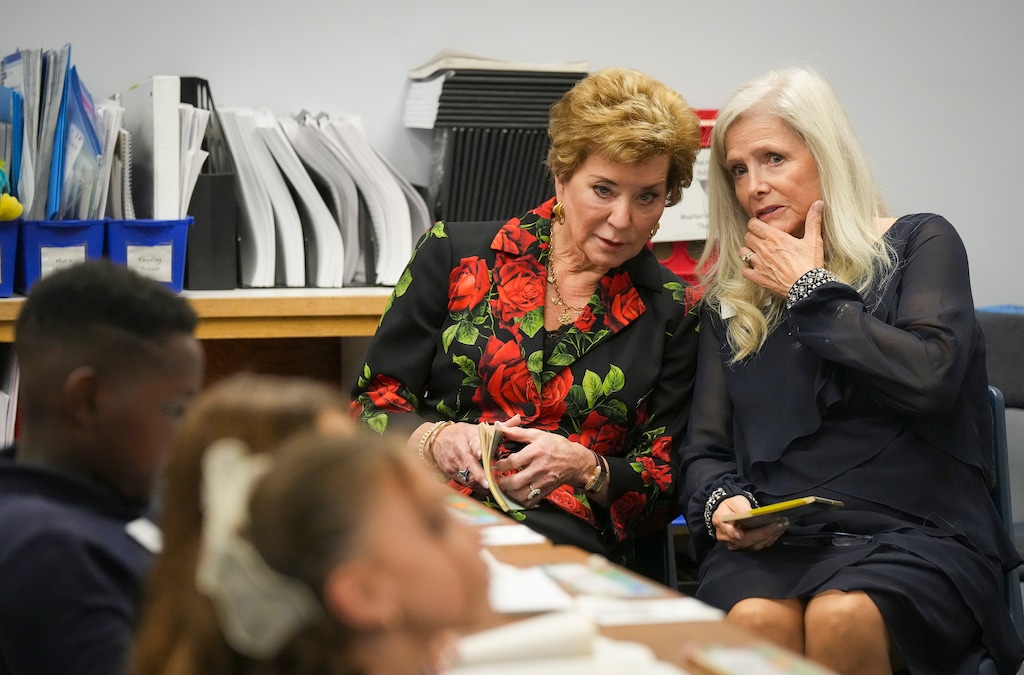
(Bethany Baker | The Salt Lake Tribune) U.S. Secretary of Education Linda McMahon speaks during her visit to American Preparatory Academy in West Valley City on Tuesday, Oct. 20, 2026.
American Preparatory Academy – a charter school network with eight total campuses across Utah – has refused to disclose how much it pays its top administrators. That refusal prompted Utah State Auditor Tina Cannon to take legal action last December.
The charter school operator argues those records are not public because its top administrators are not technically employed by the school.
Instead, they are paid by a similarly named private company, American Preparatory Schools (APS). Both the charter school and the company were founded by Carolyn Sharette, who gave opening remarks during McMahon’s visit Tuesday.
(Bethany Baker | The Salt Lake Tribune) American Preparatory Academy CEO Carolyn Sharette welcomes U.S. Secretary of Education Linda McMahon during her visit to American Preparatory Academy in West Valley City on Tuesday, Oct. 20, 2026.
The charter funnels public money to the private operator, which then cuts paychecks, according to a management contract between the two. APS argues that distinction should shield payroll records from public view. The money — at least $31 million since 2022 — still is public, though.
The contract explicitly names Sharette the company’s executive director. Sharette said in a statement to The Salt Lake Tribune that she is exclusively an employee of APS.
When asked to weigh in on the legal dispute, McMahon pointed to American Preparatory Academy’s performance, saying that she had observed “accelerated reading levels” in the classrooms she toured Tuesday morning.
“In terms of what the requirements are of reporting for private management companies, I think that the outcomes that we see from these schools probably would indicate to us if the dollars are being spent well,” McMahon said. “Whatever the requirements are in those states is what should be followed.”
(Bethany Baker | The Salt Lake Tribune) Ryan Thomas, an AP government teacher at American Preparatory Academy, teaches during a visit from U.S. Secretary of Education Linda McMahon at American Preparatory Academy in West Valley City on Tuesday, Oct. 20, 2026.
American Preparatory Academy has some high-performing campuses, including its Draper high school, which ranked among Utah’s top 10 in U.S. News & World Report’s 2026-27 rankings.
But its West Valley K-12 campus is underperforming and the state has identified it for “Comprehensive Support and Improvement,” (CSI) according to the Utah State Board of Education’s website.
The federal designation means the school is falling drastically behind in certain performance metrics and must demonstrate improvement. In this case, the school’s Black students and students with disabilities are underperforming compared to their peers across the state, according to USBE data.
For instance, at the West Valley K-12 campus, just 14% of students with disabilities in grades 3-8 performed proficiently in English language arts during the 2025-26 school year. However across all APA campuses, proficiency among that same group of students increases to roughly 23%.
(Bethany Baker | The Salt Lake Tribune) Britaini Delbo, a third grade teacher at American Preparatory Academy, watches her students work in class at American Preparatory Academy in West Valley City on Tuesday, Oct. 20, 2026.
“Overall, our schools are indeed ‘accelerated learning,’ and high-performing, which is borne out in our state rankings,” Sharette said. “However, as a free public school with open enrollment, we accept and work with a wide variety of students, some of whom are highly challenged. Two of the state-designated subgroups of students, including students with disabilities, perform at the low end of the state testing scale, so they trigger a CSI designation.”
Sharette added that they “value and love” working with students who may not test well conventionally.
“Even so, we are never satisfied, and we are working hard to help every student in these groups grow, whatever their starting point,” she said. “They are important students in our school community, regardless of test results.”
Whether APS will be forced to open its books is still playing out in court. In July, Cannon asked a 3rd District Court judge to expedite a ruling on the matter, which has gone unresolved for more than a year. Her office first asked to see the charter operator’s finances in September 2025.
(Bethany Baker | The Salt Lake Tribune) Rep. Burgess Owens, R-Utah, speaks beside U.S. Secretary of Education Linda McMahon at American Preparatory Academy in West Valley City on Tuesday, Oct. 20, 2026.
School officials opened some of their books — but refused to provide detailed records for the payments the school made to the private company since 2022, when the contract began. Instead, they disclosed only yearly “lump sum” amounts.
As public schools, generally, the only difference between a charter and a traditional public school in Utah is that charters operate independently from school districts.
Charters still receive taxpayer funds and must comply with all laws governing public education, including making financial disclosures.
In 2025 alone, American Preparatory Academy received approximately $55 million in state funds, according to Cannon’s court petition.
That’s why in her July motion, Cannon argued that because the charter is public, it should not be “permitted to insulate the handling of those public funds from the state auditor’s review by transferring millions of public dollars to a separate entity.”
APS has argued that while the state office has legal authority to audit the charter school itself, it does not have that authority over a privately held company.