 Courtney Tanner
Every few seconds, a hand reaches out from the truck window with another container overstuffed with tangy jerk chicken and crispy spiced sambusas.
With each heaping order handed off, more students step into line to place an order at Kafé Mamai.
The chef and founder, Abudujannah Soud, has been serving his signature African-Caribbean flavors at the University of Utah for more than seven years. It’s where he first launched his food truck. But this month marks his last operating on campus.
It’s not when — or how — he wanted it to end.
“It’s painful for me,” Soud said. “I have been there for so long. I’m still going through the shock of how I’m going to get the income that I was getting there.”
Soud had been part of a little collective of seven local food trucks, largely owned by people of color, that regularly park outside the student Union building and in the plaza east of the U.’s Marriott Library. They pull up each weekday before lunch time.
This fall, though, the U. decided not to renew the annual contracts it had with each individual truck.
Soud and several other owners said they got an email just three weeks before fall classes started that informed them the school planned to “move to a new model,” according to copies of the email shared with The Salt Lake Tribune.
Instead of their seven trucks, the U. is bringing a third-party management company in that will organize a different weekly rotation of both big-chain and local food trucks. To participate, each truck needs to sign a contract with — and fork over 10% of their daily profits to — the overarching Utah Food Truck League.
The Tribune spoke with three food truck owners who have long operated at the U.; each said the league only offered them two days a week on campus, at most, after years of showing up for five.
(Francisco Kjolseth | The Salt Lake Tribune) Kafé Mamai food truck chef Abudujannah Soud serves up a heaping helping of grilled jerk chicken with rice and beans at an event for incoming freshmen at the University of Utah on Saturday, Aug. 22.
(Francisco Kjolseth | The Salt Lake Tribune) University of Utah incoming freshmen J.T. Torbey, Henri Saussus, Lucas Mault and Griffen Blake, from left, dig into a plate of grilled jerk chicken from the Kafé Mamai food truck on Saturday, Aug. 22.
Soud wasn’t willing to do it. His Kafé Mamai truck already operates on ever-thinning margins as he recreates the tastes of his homeland Lamu, a small island off the coast of Kenya. He’s kept his prices relatively low despite rising ingredient costs, because he knows students often don’t have much to spare.
He knows those students by name, and even has a few regulars who text him their order so they can quickly snag it between classes. Once, he celebrated the wedding of two students who met while placing orders at Kafé Mamai.
“The food truck owners are part of this community,” Soud said. “But they’ve pushed us out.”
Tension over new direction
The original food truck coalition at the University of Utah started 13 years ago with Bento Truck.
Married couple Katsu and Tokiko Yamazaki were the first to develop a loyal campus following for their fresh teriyaki and tempura bowls. That loyalty, though, wasn’t returned by the university, Katsu Yamazaki said.
“I wish they would’ve given us a fair transition,” he said. “I wish they treated us like humans and not just a piece of paper, a contract.”
(Evelyn Harris | Amplify Utah) Bento Truck, which serves Japanese cuisine, is stationed in front of the Marriott Library on the University of Utah campus in this photo from January 2026.
Yamazaki had already placed a huge order to his specialty vendor in Las Vegas for Japanese products ahead of the school year when he received the university’s Aug. 3 email stating his existing contract would not be renewed.
Both he and Soud asked for more time, at least a semester, so they could recalibrate.
“They said, ‘No,’” Yamazaki said. “They gave no reason.”
Just a few months earlier, in June, a U. official in a message reassured Yamazaki about his place on campus after news that Jerry Basford, the administrator Yamazaki and other food truck owners had long worked with, was set to retire. Yamazaki shared a copy of that message with The Tribune.
The U. also posted an update in June about dining options on campus, celebrating that a “host of local food truck favorites also roll onto campus most days during the school year.”
In a statement about the change, the university acknowledged it “should have communicated the transition earlier and more effectively” to the existing food truck operators.
“We understand why the timing has been frustrating, particularly for operators who have built their businesses around a regular campus presence,” said U. spokesperson Rebecca Walsh. “That’s fair feedback, and we can learn from it.”
But the school said it stands by its decision under a new dining director to implement what it’s calling a “coordinated food truck model” with the Utah Food Truck League.
“We must make decisions based on what we believe will best serve students, faculty and staff across the university,” Walsh added.
The biggest reason for the new model, she said, is that it will allow the roughly 6,000 U. students who live on campus to pay for their meals at food trucks with money from their dorm dining plans, which are required at most residence halls.
That’s because the Utah Food Truck League will now use U.-provided payment devices that accept those meal plan dollars.
The league is also paying a one-time $10,000 charge to be the U.’s food truck provider for the 2026-27 school year, Walsh said, which will go toward integrating those devices, marketing and other operational costs.
Once participating food truck owners share 10% of their campus earnings with the league, owners retain the rest of their revenue, said Eliot Steimle, the league’s general manager.
For Yamazaki, who felt he had “no other option” but to join the league, the 10% cut stands to to significantly slash he and his wife’s income — on top of being scheduled on campus just two days a week.
The percentage likely amounts to more than the couple and others were previously paying to lease a parking spot at the U., which ranged from about $3,450 to $4,500 annually, according to the school and several food truck owners.
“What do they give me? They don’t give me any new customers. They don’t give me a new location,” he said. “But they get 10% of my sales. How is that fair?”
Yamazaki’s voice quivered. “We’re just trying to work hard to make a living.”
Launching a petition
(Francisco Kjolseth | The Salt Lake Tribune) Maryem Ghazal runs the window at Olive’s Oasis food truck during an event on the University of Utah for incoming freshmen on Saturday, Aug. 22.
Maryem Ghazal, who runs the Mediterranean and Middle Eastern food truck Olive’s Oasis with her mom and aunt, started a petition to push back on the U.’s decision.
Ghazal is a student at the U. and takes mostly online classes so she can help operate the family business, which the university in 2025 called “one of the most popular food stops on campus.” They’ve parked at the U. for more than three years.
“We respectfully ask the University of Utah to reconsider its decision,” Ghazal wrote in an Instagram post, sharing the petition.
It has collected more than 1,500 signatures, as well as about 40 comments from students, faculty, staff and alumni pleading with the university to keep the original trucks on campus.
“I’ve been eating lunch from the Library Plaza food trucks for years,” one person wrote. “The food is wonderful, and many of the vendors have become friends.”
Another added, “These trucks are part of our campus community. We should continue to value our relationship with them.”
A third asked the U. not to “get between my post-exam shawarma fries and cheap pizza slices.”
(Francisco Kjolseth | The Salt Lake Tribune) Alabadi Mayada joins her sister and niece as she prepares orders in the Olive’s Oasis food truck at the University of Utah on Saturday, Aug. 22.
The issue also came up during the August meeting of the university’s Academic Senate.
Jack O’Leary, a graduate student and former University of Utah student body president, lamented the change.
“It was a really great environment out there on Library Plaza,” he said. “I know a lot of students really loved having our small, local businesses on campus, myself included.”
Sarah Shreeves, dean of libraries, added in a comment that the trucks “were an important resource for our students who are studying and working in the library.”
As a student, Ghazal has taken her appeal to the school’s student government, the Associated Students of the University of Utah. She hopes the group might be able to sway the U.’s administration.
The U. said it’s seen the petition, noting, “We take that feedback seriously.”
Additionally, Walsh said, “Students and ASUU are welcome to provide feedback, and we will listen to it. However, we don’t want to create a false expectation that the petition or an appeal to ASUU will change this policy.”
‘More consistent and better quality’
The U. said there are a few more reasons it’s moving forward with this plan:
• The new model of rotating vendors “responds, in part, to student, staff and faculty feedback calling for more diverse food choices.”
The existing food truck owners say they already provide diverse options: Each offers a different type of cuisine, and Soud’s Kafé Mamai truck is the only campus dining spot that serves verified halal meat.
• The U. also says the food trucks that park on Library Plaza may be causing infrastructure damage; the plaza is technically the roof of several library floors that sit below the cement.
It’s why the university says it’s permanently moving the area where food trucks set up to the west side of the library, near the parking lot along 1500 East. The existing food truck owners say they have no issue with relocating on campus.
(Christopher Cherrington | The Salt Lake Tribune)
• According to the U., the new setup will also standardize the vetting process: The Utah Food Truck League will “verify that each participating truck meets university insurance, health, fire and other operating requirements.” The original food truck owners added they follow all necessary requirements.
The food truck overhaul had nothing to do with Chartwells, the primary dining provider on campus, Walsh noted, despite rumors the company was involved.
Troy D’Ambrosio, chief of staff for U. President Taylor Randall, said during the Academic Senate meeting last month that the university’s food truck policy “was pretty random.”
“This new setup will allow for more consistent and better quality food trucks on campus,” he said.
Steimle, with the Utah Food Truck League, said a lot of trucks have expressed interest in parking at the U. and serving students. He said he’s looking forward to the league providing those options.
“Hopefully it’s a good experience,” he said.
The league oversees about 150 trucks, Steimle estimated. For a spot like the U., he said, about 50 to 70 will be in the rotation.
He schedules trucks at locations based on popularity — so if a lot of students visit a truck, he said, that vendor will appear more frequently. Scheduling will be reassessed in December.
Members of the original food truck coalition say they’re not opposed to more trucks serving campus, but they don’t think they should need to reduce their own schedules to accommodate.
There are fewer places to set up now, though. The U. is no longer offering spots outside the student Union building, and it’s limiting the amount of food trucks permitted near the library to five when it used to allow seven.
The school has said it’s assessing whether to add more sites in the future.
“We hope current operators remain part of campus,” Walsh said. So far, she added, “We are excited that the majority of operators have signed up to participate in the centralized model.”
‘We have no choice’
(Francisco Kjolseth | The Salt Lake Tribune) Customers wait for orders from a number of food truck vendors as they attend a University of Utah welcome event.
Like Yamazaki, Ghazal said her family felt they didn’t have another option.
“We don’t want to, but we have to,” Ghazal said. “We’re just trying to make the best out of it.”
Finding another place where it’s permitted to park and the league isn’t already contracted is also difficult, several said.
“You can’t just go park anywhere,” Soud noted.
In a meeting with the U., the original owners offered to instead dedicate 10% of their profits to university scholarships if it meant they could continue operating on campus, separate from the league. The U. declined.
Soud had already been doing that. But that will end as his time on campus does; he doesn’t want to see that percentage handed over to the league.
Steimle said he’s spoken with each of the food truck owners who’d been at the U. and “can see where they’re coming from being upset.”
“But there’s no solution that everyone agrees on,” Steimle said.
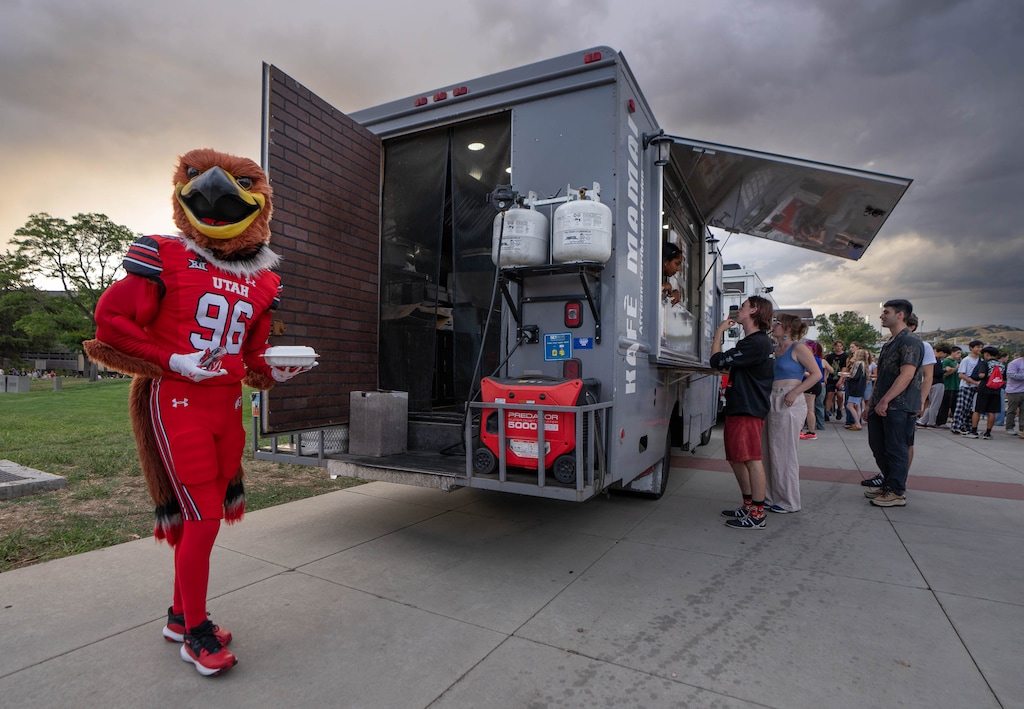
(Francisco Kjolseth | The Salt Lake Tribune) Customers at the University of Utah line up for fresh food from Kafé Mamai, including Swoop the mascot, on Saturday, Aug. 22.
Yamazaki and Ghazal, who ultimately signed on with the league, said they’re going to have to raise prices to try and compensate for the changes.
“Just like we have no choice with the league, we have no choice but to raise the price of the food,” Yamazaki said.
He’s used to serving about 100 to 200 customers each day on campus — anywhere from three to five times more than he sees off campus, including at festivals and events.
The new rotation formally starts Sept. 8. He’s going to see how the fall semester goes, but he’s already considering whether he will need to find a different job.
Soud said several owners cried during their meeting with the university. One questioned how they would be able to make their mortgage payments. “These people, their whole lives are built on the U.,” Soud said.
Ghazal said her family is still paying off the $2,500 loan they took out to start their truck. But stepping away from the U. would also mean stepping away from the campus catering contracts that come up throughout the year.
Soud isn’t sure how he’ll make up for losing those, which had become a big part of his business. He also owns a brick-and-mortar Kafé Mamai restaurant, at 49 E. Gallivan Ave in downtown Salt Lake City, and will focus on that; most of the other owners don’t have that option, he acknowledged.
He hopes pulling the brake on his food truck won’t be permanent.
(Francisco Kjolseth | The Salt Lake Tribune) Kafé Mamai food truck chef Abudujannah Soud makes a plate during a University of Utah campus welcome event on Saturday, Aug. 22.