facebook-pixel

Meet the new Utah State University president, who was selected in secret because of a new state law

The new leader may be familiar to many in the state.
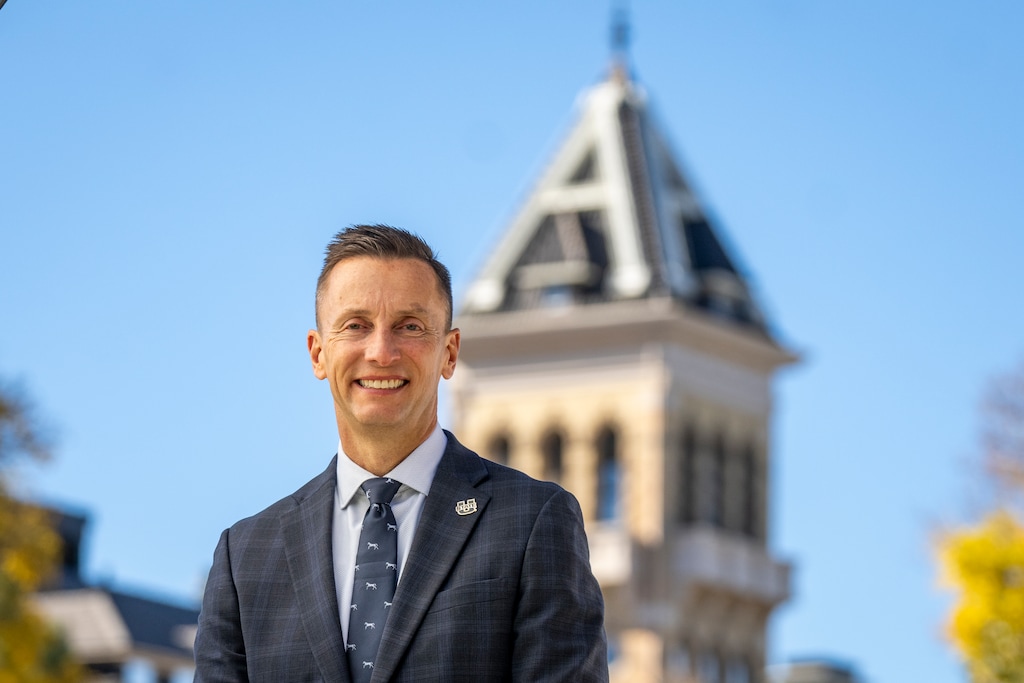
(Rick Egan | The Salt Lake Tribune) Brad L. Mortensen, the new president of Utah State University, poses for a photo on the USU campus in Logan on Thursday, Oct. 30, 2025.

Utah State University has a new president — the first to be picked under the state’s now entirely secret hiring process for higher education’s top posts.

The public wasn’t informed about any finalists or told about their experience. But the name of the next leader may still be familiar to many: Brad Mortensen, currently the president of Weber State University in Ogden, will now head north to take the helm of USU in Logan.

The hope is that Mortensen will usher in a fresh era for the university after a rocky past few years.

“This is incredibly humbling and almost unbelievable to be here,” Mortensen said from USU’s campus after the announcement. “I can’t say it’s fulfilling a dream because it’s beyond any dream.”

After 21 years at Weber State — including nearly seven as its president — Mortensen returns to his alma mater, where he got his bachelor’s degree in political science in 1995 as a first-generation college student.

The school’s previous leader, Elizabeth “Betsy” Cantwell, stepped down after a historically short term. Her brief year and a half was marked by continued allegations of a toxic football program and unchecked spending that has now prompted a statewide audit.

She left abruptly in March to become the president of Washington State University after many criticized her leadership. One Utah lawmaker previously called the process that resulted in Cantwell’s appointment “a failure.”

The state Legislature soon made Utah’s public university presidential searches completely secret, with no opportunity for the public to vet candidates. Mortensen’s name was only made public by the Utah Board of Higher Education during its much-anticipated USU announcement Thursday.

The hope was to attract more top-tier candidates, without the worry that their current employers would be alerted they applied elsewhere.

The higher education board didn’t say if the newly private job search led to more applicants. Chair Amanda Covington said it was a “transparent and inclusive process” and fielded both local and national candidates.

USU trustee David Huntsman added: “The process worked exactly the way it’s supposed to, and I want you to know that.”

(Rick Egan | The Salt Lake Tribune) Brad Mortensen says a few words after he was named the new president of Utah State University on Thursday, Oct. 30, 2025.

Board members unanimously approved Mortensen’s appointment. He is set to start the post quickly, on Nov. 10.

Meanwhile, the board will now need to name an interim president at Weber State and start the search for Mortensen’s permanent replacement there.

Mortensen has built a name for himself at Weber State by advocating for affordable education and access for all students.

The Ogden school has a unique dual-enrollment mission, meaning it serves students seeking two-year associate degrees and four-year bachelor’s degrees.

This year, Mortensen drew attention when he moved to freeze tuition rates for two-year programs to help students save money. The plan was immediately heralded as “innovative” by the state’s commissioner over higher education. And it drew attention and praise from Utah lawmakers.

The school also launched the state’s first accelerated bachelor’s degrees programs, meant to be completed in three years.

Mortensen also created a direct admissions program with two neighboring technical colleges for Utah high schoolers in Weber, Davis and Morgan counties.

He is taking the helm at a challenging time for USU. Immediately, he will be tasked with reshaping the school’s proposal to cut its budget as required by the Legislature this year.

Each school was ordered to cut their share of $60.5 million that legislators slashed from higher education overall. Campuses were then directed to reallocate that money into programs the state says lead to high-wage, high-demand jobs. USU’s cut was $12.6 million.

Alan L. Smith, a USU administrator who’d been serving as the school’s interim president, shared a plan with lawmakers that included consolidating colleges and reinvesting in nursing. But legislators raised concerns about the recommendations and waited to approve anything until the new president could weigh in.

Smith was not among the candidates to become the next leader of the school, with his contract for the interim post specifically outlining that he wouldn’t submit his name for consideration, according to a copy obtained by The Salt Lake Tribune in a public records request.

Mortensen’s experience already crafting the plan for Weber State, with a $6.7 million cut, should help him with the task. The Ogden school trimmed 89 classes and eliminated 49 employee positions, which all came from voluntary resignations or posts that were already vacant.

Overall, Weber also eliminated 31 programs. Most were in the humanities and liberal arts, Mortensen said. The president had been an early proponent in protecting those programs, defending the value they provide to students and the community, but he said he was left with few other choices.

On Thursday, the chair of USU’s board of trustees, Tessa White, said Mortensen represents “the intersection of experience and fresh possibilities” for the school.

“We are ready for our next chapter,” she added.

Later in the day, Mortensen sent a message to students, faculty and staff at USU pledging to listen and learn — including on budget cuts.

“I’m grateful for the important work already in motion and understand the urgency of moving several priorities forward, including securing approval of our HB265 plan.”

Mortensen comes in at after a major shuffling of leadership at universities across Utah, with USU having the most turnover.

He was welcomed with a standing ovation and boisterous cheers that boomed even louder when he held up his hand in the sign of a bull to represent the Aggies’ mascot.

(Rick Egan | The Salt Lake Tribune) Brad Mortensen, the new president of Utah State University, poses for a photo with his wife, Camille, on the USU campus in Logan on Thursday, Oct. 30, 2025.

Inheriting troubles from Cantwell

Mortensen will also find himself in the hot seat for other concerns that have stacked up at the school.

As part of an initial “assessment” of executive spending at USU, state auditors identified a “culture of policy noncompliance.” The Utah System of Higher Education will now audit the presidential expenditures for each public institution in the state.

The review from the Utah Office of the Legislative Auditor General followed Tribune reporting and whistleblower concerns about Cantwell’s spending during her brief 18-month tenure.

Through public records requests, The Tribune tracked $661,800 that Cantwell spent on two new cars, a climate-controlled golf cart, an apartment in Salt Lake City, extensive national travel and new furnishings for her office, including a $750 bidet.

The Tribune’s reporting noted there appeared to be little oversight of her purchases by the university’s board of trustees, which is responsible for checking the school’s finances and auditing all spending. The state’s assessment confirmed that.

USU has also said it plans to assess its own spending. White, the recently appointed chair of the university’s board of trustees, told lawmakers they are already working on improvements. “There are areas that we are aware of and taking aggressive steps to remedy,” she said.

Cantwell came into the position following the troubled tenure of former President Noelle Cockett, who stepped down in July 2023 amid scrutiny over the football program. Some of that carried into Cantwell’s term, including several lawsuits.

But Cantwell made new headlines when she chose to fire then-football coach Blake Anderson.

Cantwell said an independent investigation showed Anderson failed to appropriately respond when a player was arrested for domestic violence — allowing the player to continue with the team while the coach conducted his own fact-finding mission that allegedly included contacting the victim.

Anderson has denied the allegations and sued the school for $15 million, saying USU used “sham” claims to purposefully get out of having to pay him a $4.5 million buyout under his coaching contract.

That kept a harsh spotlight on Cantwell, even as she was able to wrap up the ongoing oversight agreement with the U.S. Department of Justice over concerns with how the school had previously responded to victims’ reports of sexual violence.

Her departure also came amid scrutiny from the Utah Legislature, which passed a bill this spring banning transgender students from living in dorms that align with their gender identity. The measure was drafted, in large part, in response to a roommate conflict at USU that saw widespread attention.

(Bethany Baker | The Salt Lake Tribune) Utah State University President Elizabeth Cantwell speaks during her investiture ceremony at Utah State University in Logan on Friday, April 12, 2024.

Cantwell, like other presidents at Utah’s public universities and colleges, had also been tasked with rolling back diversity, equity and inclusion (DEI) programs that the Legislature prohibited. And she faced heat for her decisions.

USU disbanded its Inclusion Center that served all students, with specific programming for students of color and the LGBTQ+ community. The school in January also canceled a popular Women’s Climb Night in accordance with that law.

Mortensen wasn’t immune. He closed all of Weber State’s affinity centers — eight total — which some argued went beyond what the law required. And he removed the words “equity” and “inclusion” from the school’s mission statement.

More recently, Weber State also canceled a conference about censorship, saying it went afoul of the new anti-DEI rules.

New president’s opportunities

There are plenty of opportunities for Mortensen make a mark at USU.

The university is the only land-grant school in the state, with a unique agriculture focus that has weathered some of the ongoing federal research cuts better than other institutions.

Mortensen defended that research Thursday, saying it finds “solutions for our most vexing challenges.”

The school also recently opened a veterinarian program that it hopes will expand the number of professionals working in the state.

And it has nearly 30,000 students overall, with several satellite locations in southern Utah, including a new campus in Monument Valley serving Indigenous students from the Navajo Nation.

Mortensen oversaw a comparable student population at Weber, with slightly more than 33,000 enrolled.

So far, Utah’s public college and universities have not faced an enrollment cliff seen in other states, but it’s expected by 2032.

Mortensen will be tasked with preparing for that. And his work at Weber to encourage more students from all backgrounds to pursue higher education will set the stage, as he put it, for his plan that “relentlessly empowers every student statewide.”

His own life experience, too, shaped that vision.

Mortensen said Thursday that he and his brothers were the first in their family to get a university education — and they were pushed by their parents to do so.

His mom and dad sat in the audience at USU for the announcement, cheering him on. Mortensen choked back tears as he spoke from the podium.

“It was their encouragement and support that led to me ending up at USU,” he said.

That experience changed his life and made him passionate about education, he said.

He first attended Ricks College (now Brigham Young University-Idaho), where he earned an associate degree in 1993 before transferring to USU for his bachelor’s.

Mortensen later received a master’s of public administration from Syracuse University in New York and a Ph.D. from the University of Utah in educational leadership and policy.

“I am forever an unabashed advocate for student success,” he said Thursday.

(Rick Egan | The Salt Lake Tribune) Brad L. Mortensen enters the the Big Blue Room at the Taggart Center as the new President of Utah State University, with his wife, Camille, on Thursday, Oct. 30, 2025.

Mortensen’s wife, Camille, along with their children — and one grandbaby — also attended the celebration. Several of their kids also pursued an education at USU, giving the family deep ties to the Logan school.

Huntsman, the USU trustee, noted that students are “our core business” and feels Mortensen is the right person to champion that.

“I have never been more hopeful and optimistic about the future of this great institution,” Huntsman said.

What’s next

Before he was named president, Mortensen stood in a hallway at USU’s student center. As a student 30 years ago, he said, he used to stand in the same place, waiting to get into the computer lab to print papers before class.

That computer lab is now a center for student veterans. Even more has changed since then.

“I want to hear what makes you proud, where challenges remain, where we as an institution need to do better, and how we can foster a stronger sense of belonging across USU,” he said in his letter to the university community.

He thanked his colleagues at Weber State for his time there, saying the USU opening was the only opportunity that could’ve convinced him to leave. He also announced that he’s extended an invite to Jessica Oyler, Weber’s vice president for student access and success, to join him at USU as his chief of staff.

The new president is set to make a salary comparable to what Cantwell was earning when she ended her tenure; that was $581,585, with an additional $283,800 in benefits.

That makes the post the second-highest paid university president in Utah, following University of Utah President Taylor Randall, who makes nearly $1 million in wages (not including benefits), according to the state’s public salary transparency site.

At Weber State, where he started as president in January 2019, Mortensen was most recently making $393,636 in salary. Those figures are set by the Utah System of Higher Education.

At the end of his speech Thursday, Mortensen focused on the future for his new school.

“Higher education is transforming,” he said, “and we can set the model for what that transformation looks like at Utah State University.”

(Rick Egan | The Salt Lake Tribune) Brad L. Mortensen shakes hands with board members as he enters the the Big Blue Room at the Taggart Center as the new president of Utah State University on Thursday, Oct. 30, 2025.