 Courtney Tanner
Utah’s public college and university presidents will soon be eligible for major bonuses in addition to their already competitive — and often criticized — salaries.
A new program from the Utah Board of Higher Education is set to offer school leaders up to 10% of their base pay in extra money if they meet certain metrics.
That will mean the state’s highest paid university president — Taylor Randall at the University of Utah, who also runs an adjoining hospital — will be able to make just shy of $1 million now annually based on his leadership role. And the seven other public school presidents won’t be too far behind, which each able to make an additional five-figures on top of their salaries.
“We’re sensitive to it. It is a lot of money,” said Utah’s higher education Commissioner Geoff Landward. “It is also such an incredibly challenging job.”
Landward, too, will be eligible for the bonus program. His base salary falls on the higher end among the presidents, at $450,000. That would mean he could earn a bonus of $45,000 a year, making his total pay surpass half a million dollars (not counting benefits, like health and retirement earnings).
The timing of the new incentives comes as state lawmakers have grown weary about administrative spending, with several measures to slash and reprioritize the funding that is funneled to higher education.
But Landward said the bonuses will come from a pool of existing funds, with no new allocation needed from the state. And presidents won’t be able to get the extra money unless they hit benchmarks the Higher Education Board sets.
The exact goals haven’t been determined yet; the board is expected to start debating terms this spring. But Landward said there will be one or two measures per president that revolve around the state’s push to increase student retention, boost graduation rates and launch graduates into high-paying careers.
Essentially, earning the bonuses will be based on performance.
“We want to build in some incentives for the president,” Landward said, “to make sure the institutions are hitting their marks.”
Presidential pay in Utah
(Trent Nelson | The Salt Lake Tribune) Geoffrey Landward at a meeting of the Legislative Audit Subcommittee at the Utah Capitol in Salt Lake City on Friday, Jan. 30, 2026.
Presidential pay for each of Utah’s public college and university leaders is standardized right now. Board members compare each school with national peers; Utah State University, for example, is compared with other top land grant and research institutions.
The board looks at presidential salaries among the group, then sets a pay rate based on the median.
A salary review occurs every year, and if the median goes up, the Utah president’s salary is adjusted to match.
“We want to be reasonable,” Landward said. “We’re not the highest paying or the lowest paying. We’re just trying to be competitive.”
For instance, the president of Ohio State University, which is also a land grant school, makes $1.2 million as a base salary. But USU President Brad Mortensen, who was recently named to guide the northern Utah school, has a base salary of $674,856.
Being in the middle, Landward added, helps the state attract and retain talent. Utah has had high turnover among higher education leaders as of late, with some saying it’s too difficult to answer the divergent demands of donors, legislators, faculty and students.
Before leading USU, Mortensen led Weber State University, a regional school with a dual-mission of offering both four-year and two-year degrees. There, he made about $381,000 as a base salary. (The school is currently led by an interim president who makes slightly less.)
After taking the helm at USU, Mortensen told The Salt Lake Tribune that talking about higher education salaries is “my least favorite part of the job.”
He said he acknowledges that some feel the pay is too high. For comparison, Utah’s Gov. Spencer Cox made $188,744 as his base salary in 2025, according to Transparent Utah, a database of public employee salaries operated by the Office of the State Auditor.
“I don’t do this job for the salary,” Mortensen said. “I didn’t leave Weber to come here to make more money. I’ve always felt more than fairly compensated — and also kind of feel this obligation to work tirelessly.”
(Rick Egan | The Salt Lake Tribune) Utah State University President Brad Mortensen speaks during his inauguration ceremony at the Russell/Wanlass Performance Hall in Logan on Friday, Jan 16, 2026.
The salaries for Utah’s presidents have been criticized by lawmakers, who pointed to “administrative bloat” as the reason behind the multimillion-dollar budget cuts and reallocations that started in 2025.
House Speaker Mike Schultz, R-Hooper, said that in the past decade, administrative costs at Salt Lake Community College have gone from $2,998 per student to $7,280 per student. And the University of Utah now spends $8,841 per student — more than double the $4,176 spent on each in 2015.
“We work really hard as a state to hold our state agencies accountable and to make them run efficiently, but nobody’s ever looked at higher ed,” Schultz said at the time.
Ultimately, none of the $60.5 million in required 2025 cuts came from any presidential salaries, because the board sets them.
Utah State in particular faced harsh pushback from lawmakers for its previous president’s lavish spending, including on an office suite remodel, a bidet and a climate-controlled golf cart.
Mortensen’s base presidential pay, though, is up significantly from what Elizabeth “Betsy” Cantwell was making in the position. Cantwell had a set salary of $581,585 in her contract. Mortensen is making $93,000 more for his base.
Landward said that’s because USU’s peer group changed when the university achieved R1 status, the highest classification for research-intensive U.S. institutions.
Mortensen’s higher base pay means he will be eligible for a bonus of $67,485 extra annually if he meets the set metrics.
How will the new bonuses work?
Landward calls the new bonus program “self-funded.”
That’s because any raises or cost-of-living increases that presidents stood to see since last July have been frozen, with the money instead accruing in a new pool to fund the bonuses.
Starting this coming July 1, the bonus system will launch. Presidents will be judged based on their performance from then through June 30, 2027.
The first round of bonuses will likely be partial, regardless of performance, because the full amount needed to fund a 10% bonus each is $372,862.
It will take time to collect that much money, with full bonuses not feasible until at least 2028, Landward estimated. The average bonus then will be $46,608 per president.
But bonuses could also go up dramatically after that, too.
Once the pool is fully funded, each president’s base salary will be unfrozen and eligible for increases. That means the figure the bonus calculations are based on will grow, so the bonuses will, too.
And presidents can start getting COLA increases again, too, on top of that.
(Chris Samuels | The Salt Lake Tribune) University of Utah President Taylor Randall speaks during a ceremony announcing the creation of the J.W. Marriott Jr. Institute for hospitality at the University of Utah, Friday, April 18, 2025.
The commissioner said state statute has long directed the Utah Board of Higher Education to incorporate performance-based pay into presidential salaries, but this is the first time it’s happened.
If a president doesn’t meet the new performance measures, Landward said he’s not sure what will happen with the pooled money. It could be allocated elsewhere, or a president may earn a partial bonus for meeting some metrics, not all, depending on what the board decides.
“This is all subject to change, in terms of we’re going to try this,” he said. “It’s interesting. We’ve never done it before.”
What experts have to say
Judith Wilde and James Finkelstein, longtime research partners renowned for their work studying presidential contracts and compensation packages, said Utah’s plan is a reasonable way to incentivize leaders.
“If they’re coming up with some specific metrics for these bonuses, I think that’s a very good thing,” Wilde said.
The George Mason University researchers said they’ve long seen presidential contracts with high salaries and no accountability measures.
Only a handful of states currently have clear, measurable and transparent metrics tied to pay for public university leaders. Wilde pointed to Arizona, “where we see this most completely.”
The Legislature there sets three goals that all three state-funded institutions must meet. On top of that, lawmakers set another three goals specific to each school, making for a total of six per president.
Each goal they meet has a bonus tied to it. The University of Arizona president can earn up to $285,000 if he meets all six, according to reporting from The Arizona Daily Star. That’s on top of the $810,000 base salary he makes.
That’s a lot more money than Utah’s bonuses, but the Arizona goals are pass-fail and high-stakes.
One president there, for instance, had a goal to increase enrollment by 10%, Wilde said. They did so by 9.9%, just shy of earning any corresponding bonus money.
Performance bonuses have become more common for presidents in the last decade, Finkelstein said. He’s seen some contracts go as high as 50% of a president’s base pay in a bonus.
But even smaller bonuses are still a large amount of money, he added.
Data from the National Education Association, which most recently published 2024 figures, indicates the average faculty salary for a full-time professor at a public four-year university in Utah is $112,057. At a two-year college, it’s $82,893.
That means one annual bonus alone for a Utah university president is about one-third to one-half of what a typical faculty member makes in a year.
Some presidents, such as Randall, also teach, so they earn faculty pay on top of presidential pay. Presidents often get extra stipends for housing or cars, too.
Overall, the current base salaries of all eight public college and university presidents here amount to nearly $4 million in spending each year — not counting the new bonuses.
Finkelstein noted: “They end up being quite substantial.”
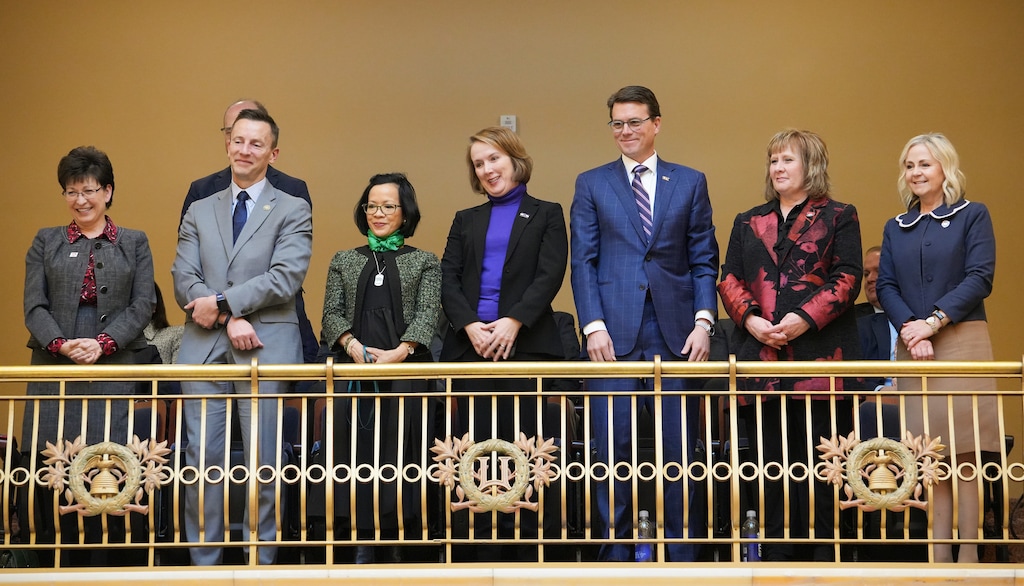
(Chris Samuels | The Salt Lake Tribune) University presidents and executives listen during Senate floor time at the Capitol in Salt Lake City, Tuesday, Jan. 20, 2026.
Note to readers • This story is available to Salt Lake Tribune subscribers only. Thank you for supporting local journalism.