 Courtney Tanner
An upcoming Utah conference that’s been billed as an academic debate over whether The Church of Jesus Christ of Latter-day Saints’ founding leader, Joseph Smith, actually practiced polygamy is causing an uproar, accusations of “denialism” and threats to the organizers.
“I guess there are people who do not want this topic discussed,” said Michelle Stone, one of two women who founded the annual conference. “It’s very strange. They’re trying hard to stop us.”
It’s not just one group or voice trying to shut down the discussion. There’s a chorus of pushback, including from the church itself.
The predominant Utah faith has long recognized that Smith was polygamous and had as many as 40 wives. It’s not history that the church tries to hide. It has been mentioned by leaders and included in several essays published by the religion in recent years.
The majority of historians also say evidence points to that conclusion. In fact, Brooke LeFevre, a doctoral candidate at Baylor University who has written about the experiences of 19th-century Latter-day Saint women in plural marriages, said it’s “overwhelmingly” the case.
“It is very hard to walk away with enough evidence claiming that he did not practice polygamy,” she said.
So holding a conference to debate what most say is well-supported fact? LeFevre says it feels absurd, dogmatic, even “anti-intellectual.”
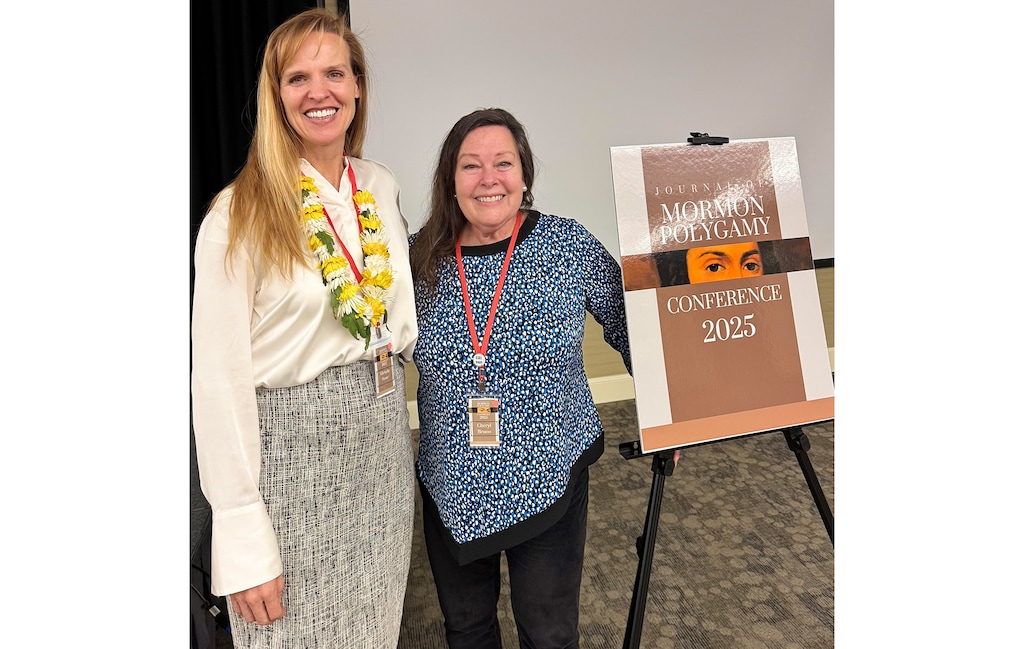
That’s not how Stone or co-founder Cheryl L. Bruno see it, though, as their second annual gathering convenes this weekend under the name of their publication, the Journal of Mormon Polygamy.
They welcome anyone from either side of the debate who wants to present research — including people outside the faith.
In fact, the two themselves are on opposite sides of the issue. Stone is a leading voice in the contemporary movement that pushes Smith was never polygamous. Bruno believes he took multiple wives.
(The Church of Jesus Christ of Latter-day Saints) Church founder Joseph Smith
They acknowledge that it’s a sensitive topic for many members of the faith, but the two say that shouldn’t make it off-limits — or mean that it’s entirely resolved.
“We’ve been very respectful,” Bruno said. “But we feel that we need to let people talk about these things and sort this out in a scholarly way.”
They started a few years ago with the journal itself, which they say accepts well-researched and supported academic papers on the topic, as well as on other subjects within the faith. Publication involves a rigorous peer-review process, working with editors who are experts in the field.
From that work, they decided to hold an annual conference where authors and experts could present their findings. Last year’s event attracted some dissenters but mostly carried on quietly.
This year, they say, it’s gained much more attention. “The church,” Bruno said, “is very aware.”
Leading up to the event, several scheduled speakers withdrew as the conference drew more and more heat. That criticism has included local faith leaders who allegedly told participants that attending could result in discipline.
Formally withdrawing membership — previously referred to as “excommunication” — has been on the table for some, including Stone.
Stone said she received a letter from the faith’s leaders about two weeks ago, advising her that her hosting the conference would likely be considered apostasy. She said she has “navigated” the issue for now and the event is moving forward.
A spokesperson for the church declined to comment.
“I am a faithful and lifelong member,” Stone said. “I have never wanted to be viewed as an enemy. We just have difficult issues in the church. ... And I am doing research that could really help people navigate these questions.”
BYU cancels a visit by the group as critics stack up
The conference was initially scheduled for Utah Valley University, but with more than 300 people registered, it outgrew the planned venue.
Organizers instead opted to book the auditorium of an Orem junior high school, which offered more space to hold panels.
The move was voluntary, but before the conference began, Stone and Bruno were supposed to host a different event at church-owned Brigham Young University — until, they say, BYU canceled it.
The event would have involved a Friday afternoon visit to BYU’s archives, with about 30 conference attendees. But on Monday, the university emailed Stone to say the visit was off.
“We are unable to go forward with the training session in our library,” university librarian Rick Anderson wrote in a message shared with The Salt Lake Tribune.
Anderson didn’t provide a reason. He’d initially said organizers shouldn’t have been charging a registration fee. But when they said they would remove that requirement and provide refunds, Anderson still wrote that it was canceled.
He declined to speak to The Tribune and referred questions to the university’s spokesperson. A message there went unreturned.
At its inaugural conference last year, organizers had conducted a similar visit to the University of Utah’s library archives without issue, they say.
(Cheryl L. Bruno) Attendees view historial artifacts at the University of Utah ahead of a 2025 conference held by the Journal of Mormon Polygamy.
Bruno feels that BYU is “discriminating against a group they feel threatened by.” The reason for visiting the archives, she said, is to help members learn how to look at historical documents and conduct research according to best practices.
Everyone who planned to attend, she noted, were Latter-day Saints in good standing, and not all believe Smith didn’t practice polygamy.
But the pushback has continued, with several BYU professors and prominent historians decrying the conference.
Christopher Blythe, an assistant professor of English at BYU, has posted several videos critical of the event. In one, he said it “masquerades as a scholarly movement” but is just “a modern conspiracy theory” based on religious fanaticism.
When The Tribune reached Blythe, he said he couldn’t speak to the newspaper because of his university employment.
Brian Hales, who has written polygamy books often cited by the church, has also spoken out. On one podcast, he argued conference organizers want to see Smith as flawless.
Stone said she’s become used to the criticism. She is often called a “flat-earther” or “polygamy denier,” the latter of which is meant to echo “Holocaust denier.”
She also alleges she was pressured by her local church leader to end her popular podcast on polygamy, “132 Problems: Revisiting Mormon Polygamy,” which had more than 3 million views over its three-year run.
(Cheryl L. Bruno) Attendees at the 2025 conference held by the Journal of Mormon Polygamy.
What evidence does Stone point to?
Stone maintains that her research is legitimate academic work, not driven by an agenda or activism.
She said it started because she was raised with powerful stories about her polygamist great-grandmother, Athelia Violet Call, and was told that Call loved her sister-wife just as much as her husband.
But when she started digging, Stone found that wasn’t the case.
Call, she said, was 16 when she was married as a second wife to William Gailey Sears. That marriage came after the church’s famous first Manifesto in 1890 promising to end polygamy.
Stone said she found documentation showing church leaders continued to condone the practice, including giving Sears express approval to go to Mexico to marry Call because his first wife had been unable to have children.
She has accounts showing Sears and his first wife, Agnes, took Call’s children away from her and claimed them as their own.
“It was this totally sad, ‘Handmaid’s Tale’ story,” Stone said, referring to the Margaret Atwood book. “I started to have my eyes opened.”
That led Stone to try to figure out where polygamy started in the church and why. She examined the faith’s seminal scriptures and found what seemed to her like discrepancies.
In the faith’s Doctrine and Covenants, the part that outlines polygamy is Section 132, which is attributed to an 1843 revelation from Smith. It mentions the “many wives and concubines” of the biblical figures Abraham and Moses, among others, and says that plural marriage is a covenant with God.
Stone notes, though, that Section 132 wasn’t revealed by the second prophet Brigham Young until eight years after Smith was killed in 1844 in Illinois. And it wasn’t added to the Doctrine and Covenants until 1876.
The first edition of the Doctrine and Covenants that she looked at through her research instead had Section 101 that purported that for “one man” there should be “one wife.”
Meanwhile, in other places in the faith’s foundational text, the Book of Mormon, she says, having multiples wives or concubines is condemned. “Section 132 does not play nicely with the rest of the Mormon canon,” Stone said.
She noticed a similar pattern of edits, too, in the journals of Smith that were kept by his scribe, William Clayton.
In an original entry from Oct. 5, 1843, the journal describes Smith instructing Clayton that those teaching the doctrine of plural wives should be tried in court. It says: “Joseph forbids it, and the practice thereof — No man shall have but one wife.”
The version the church uses today adds to the end: “unless the Lord directs otherwise.”
The Joseph Smith Papers have been part of a major release of documents by the faith, starting in the early 2000s. And that has led a lot of members and historians, like Stone, to further study the issue.
That has reawakened what has been a 200-year-old tension that’s persisted as long as the church has existed.
Here’s what historians say
Historians acknowledge that the evidence for supporting Smith’s belief in and practice of polygamy can, at times, be spotty, sparse or contradictory.
There are several documents from the time Smith was alive in which he openly disavowed polygamy; that included in a May 1844 speech and statements in the Times and Seasons newspaper, a Latter-day Saint publication in Nauvoo, Illinois. (Meanwhile, other nonreligious newspapers at the time published that he had multiple wives.)
LeFevre, the Baylor doctoral candidate, says there was logical reason for Smith to say that publicly while continuing to practice secretly: Polygamy was against the law. That doesn’t mean, though, there aren’t other sources to turn to, she added.
There are several places in Clayton’s journals where it’s referenced, she noted. Clayton specifically documented an 1843 marriage between “J” and “LW,” which is widely accepted to mean Smith and Lucy Walker.
“You can’t just look at a single entry,” LeFevre said. “You have to look at the entire document. … As a historian, you can’t just cherry-pick your evidence.”
There are also many documents from women who said they were married to Smith, she said, prominently including Eliza R. Snow. And a letter from 1842 in Smith’s handwriting in which he describes a relationship with Sarah Ann Whitney, another woman widely accepted to be one of his wives.
Emma Smith, his first wife, rejected the practice of plural marriage. And her sons later started an offshoot originally called the Reorganized Church of Jesus Christ of Latter Day Saints (now Community of Christ) based on that.
More recently, Community of Christ has conceded that Smith practiced polygamy.
Joseph Smith, top left, and some of his wives, clockwise from top middle: Emma Hale Smith; Eliza R. Snow; Martha McBride (Knight Smith Kimball); Marinda Nancy Johnson (Hyde Smith); and Zina Diantha Huntington Jacobs (Smith Young).
But Stone discredits much of those women’s accounts as being too biased or too far away from Smith’s lifetime to hold as much credibility. “We should not think that the verdict is in on all of these stories,” she said.
For instance, a bulk of the primary documents that say Smith was a polygamist came from affidavits and court testimonies from women who said they had been married to him. But a lot of those weren’t produced until 30 to 40 years after Smith was killed, and much of that was done at the direction of church leaders at the time.
LeFevre, who recently spoke on The Tribune’s “Mormon” Land podcast, said those accounts still need to be considered, noting they match the writings and speeches those women gave for rest of their lives. She also maintains there’s no evidence that the church’s leaders had enough power to coerce the statements.
“To deny Joseph Smith practiced polygamy,” she said, “is to ignore the voices of so many women.”
‘It should be discussed’
Stone has focused her research on one of the wives said to have married Smith: The youngest, Helen Mar Kimball, who was 14.
The church’s 2014 essay, which acknowledged Smith likely had up to 40 wives, specifically named Kimball among them, noting she was “sealed to Joseph several months before her 15th birthday.” She’s also mentioned in biographies on Smith, including scholar Todd Compton’s 1997 book that documents 33 wives.
Stone’s paper in the upcoming third edition of the Journal of Mormon Polygamy is titled, “Constructing Helen: The Allure and the Illusion of the ‘Fourteen-Year-Old Wife’ Narrative.” Copies will be available, she said, to buy at the conference, where she’ll also speak about it.
She declined to tell The Tribune specifics about her arguments, but asserts, “The evidence we have on Kimball was not done well. People didn’t stop to do careful analysis of the documents.”
Historians have noted that after Smith died, Kimball wrote a lot herself about being married to him and how she came to support polygamy. They also note that it remains disputed how intimate Smith was with many of his wives, including Kimball.
Stone believes there are holes in the evidence overall to support that the marriage ever happened. She said she’s invited historians and the church to provide evidence to challenge her, but insists, “They have not done that.”
LeFevre says historians are open to reviewing new evidence and adjusting conclusions when called for, but she doesn’t believe Stone’s work merits that.
She said, though, she appreciates that conference organizers are trying to take a more academic approach, including inviting renowned scholars, which this year includes University of Utah professor Margaret Toscano.
Toscano is presenting on the faith’s views on Heavenly Mother. Historically and doctrinally, Toscano told The Tribune, there’s been the perspective of only one mother.
But in a recent 2025 address before he was named the faith’s president, Dallin Oaks mentioned multiple mothers and only one Heavenly Father, matching descriptions of plural marriage.
(Francisco Kjolseth | The Salt Lake Tribune) “Mother Divine,” by Courtney Vander Veur Matz, is part of a new exhibit at Writ & Vision Rare Books & Fine Art store in Provo, entitled Visions of Heavenly Mother on Tuesday, May 4, 2021.
Toscano openly notes that the church withdrew her membership in 2000 over her research, including on that topic, but she said she still considers herself a believer. For her part, she supports the faith’s view that Smith was a practicing polygamist. But she doesn’t think “the door is completely closed.”
“From my perspective, it should be discussed,” Toscano said. “But I feel like that with everything about history.”
People have been studying Homer’s “The Iliad” and “The Odyssey” for thousands of years, Toscano noted, and views still continue to shift.
Moving forward, Stone is starting a doctoral program in the fall in which she hopes to further study Smith and polygamy. She declined to say at which university, for fear of harassment. She’s also planning a second paper on Kimball for a future edition of the Journal of Mormon Polygamy.
“If Smith didn’t practice polygamy, shouldn’t we try to find out?” she asked. “If the evidence doesn’t support that, shouldn’t we note it?”
Being open to asking those questions, she said, is an important start, and she’s glad the conference is providing a place for that.
Note to readers • This story is available to Salt Lake Tribune subscribers only. Thank you for supporting local journalism.
Courtney is a reporter at The Tribune, where she has worked since May 2016. She unwinds by fishing in the mountains far away from cell service. She’s a fan of bacon and Kevin Bacon.