 Carmen Nesbitt
Before state lawmakers passed dozens of education bills focused on absenteeism, early literacy and more this year, The Salt Lake Tribune asked educators what they thought were the biggest challenges facing Utah classrooms.
More than 40 teachers, administrators, school psychologists and other specialists chimed in, citing challenges with students, parents, resources and legislators.
Here are some of the most common responses we heard — and what action, if any, lawmakers took.
Lack of resources
Legislators started the year asking Utah’s K-12 leaders to model a $163 million cut to their $5.9 billion budget, or roughly 2.76%.
The finalized K-12 reduction ultimately amounted to just 0.8%, said Sam Urie, the Utah State Board of Education’s finance director.
Overall, though, public education funding will see a modest increase in fiscal 2027. That’s because lawmakers bumped the minimum amount the state must allocate for each student by 4.2%. That figure, the “Weighted Pupil Unit,” (WPU), is now $4,870, up from $4,674.
It’ll generate an additional $191.4 million for public education, which Urie said is consistent with past years.
The shift comes as educators told The Tribune they’re struggling to provide students with adequate resources.
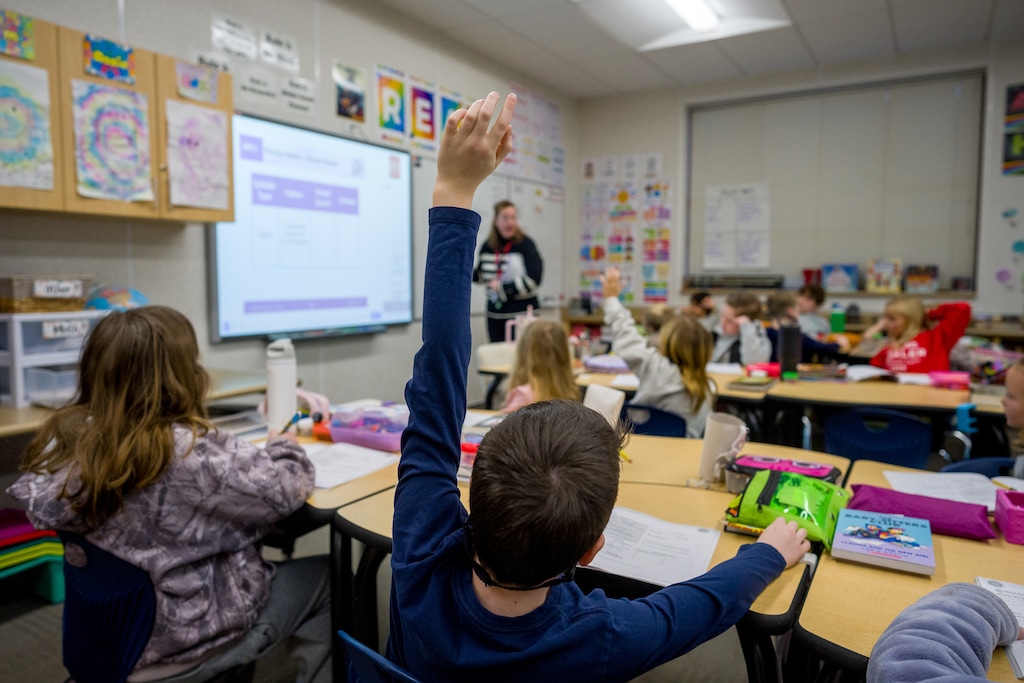
(Trent Nelson | The Salt Lake Tribune) A third grader works on an assignment at Indian Hills Elementary School in Salt Lake City on Thursday, Jan. 15, 2026.
Even schools that are technically considered fully staffed may still lack the personnel to meet students’ increasingly complex needs, one respondent said. Many called for more funding.
“I do believe that many teachers and schools in Utah are trying their best to do right by kids,” said one teacher, who works at a charter school in Logan.
“I think there are several places that are model schools with greater school cultures and higher student achievement,” they said. “Unfortunately, it’s not become a statewide accepted system with the necessary legislative backing, funding, or other administrative supports necessary to ensure that all schools across the state can run well.”
Several others mentioned “underfunded mandates” and a lack of “high-paying and full-time positions for support staff.”
“The expectations from everyone in our community and from administration in the districts is unrealistic, and we are not being given the resources to even meet those expectations,” said a teacher with the Davis School District. “There’s very little funding, time and support.”
Unruly, sometimes apathetic students
(Trent Nelson | The Salt Lake Tribune) Kindergarten teacher Kristie Koyle preps her room at Glacier Hills Elementary in Sandy on Thursday, Aug. 15, 2024.
Fifteen respondents cited “student behavior” as the No. 1 challenge for them.
“I can’t help my other 26 seventh graders when 12 of their classmates are disrupting me constantly, intentionally interrupting the whole class and being terribly disrespectful,” said a teacher with the Alpine School District.
Several others said there are no “real consequences” for students who misbehave or are disrespectful to peers and teachers. One respondent said that if there are consequences, they amount to little more than sending a student to the principal’s office, where they are allowed access to an iPad.
Underlying those behavioral issues, many felt, is a general disinterest among students.
“The apathy is crazy,” wrote one teacher, who works at the Alpine School District. “They just think it will be OK if they fail, and they are right. Again, we can’t ‘make’ them do anything.”
Another said they feel like they’re trying to “figure out how to trick students into learning something,” and too often, parents don’t step in.
“We need students and parents and families and the community to meet us halfway,” wrote a teacher with the Canyons School District. “The onus is only on the teachers when students don’t learn. You can lead a horse to water, but you can’t make them drink.”
Utah lawmakers and ‘whiplash’ legislation
Utah lawmakers were the third-most cited challenge for educators, with 13 different mentions.
Specifically, respondents raised issue with what they viewed as legislative “micromanagement” and “underfunded” mandates that add to an already unmanageable workload.
“Utah legislators are not listening to educators’ needs but rather other voices that are not informed of the challenges in schools,” wrote a school psychologist with the Salt Lake City School District.
Another teacher at the Alpine School District agreed.
“They are not experts in education, but that doesn’t stop them from meddling,” she wrote. “Leave us alone for a few years so we can breathe and see if any of the laws passed in the last few years work or not. The constant barrage of new legislation on top of new legislation is exhausting and demoralizing.”
(Francisco Kjolseth | The Salt Lake Tribune) House Speaker Mike Schultz, R-Hooper, in the House Chamber at the Utah Capitol in Salt Lake City on Thursday, Jan. 22, 2026.
Lawmakers this year, for instance, passed legislation that gives the state school board a year to develop brand-new social studies curriculum for grades three through 12 that must include a “historical and literary” study of the Bible in certain lessons about America’s founding.
Lawmakers allocated $12 million to USBE to develop that curriculum, far less than the $135 million board members asked for, Urie said.
Legislators quoted Thomas Jefferson to defend the bill, arguing that the “nucleus of all public education is civic or citizenship and education.”
“I think that this goes a long way towards making sure that our kids are being able to be taught the amazing values and principles that America was founded on,” said bill sponsor Rep. Tiara Auxier, R-Morgan, during a Feb. 12 hearing. “It’s our responsibility to pass it on to the next generation.”
Sen. Kathleen Riebe, D-Cottonwood Heights, was among those who responded to The Tribune’s survey.
She, too, criticized the revolving door of education laws, calling it “whiplash.” In addition to being a lawmaker, Riebe is also a digital teaching coach for Northeastern Utah Educational Services, one of the four regional education service agencies in the state.
Class sizes
Classes filled with too many students to adequately manage was cited in 12 survey responses.
“Class sizes are too large and they take away learning opportunities,” wrote a teacher at the Canyons School District.
Another argued class sizes would be less of a problem if schools had enough funding to hire teacher aids, especially in primary grades.
(Francisco Kjolseth | The Salt Lake Tribune) School groups tour the Utah Capitol on Thursday, Jan. 22, 2026.
“Classes are too big to address the number of diverse needs one teacher is asked to provide interventions for,” a teacher with the Davis School District wrote. “My class is considered small [with about two dozen students] but I am overwhelmed by the constant needs.”
The latest legislative session saw one bill that attempted to cap class sizes, but it did not pass.
Absenteeism
Rounding out the top five challenges in classrooms, according to educators who responded to The Tribune’s survey, was absenteeism — mentioned 11 times.
“Student absences have been the major cause to low scores and failing students at the middle and high school level,” wrote a teacher at the Alpine School District. “There cannot be learning in our brick-and-mortar public schools when students are not present.”
Other respondents said there’s no enforceable consequences when students don’t come to school.
“Since we have no recourse, kids don’t come to school, or when they do, they know that we can’t really do anything about their behavior,” another teacher said.
Several also said parents seem unmotivated about the issue.
“I have at least 10 students that have been absent 60+ times this year already,” one teacher wrote. “... I can’t be responsible for the learning of students who are not ever in class and whose parents simply cannot be bothered to get their child to class.”
Lawmakers took aim at absenteeism this year with two bills they hope will improve attendance.
One, SB58, would require individual schools to keep attendance records and and “regularly review” that data to identify chronically absent children. It also requires schools to notify parents “within two instructional days of a student’s unexcused absence” and provide “tiered interventions for students with attendance concerns.”
The other, HB502, would allow schools to adopt policies that factor attendance into a student’s final grade. Attendance could count for no more than 20% of a final course grade for students in grades seven through 12, according to the bill.
As of Wednesday, Gov. Spencer Cox had not signed either bill into law.
Take the survey
Do you agree with what these educators said? The survey is still live.
If you would like to chime in, you can fill it out below or visit this link.