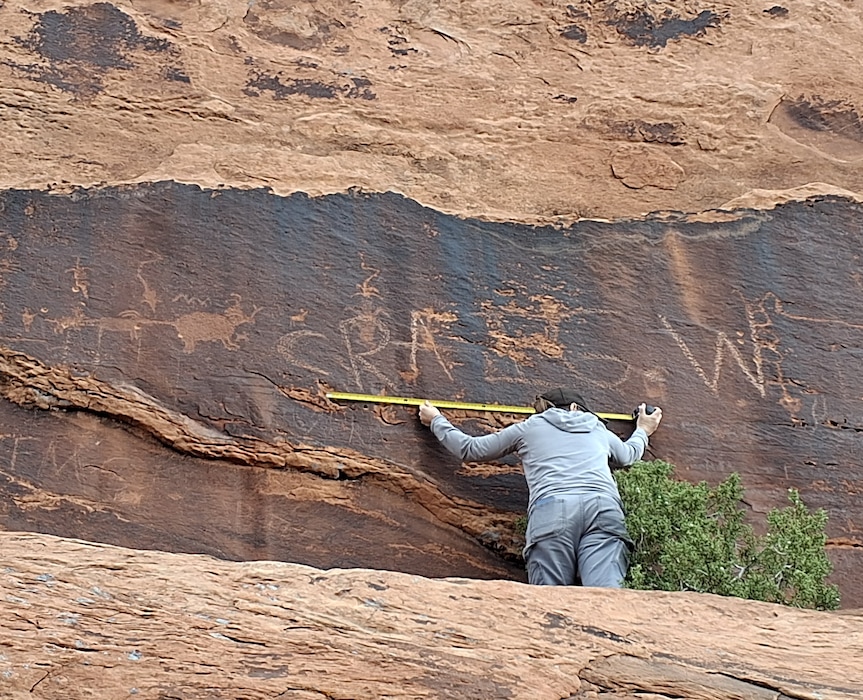
The Bureau of Land Management is asking for the public’s help identifying whoever scratched names into or near ancient petroglyphs at two sites near Moab, leaving damage that conservation work may not fully erase.
BLM announced Nov. 6 that it is investigating separate incidents at the Bear Panel along Highway 279 and at a site near Hell’s Revenge in the Sand Flats area. Anyone with information about those responsible should contact BLM Moab law enforcement at 435-259-2131.
In written responses to The Times-Independent, a BLM spokesperson said someone scratched graffiti near the bear petroglyph and directly beside a depiction of a bighorn sheep at the Bear Panel in the Wall Street area. At the site near Sand Flats, a first name and initial cover several images, including a humanlike figure with head adornments and a geometric figure.
The spokesperson said BLM had no information about potential suspects to share.
(Bureau of Land Management) Graffiti appears above the bear figure at the Bear Panel along Highway 279 near Moab. BLM plans to treat the damage but says conservation work may not erase all traces.
In its Nov. 6 social media post, BLM said the sites are protected under the Archaeological Resources Protection Act.
“Vandalism or unauthorized disturbance of archaeological resources is a serious federal offense and can result in significant fines, imprisonment, and/or exclusion from public lands,” the agency said.
BLM plans to treat the damage in the coming days. Specialized techniques can remove chalky residue left by scratching, but deeper incisions in the soft sandstone may remain, the spokesperson said.
“While the appearance of this type of vandalism can often be reduced, it cannot always be fully removed,” the spokesperson said.
Visitors should not attempt to remove the graffiti themselves because doing so could further damage the rock surface and underlying imagery, the agency warned.
Petroglyphs are images carved or pecked into rock. Based on their styles and imagery, BLM dates the affected panels to approximately A.D. 400 to 1300. During that time, known as the Formative Period, people practiced maize farming throughout the Moab region.
The sites hold significance for descendant tribes and pueblos, whose oral histories, ancestral migrations and continuing stewardship connect them to the cultural landscapes of Grand and San Juan counties, the spokesperson said. Some tribes, including the Hopi Tribe, view petroglyphs and pictographs as footprints of ancestral migrations.
The panels also inform archaeological research. Their styles and imagery connect them with similar sites as far away as the Uintah Basin, the Gateway area and Rock Springs, Wyoming, according to the spokesperson.
This story was first published by The Times-Independent.