 Jose Davila IV
He’s a friendly face at the entrance to many of Utah’s greatest outdoor destinations.
Without him, you might not know how likely it is that a fire could spark where you’re riding, hiking or camping.
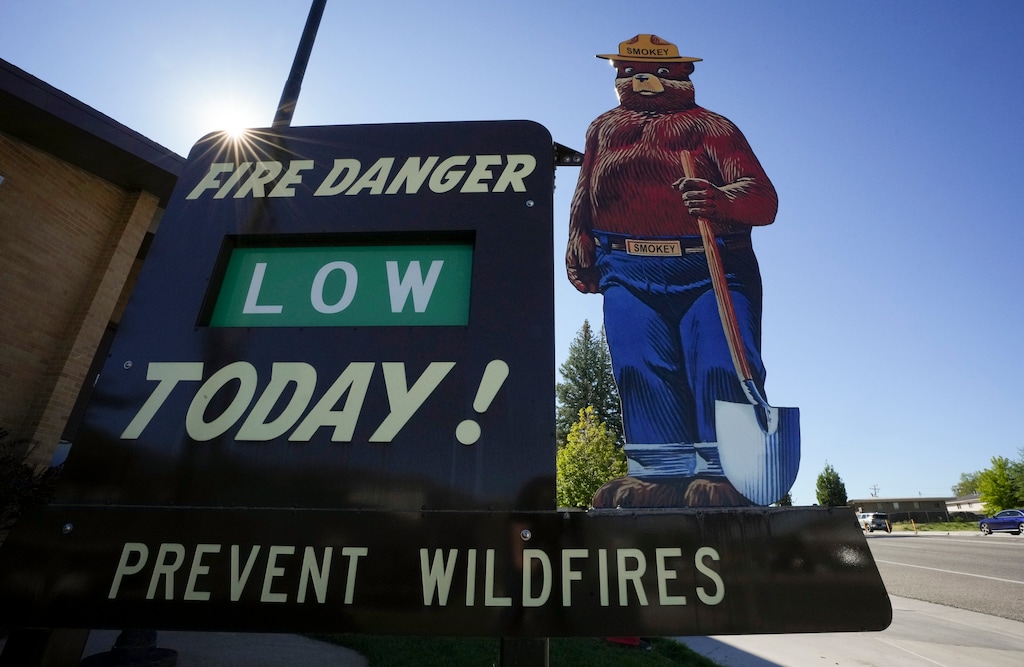
Smokey Bear appears on dozens of brown fire danger signs across the Beehive State, from Zion National Park all the way north to Logan Canyon.
The signs show whether the fire danger is rated low, medium, high, very high or extreme. As you might expect, the furry mammal isn’t the one changing the signs when conditions change.
That’s up to U.S. Forest Service personnel and state and local firefighters whose agencies own the signs. Even though many of the signs are the standard brown ones, any department can put one up.
(Bethany Baker | The Salt Lake Tribune) A fire danger sign in front of Ogden Fire Station No. 5 reads "low" in Ogden on Thursday, Sept. 24, 2026.
And deciding what the signs should say is complicated.
“It’s more complex than I think folks would ever think,” Brook Chadwick, the fire chief for the Uinta-Wasatch-Cache National Forest, said. “It’s not just we wake up and feel like it’s high today.”
Instead, each morning at the Northern Utah Interagency Fire Center in Draper, staffers run calculations that take temperature, humidity, wind and plant moisture into account. They also look at the fire potential for each of the next seven days, Chadwick said.
The forecast is important because people often only drive past one sign on their way to a multiday camping or hunting trip, he said. If fire officials were changing the signs every day, some recreationists might drive up on a “low” day but not see a new “very high” rating the next and might be more lax with their fire safety, despite worsening conditions.
“We are typically on a change-it-once-a-week schedule, unless there’s a drastic need to change it more often,” Chadwick said. “Once a week, right before the weekend gets started, seems to be a sweet spot for us.”
The goal is to give recreationists a good idea of how easily a wildfire could start and grow so they can enjoy the outdoors safely.
There are three fire danger rating areas in northern Utah: the West Desert and its mountain ranges, the Wasatch Mountains, and the western Uinta Mountains.
That means the sign at the entrance to Logan Canyon should be the same as the one at the entrance to Big Cottonwood Canyon, but may be different from the one at the Heber-Kamas Ranger District office on Mirror Lake Highway.
Chadwick said the interagency fire center calculates the ratings typically starting in May or June and ending in October or November, depending on weather. The daily rating is sent out to fire departments and ranger offices by text and radio.
Sometimes, though, he’s seen smaller fire departments with out-of-date or incorrect signs.
“It is our desire to be as open and friendly and helpful as possible at the Forest Service to help all the departments understand. Here’s the data. Let’s all do this together,” Chadwick said. “That’s our ultimate goal. But we probably still have some work to do there.”
Incongruous ratings aren’t the only headache when it comes to the signs. Theft of a certain American icon happens, too.
“Our biggest problem actually is people stealing the Smokey Bear part of the sign,” Chadwick said. “That happens more often than you would ever believe. We love Smokey, right? He’s our national mascot for fire prevention.”
Next time you’re heading up to the mountains, don’t just take a peek for the fire danger rating, look for Smokey, too.