 Jose Davila IV
 Jordan Miller
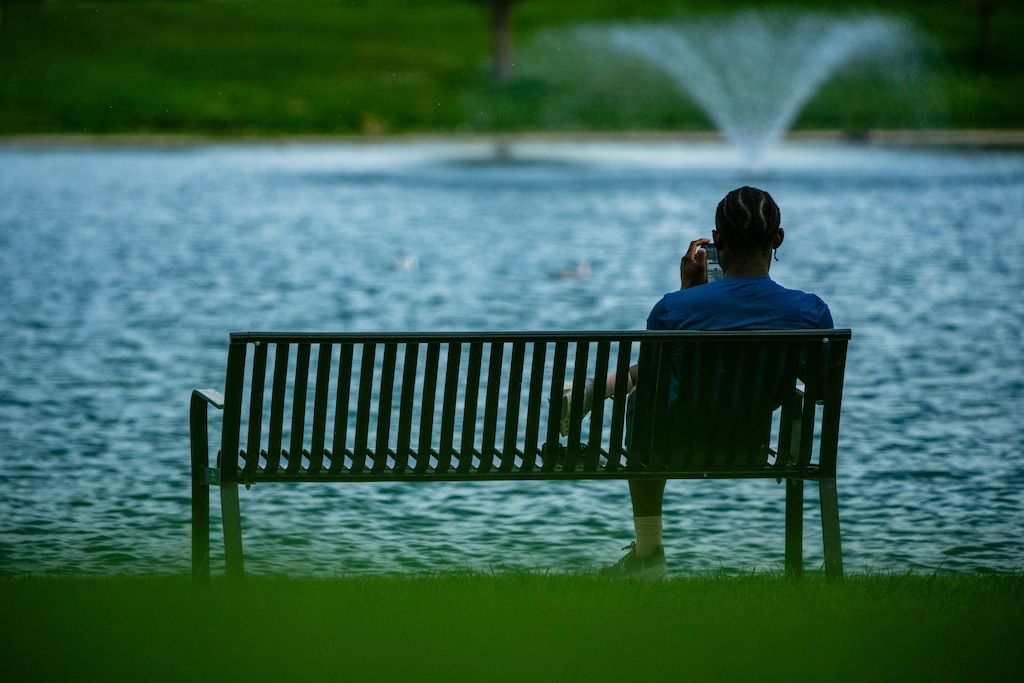
The Sugar House Park pond is glistening once again, refilled with water from Parleys Creek, and offering its iconic reflecting views of the Wasatch Mountains.
That also means the stench of rotting plants wafting into the paths of the park’s runners and walkers has disappeared.
“It looks perfect right now,” Richard Layman, the vice chair of the Sugar House Park Authority, said. “It’s the best it’s probably been all year.”
(Trent Nelson | The Salt Lake Tribune) The pond at Sugar House Park in Salt Lake City on Thursday, Sept. 17, 2026.
The pond’s levels are higher now because the Salt Lake City Department of Public Utilities is testing a nearby groundwater well and sending more water into Parleys Creek, Salt Lake County Parks and Recreation spokesperson Lauren Brady said. (Brady’s agency is generally responsible for maintenance at the park.)
“Given this increased flow, combined with recent rainfall and cooler temperatures,” she wrote in an email, “our park operations team closed the pond outflow gate to capture the additional water.”
While the pond has moved from poisonous to pristine this month, its long-term future is murky.
(Trent Nelson | The Salt Lake Tribune) The pond at Sugar House Park in Salt Lake City on Thursday, Sept. 17, 2026.
Authority board members and county parks and recreation director Chris Otto discussed converting the waterbody — which has existed in some form since at least the mid-1960s — back into a more natural creekbed at the panel’s August meeting.
To do so, Otto pitched using some of the $1 billion President Donald Trump promised to spend to save the Great Salt Lake. The pond hemorrhages water due to evaporation, so sending all of its water down Parleys Creek would get more of it to the lake, he said.
“The pond itself does not serve any water quality [purpose],” Otto told board members. “There’s no recreational use. It doesn’t do anything for drinking water. You can’t swim in it. There’s all the reasons that we want to have bodies of water that this particular basin does not really serve.”
(Trent Nelson | The Salt Lake Tribune) The pond at Sugar House Park in Salt Lake City on Thursday, Sept. 17, 2026.
Instead, the pond operates as a flood control measure, meant to limit flows down Parleys Creek during times of high runoff. Now, with drought occurring more frequently in the Beehive State, Otto said that county flood control officials believe that the pond could be reformed into a creekbed for the Jordan River tributary.
Layman, the vice chair, cautioned in an interview that any such reconstruction of the waterbody remains years in the future and would require significant planning, funding and public engagement. Brady, the county parks and recreation spokesperson, said the idea “remains conceptual.”
Bird death a recurring problem
The pond has seen its fair share of issues and maintenance over the past decade or so. When silt and other debris flows from Parleys Creek into the waterbody, it settles in the warm water and creates the ideal conditions for avian botulism in low water years. The disease can paralyze birds when they eat the toxic bacteria, said Richard Nowak, director of Avian Sanctuary and Protection in West Valley City.
(Trent Nelson | The Salt Lake Tribune) The pond at Sugar House Park in Salt Lake City on Thursday, Sept. 17, 2026.
In 2015, several ducks were killed and one dog was paralyzed after swimming in the water. This year, the Wildlife Center of Salt Lake has treated over 50 birds affected by avian botulism from Sugar House Park at its rehab facility, with about a 70% success rate, according to Michiko Berceau, a certified veterinary technician and one of the center’s directors.
While the county’s Parks and Recreation Division works to maintain healthy conditions at the pond, spokesperson Mimi Schneider deferred questions on the botulism outbreak to the Utah Division of Wildlife Resources. A spokesperson for the state wildlife division said late last month its biologists haven’t received any recent reports from the pond, and didn’t have details about the situation at Sugar House Park.
The pond was also dredged in 2018 and again early this year to remove excess sediment from its bottom, leaving the park with a muddy eyesore for months at a time.
(Trent Nelson | The Salt Lake Tribune) A gull flies over the pond at Sugar House Park in Salt Lake City on Thursday, Sept. 17, 2026.
(You may be wondering why the ponds at Liberty Park and Fairmont Park seem to fare better. Layman said that three creeks feed the Liberty lake, boosting its levels, and the Fairmont one is actually directly spring-fed.)
Sugar House Park’s future
Turning the pond into a more natural creekbed could solve some of the persistent problems with water quality, animal health and maintenance.
Actually getting a project of that magnitude off the ground, though, would be complicated because of how many government agencies would have to be consulted on it, Layman said. He named about eight organizations, ranging from the U.S. Environmental Protection Agency to the Salt Lake City Public Utilities Department, that might have interest in such a change.
“From a planning standpoint, I call that, well, there are two different words,” he said. “One is a mess, or the other is a challenge.”
(Rick Egan | The Salt Lake Tribune) Sugar House Park pond, on Thursday, Aug. 20, 2026. The pond has since been refilled.
It also remains an open question whether and when all of Trump’s promised Great Salt Lake funds come through and if this would be eligible for them. In June, U.S. Rep. Celeste Maloy secured $10 million to start the Great Salt Lake Watershed Recovery Program.
The Sugar House Park Authority itself only controls the revenue it makes from pavilion rentals, which leaves its board with a measly $30,000 to $40,000 to spend a year, Layman said. Salt Lake City and Salt Lake County, the park’s owners, must jointly fund any major improvements to the park, further complicating matters.
Layman estimated that even just planning the pond replacement would cost $300,000, money his board doesn’t have. Construction would likely be even more expensive.
(Trent Nelson | The Salt Lake Tribune) The pond at Sugar House Park in Salt Lake City on Thursday, Sept. 17, 2026.
If the creek restoration doesn’t happen, Layman said, outside of monitoring, the board has to keep the pond’s bubblers in working order and may look to reduce its size so less water is necessary for a healthy ecosystem.
As for the immediate future, the pond’s outflow gate will remain closed for now, Brady said.
“Park operations routinely open it toward the end of fall as part of regular seasonal maintenance to keep water flowing downstream and prevent winter freezing,” she wrote. “Once this occurs, the pond level will be low again for the winter season.”