 Tony Semerad
For a glimpse of what it all could mean, you first need to understand what Salt Lake City’s emerging Real-Time Crime Center already can do.
Hardware and staff are still being fleshed out, but the Salt Lake Police Department’s technology-filled hub at police headquarters downtown is now alight. The room’s purpose: centralize monitoring of major crime incidents as they unfold.
Mostly these days, this is where drones are launched as they become the latest first responders, lifting off from a handful of docking sites around Utah’s capital and speeding to where residents say they might need help.
(Rick Egan | The Salt Lake Tribune) Drone modules on the roof of the Salt Lake City Police Department headquarters, Monday, Sept. 21, 2026.
The airborne fleet of mostly Skydio drones flies on hundreds of calls monthly, usually arriving in a matter of seconds to check out calls for police and fire service.
The Real-Time Crime Center is also a future epicenter where live streams from a range of technologies used by law enforcement across the city are meant to converge, lighting up interlinked screens and devices with visuals and information as assigned officers focus on major crimes in progress.
Audio from dispatch calls. Live images and sounds from drones. Feeds from body cameras worn by police on scene. Views from static and trailer cameras that might be within observing distance. Information from state and national databases fed in from assisting personnel.
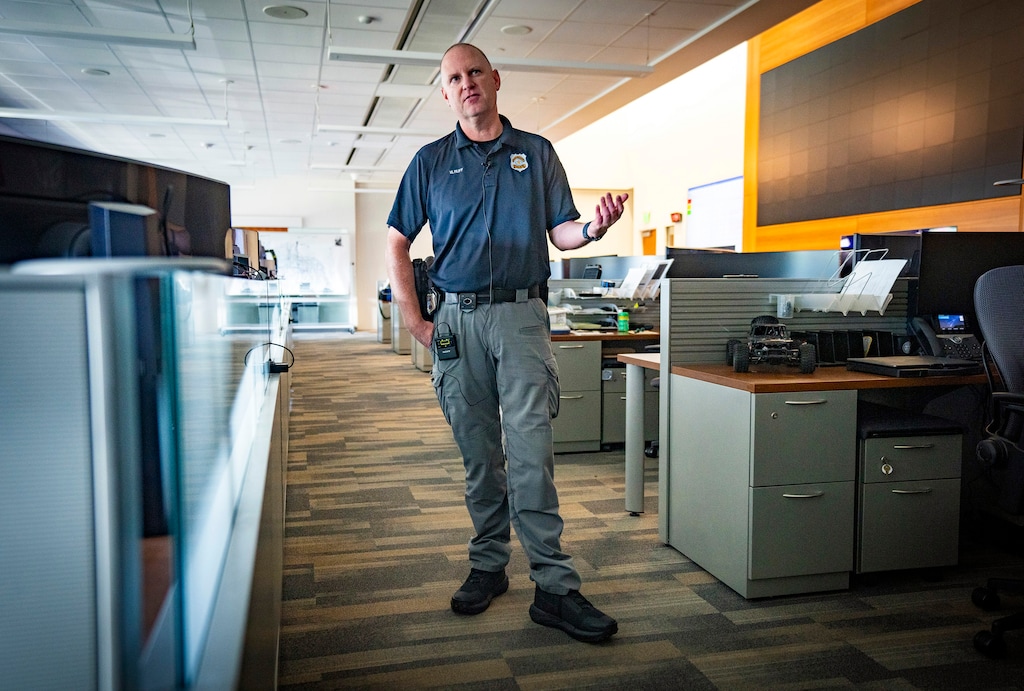
(Rick Egan | Salt Lake City Police Department Detective Mike Ruff shows off a police drone.
The concept is that all this visual, audio and text data can be sliced and diced and displayed dynamically with a few keystrokes. Versions of these feeds can also all be beamed to officers in their vehicles and on-scene, via advanced computers that are now standard equipment.
Then you can add information from controversial automatic license plate readers, sometimes referred to bluntly as Flock (despite there being multiple brands that produce these cameras), which are drawing critiques nationally and in cities across Utah.
What Flock controversy has touched off
(Francisco Kjolseth | The Salt Lake Tribune) An automatic license plate reader along 600 North and Interstate 15 in Salt Lake City on Monday, Aug. 24, 2026.
Although Salt Lake City uses a different license plate camera provider known as Vigilant, a subsidiary of Motorola, public outcry over license plate readers in general has brought broad scrutiny of the emerging crime center and other technologies — centered on concerns over privacy, civil rights and the future potential of mass surveillance.
The power of each of these individual systems is one thing, according to civil rights advocates.
Integrating their use simultaneously in one venue is a very different matter, lifting their combined capabilities to a new and more concerning level.
(Trent Nelson | The Salt Lake Tribune) Police surveillance cameras in Salt Lake City in 2025.
“You start to really see how serious of a threat these technologies can be to our privacy rights, especially when they’re working together,” said Ellie Menlove, policy director for the Utah chapter of the American Civil Liberties Union.
Menlove’s chief worry: the new take the technologies present for unreasonable searches and seizures by government authorities.
“It just amplifies our Fourth Amendment concerns,” Menlove said, “because it gives the police and our government such stronger capabilities to track where we are and what we’re doing and what activities we’re doing.”
Tech as ‘a vital public safety tool’
(Francisco Kjolseth | The Salt Lake Tribune) Salt Lake City police officers respond to a call in November.
Police say this is a natural extension of using technology in law enforcement in a way that has become increasingly second nature over several decades. It’s been not much different, they contend, from adding another piece of equipment to their uniforms, like a radio or gun.
And these high-tech tools are used in combination only for specific incidents, they say, differentiating them from mass surveillance running 24/7.
Tech, said Police Department spokesperson Glen Mills, “is a vital public safety tool” and building out tools such as the Real-Time Crime Center is another next step in promoting that goal and making officers more efficient at their jobs.
“We’re all about utilizing technology to make our community safer,” he said, “while putting reasonable guardrails in place to protect privacy.”
(Rick Egan | The Salt Lake Tribune) Salt Lake City police security cameras on 500 North, near the Jordan River, in 2025.
Showing the crime center to the public, elected officials and even critics, Mills said, is part of being transparent about that balance. “We haven’t had one person I’m aware of who doesn’t say, ‘I understand it a lot more and I’m more comfortable with it now after seeing it.’”
Detective Michael Ruff, with 19 years on the force, said the center is, in a crucial sense, not new.
“This room has been here since we built the building 13 years ago,” said Ruff as he showed visitors some of its features, including its massive segmented wall screen and an array of turbo-charged workstations beneath.
“It’s always been an intelligence center,” Ruff said. “It’s just evolving now into a real-time crime center as the technology has changed.”
What to know about these drones
(Rick Egan | The Salt Lake Tribune) Salt Lake City Police Department Detective Mike Ruff.
It takes about five seconds these days for the department to launch a drone, with officer-pilots able to remotely deploy them from five dock clusters around town, according to Ruff, with several of those located atop fire stations.
The department began using drones in this way about three years ago, he said, and, the devices now usually arrive on scene faster than any patrol officer or firefighter ever could.
“They can pick whichever drone’s closest and launch and fly from there,” Ruff said of the department’s pilots. “They’re going line of sight, so it’s point A to point B. They’re not having to worry about traffic lights or anything else.”
A navigating officer might be listening to a dispatch call while they fly out the propeller-driven devices that are roughy the size of a small laptop computer, all while their cameras send streams back live.
“The cameras are looking actually ahead, so you’re watching where they’re going and don’t crash,” said Ruff. “They’re not looking down in yards. They’re not flying with the camera down.”
No video is recorded, he said, until an officer deems there’s a legitimate law enforcement reason “and hits the button.”
Once the drone returns to its dock, said Ruff, any video is uploaded “into our evidence cloud” as-is.
Flying robots as first responders
Meanwhile, what’s generated and displayed in the Real-Time Crime Center — including drone feeds — is pulled together by an underlying, cloud-based operating system provided by Axon, which has supplied the department’s body cameras for several years.
Usage numbers for drones tell an important story.
Statistics on 391 flights during a three-week period in August showed the department’s flying robots were first on scene in 70% of those incidents. On 88 of the flights, the trained pilot back at headquarters determined a patrol officer wasn’t needed on scene.
On 24 flights, a drone helped spot and surveil suspects who were later arrested by responding officers.
Ruff said without always having to send a human patrol, the department is also able to get eyes and ears on a wider range of calls for service, including 911 hangups.
Along with cameras, the drones have speakers, sirens and red-and-blue flashing lights. The aerial vehicles also offer thermal sensing capabilities, Ruff said, “which can be very handy looking for missing people or for suspects.”
None of the police technologies Salt Lake City deploys, though, is authorized for facial recognition.
“We don’t have any ability to do that,” said Ruff, “regardless of what our cameras are.”
ACLU’s recommendations
(Trent Nelson | The Salt Lake Tribune) A police surveillance camera near the Utah Capitol.
A more central concern, according to the ACLU, is that the combined power of these technologies “really flips how we understand the Fourth Amendment” and its protections against unreasonable search and seizure by the government, said Menlove, the group’s Utah policy director.
Under historical norms, she said, “we understand the police are going to start from a crime and they’re going to investigate that crime.”
But the use of surveillance tech, Menlove said, “gives them the ability to start with a person, with a community, or start with a neighborhood or an intersection, and work backwards from there to see if a crime has occurred.”
“That, to us, is extremely worrisome,” she said, adding that tech capabilities are rapidly advancing. “Who knows where it’s going to be in five, 10 or 20 years?”
“Once we let the cat out of the bag,” Menlove said, “it’s very hard to to roll back some of these things to protect our privacy once we start using them.”
Menlove said the civil rights group has appreciated having input and dialog with the Police Department on its technology and surveillance policies.
With regard to drones — and license plate readers — she said the ACLU is now pressing for:
• Rules limiting their use to emergencies.
• Limits on retaining images they collect to circumstances where there’s a reasonable suspicious of a crime.
• Geofencing technology that can blur what is outside a drone’s flight path.
• End-to-end encryption for data, preferably stored on Police Department-side servers, not cloud-based ones.
• A complete ban on arming drones with any sort of weapons, lethal or non-lethal.
Tech under SLCPD Chief Brian Redd
(Francisco Kjolseth | The Salt Lake Tribune) Salt Lake City police Chief Brian Redd in January, with department spokesperson Glen Mills in the background.
The Police Department’s broader evolution toward tech in this regard has been nudged significantly forward by Chief Brian Redd since he took the helm of Utah’s largest police force in early 2025.
The former state prisons chief brings an extensive and tech-savvy professional background to the post, with experience in intelligence sharing, cybercrime investigations and corporate surveillance, according to his resume.
Before Mayor Erin Mendenhall hired him to replace former Chief Mike Brown, Redd had a 21-year stint with the state Department of Public Safety, eventually overseeing both the Statewide Information and Analysis Center and the State Bureau of Investigation.
(Salt Lake City Police Department) The latest mission statement for the Salt Lake City Police Department under Chief Brian Redd, which is posted prominently around downtown police headquarters.
Embracing technology and innovation are now embedded values for the city Police Department.
That’s according to a mission statement posted around headquarters that Redd helped develop and push out shortly after he took the job, a statement that also highlights support for personnel and strengthening community.
Technology is likely to be among the cornerstones of the department’s soon-to-be released five-year strategic plan.
So far, in his nearly 19 months running the department, Redd has promoted expanding the city’s fleet of static and mobile police cameras; adding more drones and hiring pilots; buying a tech-heavy on-site mobile operations trailer; and more funding for the growing Real-Time Crime Center — all as part of budget talks.
That tech push now seems to be running up hard against a relatively recent public outcry over widely deployed license plate reader cameras. Those are drawing fire for providing police, and, in some cases, federal immigration authorities, with the ability to query a 24/7 capture of vehicle and license plate information from many city streets.
Salt Lake’s Police Department, meanwhile, has used the Vigilant system for 10 years. The city’s contract, they insist, adamantly bars unauthorized data sharing with other agencies — and the system entirely blocks any city data reaching immigration authorities.
Where some of the debate stands
(Trent Nelson | The Salt Lake Tribune) Salt Lake City Council Chair Alejandro Puy.
While the latest debate over privacy and police technology in Salt Lake City was sparked by a proposal to use grant money to add some license plate readers, police already have nearly 70 such cameras deployed at major intersections.
The City Council is in the process of developing a formal policy on license plate readers usage in reaction to public concern. The public side of the debate, though, is currently on hold while city officials try to gauge how the Utah Legislature might weigh in on the broader issue come January.
(Francisco Kjolseth | The Salt Lake Tribune) An automatic license plate reader, stationed at the Utah State Fairpark.
The city also has recommendations from its Human Rights Commission, many of which are being incorporated into the draft ordinance. In many ways, the city’s existing policy language mirrors a set of state limits already in place on how law enforcement can use license plate readers.
But, tellingly, both city and state leaders have been laying the groundwork in recent months for expanding such rules to cover additional kinds of technology in the hands of police.
Council Chair Alejandro Puy has said he still intends to pass the city’s ordinance on license plate readers this year, while also trying to ensure the city’s work isn’t later undone by state action.
“The more time that passes,” Puy warned, “the more uncertainty there is for the community.”
Tony covers growth and development issues for The Tribune. He is a former editor and politics reporter and has been with The Tribune since 1991.