 Tony Semerad
While they aren’t the controversial Flock cameras sparking public outcry these days, Salt Lake City’s automatic license plate readers have issues of their own.
The American Civil Liberties Union is flagging privacy and surveillance concerns over Motorola and its subsidiary Vigilant Solutions, the city’s vendor and one of Flock’s major competitors. Among those concerns: that Motorola firms separately sell access to immense databases of license plate data captured with Vigilant and similar technologies.
Alongside Vigilant’s data collection from the cameras of its law enforcement customers, a new ACLU study finds, a related firm under the Motorola umbrella strikes deals for tow truck companies and fleet vehicles to carry license plate readers — often called ALPRs — and help to populate what’s known as the Digital Recognition Network.
Access to that system with billions of license plate impressions is sold commercially, the civil rights group says, and law enforcement agencies can access it for a fee.
In addition, according to study author Jay Stanley, a senior policy analyst with the ACLU Speech, Privacy, and Technology Project, Vigilant parent company Motorola maintains contracts with U.S. Immigration and Customs Enforcement.
“There are certain things that are worse about Flock,” Stanley told The Salt Lake Tribune, “but there are other things that are worse about Vigilant.”
Cities and counties in Utah may try to avert worries and controversy associated with Flock by using other ALPR vendors, he said, but they still face hard questions on civil liberties and potential abuse.
“You can try to get out of the frying pan and into the fire,” said Stanley, who is based in Washington, D.C, “but you’re still dealing with a mass surveillance infrastructure.”
Other Utah cities use Vigilant
Such concerns don’t just involve Salt Lake City. While state financial records show 45 Utah cities and counties have made payments to Flock since 2020, another 21 have transacted with Vigilant, which is based in California.
Salt Lake City Police Department spokesperson Glen Mills said the department’s contract with Vigilant “explicitly spells out that we are the owner of the data, and Vigilant is not.” As a result, Mills said, local data is barred from being used or sold through other databases.
“Anyone saying that our LPR data is collected and sold commercially is incorrect,” Mills added. The Police Department is also adamant, he said, that it in no way shares its data with ICE, not even indirectly.
Vigilant did not respond to questions from The Tribune regarding protections of data captured by the existing ALPRs deployed by local police.
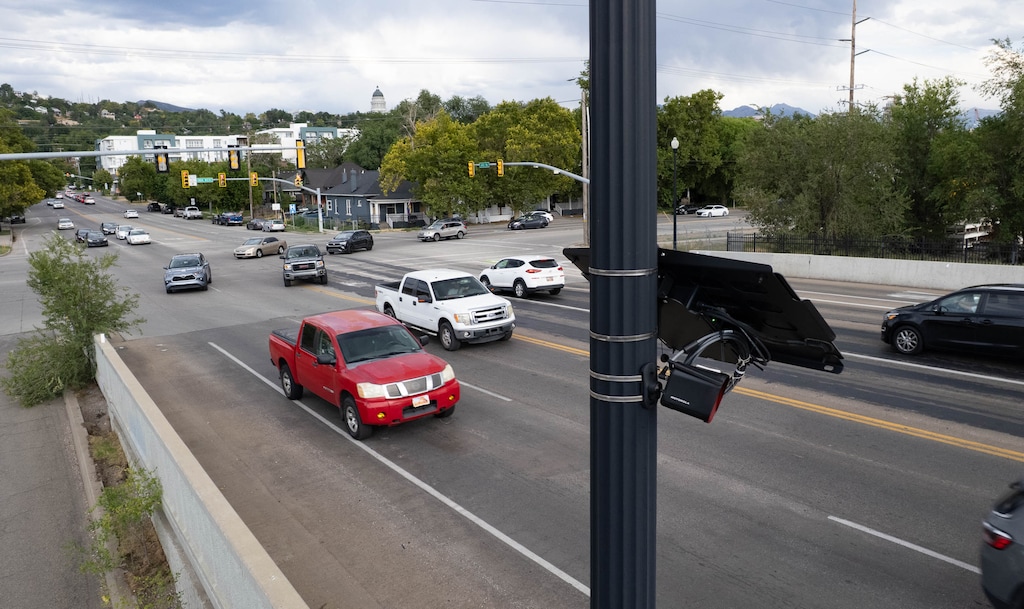
In Salt Lake City’s case, those devices are typically stationed at major traffic thoroughfares in and out of the city. Police Chief Brian Redd and others in the department have said they’re proven to serve a vital public safety function.
Firms compete for police tech networks
Another major Flock competitor, Axon, formerly known as Taser, is also raising concerns among civil rights advocates, Stanley at the ACLU said, partly over its use of artificial intelligence and for bundling various technologies together in its contracts with police agencies.
Axon is Salt Lake City’s vendor for police body cameras, but not for license plate readers.
Stanley said that, like Flock and Motorola, Axon is vying to become a broad “operating system for police departments” and is seeking to bolster its ALPR offerings with that goal.
State records show up to 127 Utah cities and towns made payments to Axon since 2020, though it’s unclear what specific technologies or services they might have purchased. Along with Taser weapons and body-worn and in-car cameras, Axon offers police agencies cloud-based evidence-management software and drones.
SLC shaping new rules on cameras
The ACLU has highlighted an array of issues over Flock, Vigilant and Axon just as Salt Lake City is drafting a new set of rules to formally restrict how police continue to deploy license plate reading devices while balancing public safety, privacy and civil liberty protections.
The new framework, which goes to a public hearing Sept. 15, is aimed at tightening why, how and who can use the cameras and any resulting data — and on narrowing the terms for sharing it with other law enforcement agencies.
The debate, spurred last fall by an otherwise routine police grant request, has since been infused with public worries over Flock as a near-ubiquitous U.S. provider of ALPRs and the company’s sharing of data with immigration authorities.
“Flock has become like Kleenex,” Stanley said. “It’s a particular brand of a product, but the brand name now stands in for the whole product category.”
What the city’s rules would do
Along with strict rules on how data might be accessed by officers in-house as well as by other law enforcement agencies, Salt Lake City’s new rules limit their use to criminal investigations; when police are trying to arrest someone with an outstanding warrant; to locate a missing person, a kidnap victim or someone else endangered; or to find a stolen vehicle.
They also ban the use of any facial recognition, though the cameras can deploy object recognition.
More pointedly on civil liberties, the rules also prohibit targeting anybody engaged in expressing their First Amendment rights, such as attending a protest, a political rally, a religious service or any other lawful gathering.
That same ban would apply to discriminating against anyone based of race, color, religion, sex, sexual orientation, national origin, age, disability, or genetic information. That would appear to prevent LPR data collected from being used for immigration enforcement.
When it comes to data sharing, Salt Lake City police don’t operate their own license plate reader servers, but instead upload data to web-based servers operated by Vigilant.
So the city’s draft legal guidelines also seek to tighten how other agencies might interact with those servers, including restricting that access, making it more transparent and requiring other agencies sign guarantees to stick to the city’s own rules.
As the rules inch toward adoption, the ACLU has called on the city to further narrow its legal basis for using the cameras, including limiting it to felony crimes. The group’s Utah chapter has also suggested imposing a nine-month limit on how long license plate data is retained on Vigilant servers.