 Tony Semerad
Salt Lake City wants the public to weigh in on how best to restrict the use of police cameras that automatically read license plates.
A simple $224,000 grant request from the Police Department last October to buy new digital license plater readers and install them at major entry and exit points for the city has blown up into a major debate over public safety, civil rights and potential for abuse.
Flock has become synonymous with this type of camera and a broader surveillance discussion, but police in Utah’s capital do not use the company, though others along the Wasatch Front do.
Salt Lake City police rely on a vendor called Vigilant Solutions, a California-based subsidiary of Motorola Solutions, for its automatic license plate readers, or ALPRs, which it has used since well before the latest controversy over the cameras hit the news.
All the same, public uproar across U.S. cities that deploy Flock readers to indiscriminately scrape data from passing traffic — and, sometimes, share it with immigration agents — has led to months of policy scrutiny at City Hall, even though Salt Lake City police maintain they don’t do that.
Now, initiated by the City Council, the city has a new set of draft rules to guide how police continue to deploy these devices. It’s got an eye on restricting why, how and who can use the cameras and any resulting data — and on narrowing the terms for sharing it with other law enforcement.
The council has set a Sept. 15 hearing for the public to comment on the new rules.
Striking a balance?
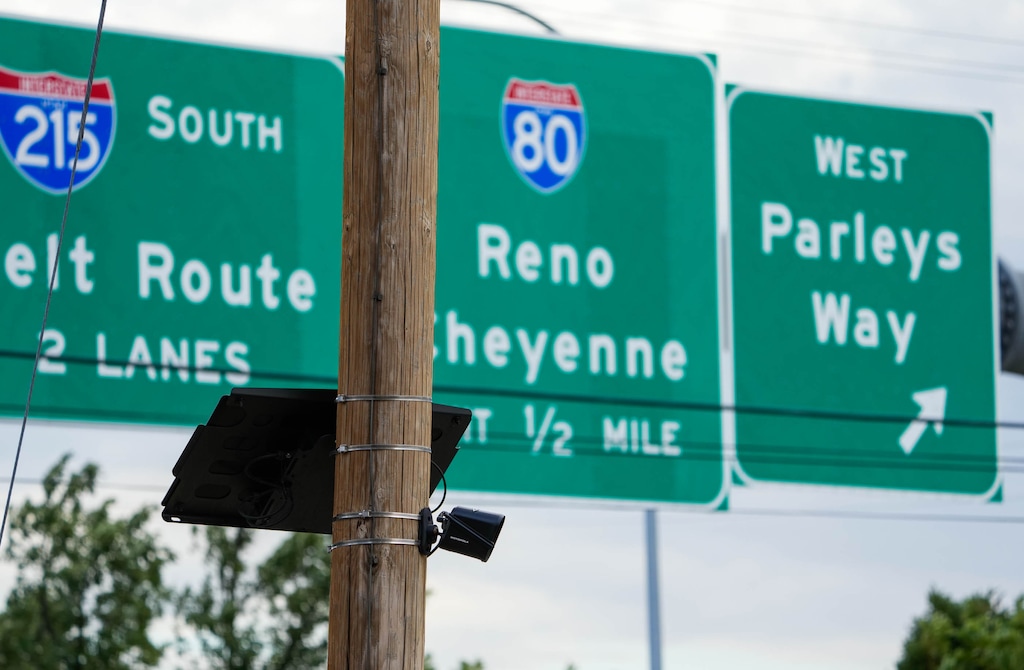
(Francisco Kjolseth | The Salt Lake Tribune) An automatic license plate reader is pictured on Foothill Drive in Salt Lake City near Parleys Canyon on Friday, Aug. 21, 2026.
Council member Erika Carlsen summed up part of how the Flock controversy has influenced Salt Lake City’s debate:
“I have faith in the Police Department to maintain that security of data. Multinational corporations, not so much,” she said. “So I want to ensure that we are well protected in that regard.”
If the city’s draft ordinance — referred to at City Hall as “enhancing transparency” — does get approved, it is likely to become part of broader rules on other technologies such as police body cameras, a fleet of increasingly smart fixed and mobile cameras, drones and even artificial intelligence.
“We want to have technology to do our jobs,” police Chief Brian Redd, who has worked to develop the ordinance, told the council recently.
“But that has to be something that the public, at some level, trusts, and we have to make it sustainable,” Redd said. “So I just want to put on the record that the privacy, the civil liberties protections, are extremely important to us in the Police Department.”
Some of the highlights
• License plate readers could only be used for criminal investigations; when police are trying to arrest someone with an outstanding warrant; to locate a missing person or, say, a kidnap victim or someone else endangered; or to find a stolen vehicle.
• The ordinance bans the use of any facial recognition, though the cameras can deploy object recognition, to filter images the way an app on your phone might.
• The rules also prohibit targeting anybody engaging in their First Amendment rights, such as attending a protest, a political rally, a religious service or any other lawful gathering.
• That same ban applies to discriminating against anyone based of race, color, religion, sex, sexual orientation, national origin, age, disability, or genetic information. That rule would, among other things, appear to prevent the data from being used for immigration enforcement.
• Any data in the camera system could only be accessed by a trained police officer. Those actions would carefully screened and monitored before they log in, requiring a specific criminal case number, crime type and other confirmations, including an authorized purpose.
• Any and all access to data would be heavily audited, according to the ordinance, both in terms of spot checks and analysis of long-term usage to detect unauthorized intrusions.
How is data shared?
(Francisco Kjolseth | The Salt Lake Tribune) An automatic license plate reader is pictured along 1300 East by Sugar House Park in Salt Lake City on Saturday, Aug. 22, 2026.
Redd has said unauthorized access to the system by officers would potentially lead to disciplinary action, firing, losing their police credentials or misdemeanor criminal charges, if verified. The ordinance also now calls for any incidents of violation or misuse to be officially reported to the mayor and a host of top city officials.
When it comes to data sharing, the Salt Lake City police manual makes clear the department doesn’t operate its own license plate reader servers. Instead, the data collected is uploaded to web-based servers operated by Vigilant.
So there are lots of guidelines in the new ordinance on how other agencies might interact with those servers, including tightly restricting that access, making it more transparent and requiring that outsiders sign guarantees to stick to the city’s own rules.
Other law enforcement agencies would have to show they keep up best practices on data security; have their own systems with unique user login credentials; make sure their officers get training; and keep written compliance rules to hold staff accountable for misuse or unauthorized leaks.
Cautious reaction from the ACLU
(Francisco Kjolseth | The Salt Lake Tribune) An automatic license plate reader is pictured on Foothill Drive in Salt Lake City near Parleys Canyon on Friday, Aug. 21, 2026.
So far, the draft rules — which build on existing state laws aimed at protecting privacy — are drawing concerns from Utah’s chapter of the American Civil Liberties Union, which continues to consult with city lawyers and elected leaders as they refine the rules.
“We’re against them, both Flock and ALPRs in general,” said Molly Karasick, an attorney with the civil rights organization. “However, if a city, municipality or law enforcement agency is going to use them, we are going to try and help them to improve the safeguards. But that doesn’t mean that we support the use of them.”
In key instances, according to Karasick, the rules don’t go far enough. The group is calling for:
• More clearly defined purposes for Salt Lake City using license plate readers, to ”prevent the overly broad surveillance that everyone’s worried about.”
• Restricting outside system access to situations with a clearly spelled-out legal basis.
• Limiting use of these cameras to felony crimes.
• Limiting how long any information collected is kept and purging it from the system after nine months.
Technology use by Salt Lake City police “is inevitable,” she said.
“But,” she added, “it’s so important they do so in a way that balances that need for public safety with that need to uphold the Constitution.”
Once the government starts making exceptions, she said, “then every single person’s freedoms are at risk.”