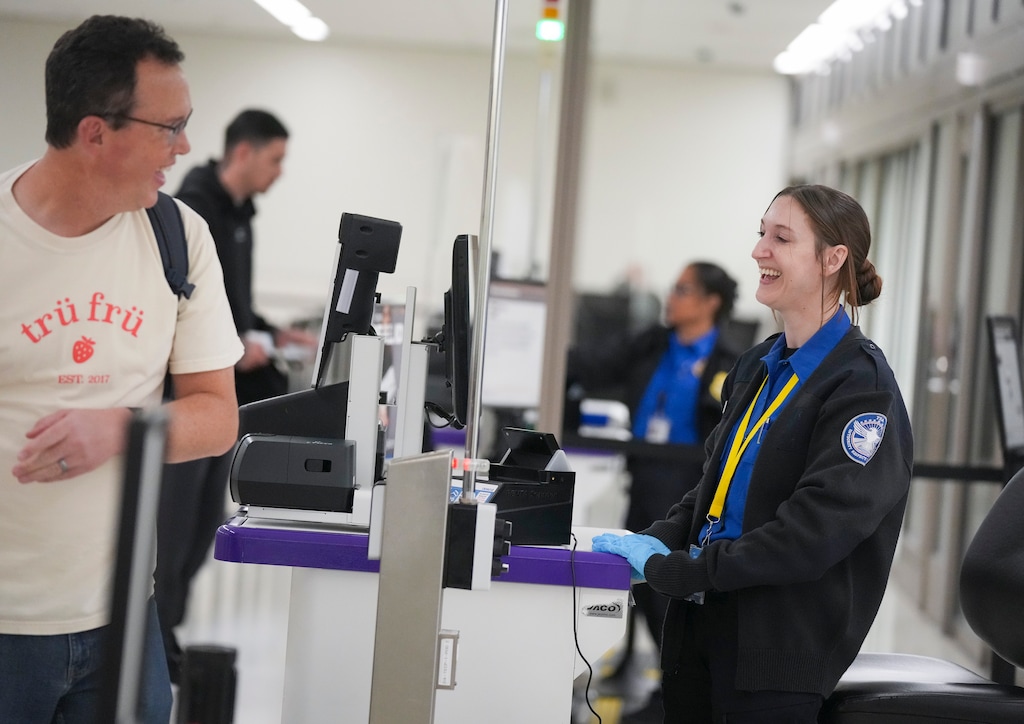
Despite spotty weather and stubbornly high fuel prices, Labor Day travelers are expected to pack airports and highways at near-record levels this weekend as they close out the summer.
The Transportation Security Administration said it estimated passenger numbers this Labor Day weekend would fall just below those of 2025, which brought one of the busiest days in agency history. More than 17 million passengers are expected to pass through screening checkpoints from Thursday through Wednesday this year, the agency said.
Most people will take to the skies Friday, with about 2.8 million travelers expected that day. On the same day last year, the TSA said it screened 2.9 million passengers, the highest volume ever for the Friday before Labor Day.
Weather challenges across the United States could complicate holiday plans. Severe thunderstorms, damaging wind and potential hail are possible from the Ohio Valley to the mid-Atlantic on Thursday, the second busiest day for air travel before the holiday weekend. The potential for severe weather is mostly centered on Washington and Baltimore, said Zack Taylor, a supervisory meteorologist at the National Oceanic and Atmospheric Administration.
In the Southwest, increased moisture will return through the weekend, bringing an increased risk of flash floods. U.S. national parks in this region are popular with this year’s Labor Day travelers, according to AAA, the automobile organization. Many renters plan to pick up cars in Denver and Las Vegas to visit Arches, Grand Canyon, Rocky Mountain and Zion national parks.
(Francisco Kjolseth | The Salt Lake Tribune) A thunderstorm moves into the Salt Lake Valley on Saturday, Aug. 22, 2026.
“For folks who may be planning a weekend trip, look at the weather now and be prepared for potential afternoon and evening thunderstorms,” Taylor said.
The risk is mainly confined to southern Arizona on Thursday. Starting Friday through Saturday, the threat covers virtually all of Arizona, southern Utah and the southwest corner of Colorado.
If intense rain rates fall on narrow channels or canyons, water can quickly rise and overcome an area. It’s less about the total amount of rain, and more about how quickly it falls, Taylor warned. Recovery is still underway in areas of the Grand Canyon’s North Rim, where a deadly flash flood forced officials to place significant restrictions on water use and lodging. All hotels within the park are expected to remain closed until further notice. Visitors should check with the park for updates.
Higher prices across the board
The national average for a gallon of gasoline was above $4 every day in August for the first time ever, according to AAA. Heading into the Labor Day weekend, drivers are spending $1 more per gallon on average compared with the same time last year.
The cheapest places to top off your tank will be in Indiana, Texas, Mississippi and Oklahoma, where the average price per gallon was under $3.70 as of Sept. 2, according to AAA data.
While AAA doesn’t provide driver number projections for Labor Day, the organization hasn’t historically seen a significant shift in people choosing to stay home because of high gas prices, according to Aixa Diaz, a spokesperson.
Despite record gas prices for August, driving is still cheaper than flying for many travelers, Diaz said. Domestic passengers are paying 2% more for round-trip flights compared with last year, averaging $750 per ticket, AAA data shows. For top holiday destinations such as Seattle, Orlando, Boston and Denver, round-trip ticket prices are 20% higher than last year, at nearly $800 on average.
“Filling up the tank once or twice during a road trip is more economical,” Diaz said.
Staying safe on the road
Friday is expected to be the busiest vehicle-pickup date leading into Labor Day weekend, according to Hertz, the car rental provider. Sport utility vehicles and minivans are the most popular rentals, pointing toward a demand for family and group travel over the holiday, the company said.
Road travel on the Labor Day weekend tends to be concentrated within short time frames, according to the transportation data provider INRIX. Most big metros will have peak congestion last up to five hours between Thursday evening and Friday afternoon. Travel experts recommend drivers depart early, allow additional time and avoid driving in the middle of the afternoon.
The insurance company Allstate said it analyzed driving behavior from last year’s holiday weekend and found drivers were about twice as likely to travel at 80 mph or faster as they make their way home from Labor Day trips, as compared with a typical Monday in August.
High-speed driving peaked from 3 p.m. to 7 p.m., according to the company. The busiest day for roadside requests came the Tuesday after Labor Day as people returned to their normal routines.
“We see firsthand what happens when long miles and vehicle wear catch up with drivers,” said Brian Dieringer, the president of Allstate Roadside. “Slow down and take a few minutes to check your car before you leave.”
The good news for holiday commuters: The Eastern United States should see a drier weather pattern Monday for the drive home, Taylor said.
This article originally appeared in The New York Times.