 Andy Larsen
Eagle Mountain residents are upset about their taxes.
While the data centers from multi-billion-dollar corporations like Meta and Google moving into the city are getting tax breaks, the residents are hearing proposals for doubling or tripling their property tax.
A lot is going on here, with multiple project developments and multiple proposed rates happening over time. The math isn’t always straightforward.
Still, the story is a classic one: a small city facing explosive growth, trying to decide how to keep both businesses and people happy within its boundaries. Here’s how it’s gone down:
Data centers have been given big tax breaks since 2018
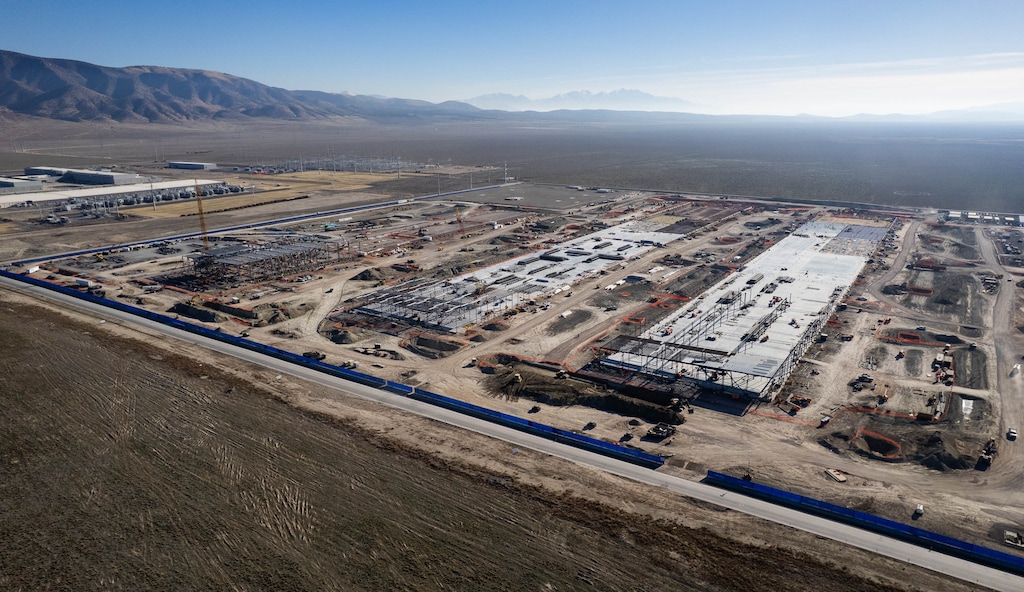
Eagle Mountain has given data center development tax breaks in the form of property tax relief through the city’s Redevelopment Agency four times. All are through Sweetwater Industrial Park Community Reinvestment Areas, on the south end of the city’s boundaries.
That means that when this new data center development is taxed, rather than those funds going into the city coffers like usual, most or all of that money goes back to the Redevelopment Agency and, to some extent, the companies creating the data centers.
Four different developments in Eagle Mountain's Redevelopment Agency have been approved with tax breaks in recent years.
The four separate announcements:
- Sweetwater No. 1 was approved in 2018 and is now a Meta — the company that owns Facebook and Instagram — data center. Meta asked for 80% of real-property taxes and 100% of personal-property taxes to be returned in the development. In all, the tax incentives given were $150 million over 40 years, though most of those came from breaks given by the Alpine School District, Utah County, Unified Fire Authority and the Central Utah Water Conservancy District. The amount Eagle Mountain gave back in 2026 was $935,382.
- Sweetwater No. 2 came in 2021 and, after some original description as “Project Fremont,” appears to be a deal with Google. This deal required the city to send back 75% of real-property taxes and 100% of personal-property taxes to the RDA. Here, the total tax break was estimated to be around $78 million, with about $280,000 per year being the city’s portion of taxes.
- The Sweetwater No. 3 deal was next, in 2023. This was a deal with Quality Technology Services, or QTS, a data center development company that Blackstone purchased for $10 billion in 2021. This was a $20 million tax break on 61% of real-property tax increment and 74% of personal-property increment. The city’s portion is about $63,000 per year to begin, and is capped at $210,000 per year.
- Sweetwater No. 4 is an expansion of the current Meta data center approved in 2025; it’s on about 567 acres directly south of the No. 1 campus. It is massive. The tax increment sendback totals $779 million over 40 years, including $1.17 million per year from Eagle Mountain.
As of now, Sweetwater No. 1, the current Meta data center, has actually been built and is earning property tax revenue, just short of a million dollars per year at the moment. Sweetwater No. 3, QTS’s facility, is finishing construction. In total, though, the four developments could add up to $2.5 million per year in property tax savings from the city itself — and almost a billion dollars from all of the taxing entities.
Eagle Mountain has also passed a big property tax increase
(Trent Nelson | The Salt Lake Tribune) Housing in Eagle Mountain on Friday, May 2, 2025.
Meanwhile, the city is raising property taxes on its residents. To Eagle Mountain’s credit, the property tax rates hadn’t increased since 2010, and were previously one of the lowest in Utah County. The previous rate was just 0.00053.
But a rising population — up from 22,289 residents in 2010 to 66,557 in 2025 — has made Eagle Mountain city government feel like it needs to grow its roster of city employees. In particular, the City Council argued that it needed the property tax increase to:
- Hire seven new police deputies for the area. Eagle Mountain has one deputy per 2,200 residents as is, where nearby cities like Lehi (one deputy per 1,400 residents) and Saratoga Springs (one deputy per 1,400 residents) have healthier ratios, they say.
- Expand city staffing to minimum levels for its new higher population.
- Give a wage bump to current city employees.
- Plan for a potential future shift in which fire services are paid for through the city, not through a separate tax levied by the Unified Fire Authority.
- Create a $2 million fund for future capital projects or more police hires.
So on July 21, the city posted a notice for a truth-in-taxation hearing to be held on Aug. 6 that would raise the rate to 0.0017 — more than triple what it previously was. It would have raised $6.7 million per year in Eagle Mountain property taxes. This made people quite mad, and indeed, residents spoke for nearly three hours in the public comment period on that day.
After the hearing, the Eagle Mountain City Council moved to lower the proposal to 0.0015, which passed by a 5-0 vote.
Residents were still furious. They pushed for a referendum to force a vote on the property tax increase, which still was huge. The City Council didn’t want that, and so instead decided to introduce a lower rate to present to the public at the next city council meeting, which happened Tuesday.
There, they proposed a 0.0009 rate — almost double the current rate, but around just over half of the original increase proposal. That passed too, this time with a 4-1 vote.
As is, that would raise $2.1 million in property taxes. Coincidentally, that’s a number just under the estimated $2.5 million per year Eagle Mountain is not charging the data center developers for property taxes.
I think it’s fair to say Eagle Mountain residents have noticed the issue. One cited a conversation with Eagle Mountain Mayor Jared Gray about the data center developments.
“Mayor Gray, you told my wife and I, directly before you were the mayor that there would be data center growth that would equal $50 a month for each household in Eagle Mountain,” resident Steve Porretta said. “Simple math says $50 a month equals $600 a year. But now you’re asking for a $300 a year increase. That’s a $900 swing from a decrease of $600 a month to an increase of $300 a month. This is not difficult math. Wrong direction from what we were told to expect.”
Gray, meanwhile, defended the data centers. He described a conversation where he asked QTS to pay for road construction at the cost of $5 million, and the company quickly wrote a check to the city to pay for it.
“I’m telling you right now, that road’s getting built because of QTS. No strings attached. And the two signals — Two signals! So to sit here and say these guys suck, I’m not OK with that,” Gray said, in response to the critical public comment period.
“I will tell you that I’m also continuing to work with both of our data center partners that are already built and those that are approved to continue to help us bridge these gaps. And so we are continually and constantly asking them to help, and they are. They are stepping up. So I just won’t allow for that to be a narrative that’s out there without saying the other side,” he continued.
“The facts are, they’ve given us money, and they’re carrying their weight,” Gray said.
Gray suggested one path forward to appease the city’s residents would be a separate property tax rate for businesses, but said the idea would need to be approved by the Utah Legislature.
“We are working with our legislators,” Gray said. “We’re working on legislation to raise taxes on data centers.”
The residents’ tax raise, however, is already done.