 Andrew Christiansen
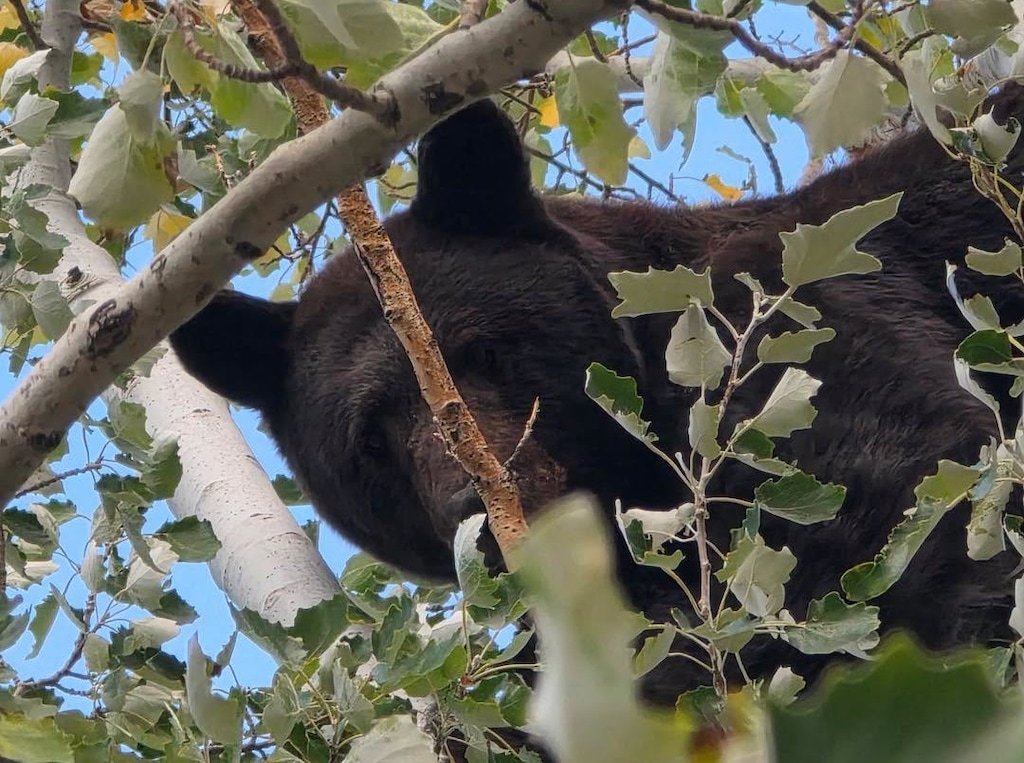
A 15-year-old female black bear that was tranquilized after climbing a tree in Spanish Valley was euthanized rather than relocated.
Brandon Behling, conservation outreach manager for the Utah Division of Wildlife Resources, said the decision was based on the bear’s age, current drought conditions and the tendency of older female bears to return after relocation.
The bear was reported early Aug. 11 on Luna Circle, according to Grand County Sheriff’s Office Lt. Al Cymbaluk. A deputy later located the bear in a tree, and DWR responded to tranquilize it.
About an hour and a half passed from when the deputy located the bear until she was sedated and safely on the ground, Cymbaluk said.
The sheriff’s office said in a social media post later that day that the bear would be relocated and “soon be back in the wild.” Cymbaluk said the deputy and people at the scene had been told she would be taken to South Elk Ridge. The decision to euthanize the bear was made after the post was published, he said.
Black bears in the West can live up to 20 years, though their average lifespan is shorter, Behling said. DWR’s concern about relocation was based on general patterns the agency sees in older bears, particularly females, rather than on a documented history involving this animal.
“Having a bear continue to return to or remain in an area with people can present safety concerns to the public,” Behling said.
DWR said the bear likely entered Spanish Valley in search of food. Behling said drought conditions are affecting plants and root-like vegetation, which make up about 90% of a black bear’s diet. He said DWR biologists believe bears may be searching more broadly for alternate food sources this year, including at lower elevations.
The reduced natural food supply could lead to more conflicts, particularly as bears get into garbage or scavenge for other food, according to DWR.
The agency has responded to three bear incidents in the Moab and Spanish Valley area this year and received eight sighting reports, seven of which were connected to those incidents. Another sighting reported Aug. 12 did not require DWR intervention.
DWR policy helps determine how the agency responds to bear incidents, Behling said. A bear may be euthanized even if it has not attacked a person if it repeatedly returns to populated or recreation areas or causes significant property damage.
“It is never an easy decision to euthanize a bear or any wildlife species,” Behling said. “We weigh a lot of factors and use policy to help determine whether to relocate or euthanize any wildlife.”
DWR has euthanized more than 15 bears statewide so far this year, Behling said, compared with seven by the same point last year. The agency euthanized 24 bears statewide in all of 2025, compared with three in 2024, six in 2023 and 13 in 2022.
The Spanish Valley encounter followed a bear sighting in Moab in July, when a juvenile bear came within a few feet of a resident before moving through the neighborhood. DWR did not respond because the bear had already left the area and was not posing a public safety concern.
DWR advises people who encounter a black bear to stay calm, stand their ground and give the bear a chance to leave. People should not run, back away or climb a tree, and DWR recommends being prepared to use bear spray or another deterrent.
The agency says a bear standing up, grunting or making other sounds is not necessarily acting aggressively and may simply be trying to get a better look or smell. If a black bear attacks, DWR advises people to fight back rather than play dead.
This story was first published by The Times-Independent.