 Andrew Christiansen
When Misty Sims’ two youngest children were scheduled for dental appointments July 1, she expected another routine visit with the Moab dentist her family had used for years.
Instead, she canceled after learning the office would no longer be able to bill Medicaid for their care. She has since scheduled the children with a dentist in Price, requiring a roughly two-hour drive each way and time away from work for care that had been available minutes from home.
As a single mother and the sole provider for her two younger children, Sims said the trip could mean lost wages if she cannot trade shifts, along with gas, meals and wear on her car.
“I’m a single mom, so I need every bit of income that I can get … so it’s hard,” Sims said.
Her family is among those now navigating a new gap in Medicaid dental care. Since a statewide transition took effect July 1, neither of Grand County’s two private dental offices has participated in Medicaid for children and pregnant and postpartum members, leaving families to seek covered care outside the county.
Approximately 445 Grand County children are enrolled in Medicaid, according to the Utah Department of Health and Human Services. That is equivalent to roughly one in five county residents under 18, based on recent Census estimates.
The transition followed legislation moving dental coverage for children and pregnant and postpartum Medicaid members from separate managed-care plans into a single fee-for-service network administered through the University of Utah School of Dentistry. DHHS, which oversees Utah Medicaid, told The Times-Independent the goal was to create one statewide dental network for families.
Both local dentists said they declined to participate because the standardized reimbursement rates were lower than the rates their practices had previously negotiated and would not cover the cost of providing care.
DHHS said the network includes more than 500 dentists statewide. In a July 21 written response, the department said the transition has “progressed smoothly” statewide and that Grand County is the only access concern it has identified resulting from the change.
“We take access to care in Grand County seriously,” DHHS said in a written response.
The department said it is working with local health departments and the University of Utah School of Dentistry on outreach and recruitment, possible program changes intended to encourage provider participation, a mobile dental clinic and discussions with federal partners. DHHS did not provide a timeline for when any of those efforts might restore local Medicaid dental care.
Why local dentists declined
Before the July 1 transition, managed dental plans could negotiate reimbursement rates with individual practices. Under the new fee-for-service system, providers are paid according to a statewide Medicaid fee schedule.
Dr. Jeffery Cornelius of Moab Dental Health Center said he had provided Medicaid-covered dental care to children since arriving in Moab in 2006 and did not take the decision to leave the program lightly.
Cornelius said his practice’s negotiated rates with Premier Access generally covered the cost of Medicaid appointments but were not highly profitable. He estimated the new rates were about 20% lower than what his practice previously received, though he had not calculated the precise difference.
“It just was too much of a cut to be able to function and do all the other things that I need to do,” Cornelius said.
Cornelius said his office asked Medicaid to continue honoring its previously negotiated rates but was told those rates would not be accepted under the new system.
DHHS said rural providers receive 20% above the standard Medicaid reimbursement rate for covered dental services. Both Moab dentists said the enhanced rate remained lower than what their practices previously received.
Dr. Merrill Hugentobler, who operates Grand County’s other private dental practice, described a similar calculation. He said the previous rates generally covered the cost of Medicaid appointments, while the new rates would leave the practice operating at a loss.
“We’d gladly do it if we didn’t have to operate in the red to do it,” Hugentobler said. “The current reimbursement is just not practical.”
Both dentists also raised concerns about communication. Cornelius said his office first learned of the transition when a patient called after receiving a Medicaid notice, while Hugentobler said his practice learned about it only a day or two before the change and did not receive direct communication from the state.
DHHS said it had communicated the change for several months through letters sent to providers and members, Medicaid Information Bulletins, the Medicaid Advisory Committee, the Utah Dental Association’s January convention, the Utah Oral Health Coalition and quarterly University of Utah School of Dentistry provider meetings.
Neither Moab dental office currently provides Medicaid dental care for adults. DHHS said adult Medicaid dental benefits transitioned into the University of Utah School of Dentistry network in 2025, and no Grand County dental office has enrolled. About 550 Medicaid members aged 19 and older lived in Grand County as of July 30, according to DHHS.
A new barrier in a community already short on care
The loss of local Medicaid providers adds another barrier in a community with limited dental care capacity, according to Mary Frothingham, the Grand County School District nurse who helps connect students and families with care.
Even before the transition, some children had to travel outside Grand County for extensive restorative treatment or dental sedation. Frothingham said families already faced transportation challenges and time away from work for those trips.
“We already have a shortage of dental providers,” Frothingham said. “We have two dentists that already provide incredible service to our community, and they need to run a business. They can’t be asked to provide services at a loss.”
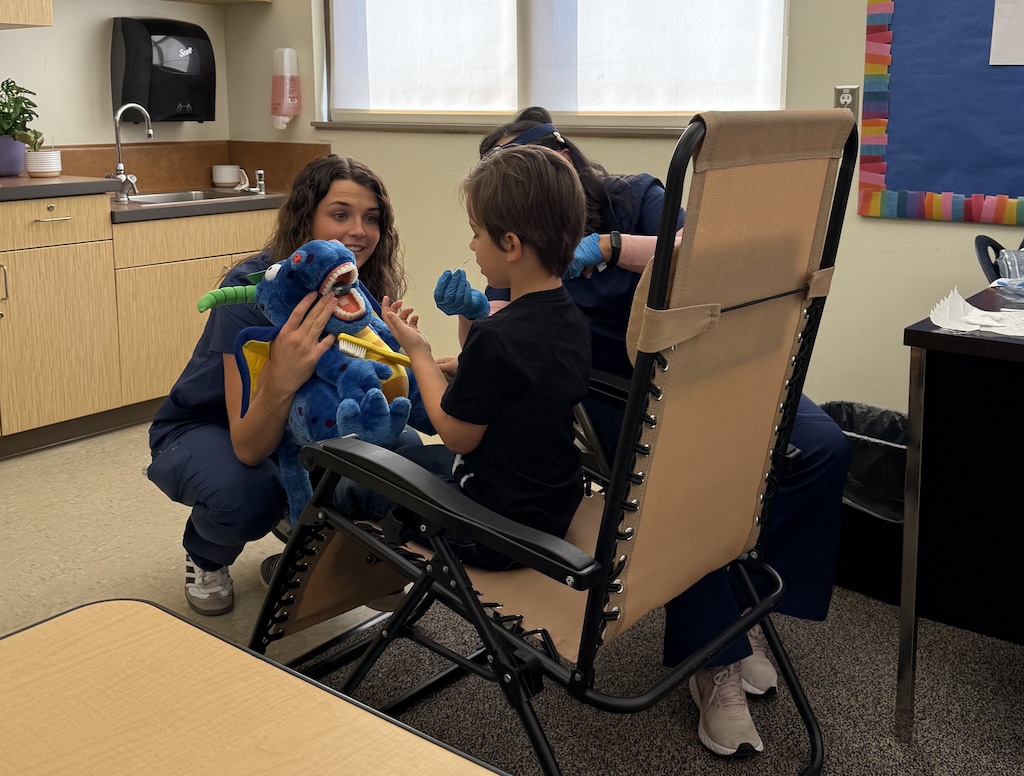
(BYU faculty) A student receives a dental screening through a Helen M. Knight Elementary School oral health program, a partnership between Brigham Young University’s College of Nursing and the Utah Department of Health and Human Services Oral Health Program on Nov. 6, 2024. A statewide Medicaid dental transition has left Grand County without local dental providers participating in Medicaid for children and pregnant and postpartum members.
Over the past three school years, Frothingham has partnered with Brigham Young University’s College of Nursing and DHHS’ Oral Health Program to provide dental screenings, fluoride varnish and oral-health education at Helen M. Knight Elementary School.
Since the program began in March 2024, students have received 1,237 visual dental assessments, according to a May 2026 project report. About 41% of those assessments identified oral-health concerns requiring timely treatment.
The screenings help Frothingham identify children needing routine follow-up, prompt treatment or emergency care and connect families with providers. The report says those connections are especially important for families facing transportation, language or financial barriers.
For Medicaid-covered children, she said local dental offices had been a key part of that care network, often seeing students quickly when screenings identified urgent problems.
Frothingham said the dentists also reduced the amount of care families had to seek outside Grand County. For children needing more extensive treatment, a local dentist could sometimes complete the initial examination and treatment plan, allowing a regional provider to perform the procedure in one trip instead of requiring families to travel twice.
“I’ve been working so hard to improve access,” Frothingham said. “This is such a step backwards.”
Now, even routine Medicaid-covered appointments require families to leave Grand County. Frothingham worries that some will delay or forgo care because they cannot secure transportation or take time away from work.
“What it really comes down to is that these kids just won’t be taken care of,” Frothingham said.
She said untreated dental problems can become more painful and expensive and affect children’s attendance, behavior, speech and overall health.
“Dental health is so critical to overall health,” Frothingham said.
The Centers for Disease Control and Prevention identifies cavities as the most common chronic disease of childhood. Untreated cavities can cause pain, infections and problems with eating, speaking and learning. The HMK program report similarly says untreated decay can affect academic performance, attendance and social development.
In response to Frothingham’s concerns, DHHS said it is working with local health departments and the University of Utah School of Dentistry to recruit dentists and that Medicaid members facing transportation barriers can access nonemergency transportation or mileage reimbursement.
Sims said she had previously sought mileage reimbursement for other medical trips but found the process time-consuming, with payments sometimes taking months, making her reluctant to pursue it again.
(BYU faculty) Students brush their teeth during a school-based oral health program at Helen M. Knight Elementary School in October 2025. Over the past three school years, the program has provided screenings, fluoride varnish and oral-health education while helping school nurse Mary Frothingham connect children and families with needed dental care.
Regional options — and efforts to fill the gap
With neither Grand County dental office participating in Medicaid for children and pregnant and postpartum members, DHHS directed families to Utah Medicaid’s provider list. The list advises members to confirm dentists accept Medicaid and are taking new patients because availability can change.
Available regional options include clinics in Green River, Monticello, Blanding and Price, generally requiring an hour or more of travel from Moab. Appointment availability and services vary.
Green River Medical Center, about 50 miles northwest of Moab, is one option. The federally qualified health center was already participating in Medicaid’s fee-for-service dental network and continues to accept children and pregnant and postpartum Medicaid members.
CEO Cody Eynon said the center has long served Moab patients and is accepting new patients, but capacity is limited because a dentist provides care in Green River only four or five days each month. As of July 17, the center’s next openings were in November, though it reserves one appointment each dental service day for urgent cases and refers children elsewhere for sedation or other specialized pediatric services.
Utah Navajo Health System operates federally qualified dental clinics in San Juan County, including Monticello, Blanding and Montezuma Creek. Chief Operating Officer Byron Clark said the clinics accept Medicaid and serve patients regardless of insurance status, but demand limits availability. Clark said the clinics have seen more patients from Grand County over the past several years, including some recent increases.
“Our problem right now is we’re so backed up on the schedule,” Clark said.
Clark estimated that routine hygienist appointments were scheduled about 10 months out in Blanding and Montezuma Creek and about 14 months out in Monticello. Procedures performed by a dentist, such as fillings and extractions, were generally available much sooner — often within about a couple of weeks, he said.
Clark said the organization wants to expand access, but limited space and the financial challenges of providing dental care make expansion difficult. Unlike smaller private practices, it can absorb dental losses through other health system revenue.
Price Pediatric Dental is another option. Office Manager Barbara McCourt said the practice accepts Medicaid, has capacity to take additional patients from Moab and provides sedation and anesthesia services. She said the office already serves some Moab families.
Moab Free Health Clinic Executive Director Kate Jagla said the clinic is exploring partnerships to address the loss of local Medicaid-covered pediatric dental care. Its regular dental program primarily serves patients ages 16 and older and is not a comprehensive option for younger children.
Jagla said she contacted the University of Utah School of Dentistry about possible solutions. The university’s Community Outreach Program will host a mobile dental clinic Aug. 24-28 at the Southeast Utah Health Department in Moab.
The clinic will provide dental examinations, X-rays, cleanings, sealants, fillings and extractions for qualifying Utah residents who are uninsured, including those without Medicaid, and have household incomes at or below 200% of the federal poverty level. The clinic can see some pediatric patients, but treatment is limited by available mobile equipment and does not include sedation services.
Jagla said the Moab Free Health Clinic remains open to partnerships and is trying to recruit more volunteer dentists, but regional provider shortages and reliance on outside partners limit those efforts.
Frothingham said the transition highlights a broader concern about dental access in a rural community with limited providers.
“There’s really no replacement for having primary care providers locally and a dental office,” Frothingham said. “And I think we as a community should be very concerned that we only have two dentists and one’s nearing retirement age. I mean, this is not just about our dentists; it’s about our whole community.”
This story was first published by The Times-Independent.