 Paighten Harkins
A new generation of aerospace and defense companies are making names for themselves in Utah, building on a foundation set decades ago by some of the country’s most foundational defense primes known for manufacturing the military’s traditional missile, rocket and fighter jet stockpiles.
In many ways, these smaller, innovative businesses are subverting that foundation, said Adam Robertson, chief technology officer at the Lindon-based Fortem technologies, which creates defense systems meant to detect and counter unmanned aerial vehicles, like drones.
“We went and did things that people said couldn’t be done, or were brand new industries,” he continued. “We went for it.”
On a recent June afternoon, the Fortem headquarters was bustling. Stand too long in one place and you’d end up in someone’s way.
On the second floor, among workers’ desks and whiteboards crowded with scrawl, cardboard boxes of inventory were stacked high, “where we don’t normally store stuff,” Robertson concedes, but their storage area is “completely packed.”
Hard, black cases packed with their proprietary DroneHunter drones — which can deploy a net to capture and stop attack drones — were lined up nearby, ready to ship to customers across the globe to help guard military bases and sporting events, like this year’s FIFA World Cup.
(Rick Egan | The Salt Lake Tribune) Adam Robertson, chief technology officer at Fortem Technologies in Lindon, on Wednesday, June 24, 2026.
“Just over a year ago, we more than doubled our manufacturing floor space,” Robertson said. “We need to double it again.”
This facility, in a nondescript Utah County office building near Interstate 15, is their fourth — the others left behind as the company ballooned.
Robertson said right now, they are working with Lindon to expand their current site; down the line, they may add locations beyond Utah to support making more products, including the company’s newer autonomous warhead-carrying drones, called the FireThorn.
Fortem isn’t alone. Other defense-focused companies, like Red Cat, Vector and Strider, are building here too, and capitalizing on this shift in how war is fought.
In interviews with executives at many of these companies, all pointed to some combination of three attributes that make Utah so attractive:
- A friendly regulatory system, and a government eager to lure them with incentives, like post-performance tax credits
- Vast swaths of land, some owned by the military, to test their drones and other systems.
- And, perhaps most importantly, they say, a ripe pipeline of eager and often more politically conservative workers graduating from the state’s universities — “People who are really passionate about protecting, defending freedom,” Robertson said. “We’ve got that in spades here.”
Companies like Red Cat, the parent company of Teal Drones (which received a multimillion-dollar contract to supply reconnaissance drones to the U.S. Army), have moved their headquarters here. Vector, a Utah drone company focused on making expendable attack drones that last year received a $61 million influx from investors, is already planning an expansion at its 35,000-square-foot Bluffdale headquarters.
(Rick Egan | The Salt Lake Tribune) DroneHunter drones at Fortem Technologies in Lindon, on Wednesday, June 24, 2026.
All this is happening as President Donald Trump’s administration has proposed a historic defense budget for 2027. At $1.5 trillion, it’s “more than any budget previously requested under any administration in history,” said Aaron Starks, the CEO and president of 47G, the state’s aerospace and defense booster organization.
That creates opportunity. And, according to Vector CEO Andy Yakulis: “Utah just provides a lot more open space, a lot more room for growth.”
The moment for drones
The war in Ukraine marked a massive change to the face of modern warfare, and the U.S. found itself falling behind.
Frontlines there, and in Iran and Lebanon, are increasingly dominated by small drones, instead of more traditional (and more expensive) weapons of war, like tanks.
Even before that conflict, the military and civilian law enforcement had come to rely on cheaply made Chinese drones. But when Congress made the 2019 decision to stop all military use of those foreign-made drones for security reasons, few U.S. made drone manufacturers existed to help fill the country’s need.
Teal Drones, created by Utah native George Matus when he was a teenager, found a foothold in that market. Matus is now Vector’s chief technology officer.
U.S. Rep. Celeste Maloy recalled the predicament at the ribbon-cutting for the new Utah headquarters of Teal’s parent company, Red Cat, in April.
(Rick Egan | The Salt Lake Tribune) Celeste Maloy, and Christian Morrison Chief Financial Officer at Red Cat Holdings Inc. join Christian Ericson for the Red Cat ribbon-cutting ceremony on Friday, April 24, 2026.
(Rick Egan | The Salt Lake Tribune) Teal Drones' Black Widow drone on display at the Red Cat ribbon-cutting ceremony on Friday, April 24, 2026.
The problem was exacerbated when the Federal Communications Commission last year effectively blocked new foreign-made drones from entering the U.S. market entirely.
“We found ourselves in a real pickle as a country,” Maloy said, “where we had learned to do things better with a new technology, and then we learned that technology wasn’t our friends, and we didn’t really have any way to move forward.”
Everyone who had come to depend on drones — civil engineers, law enforcement, mosquito-abatement specialists and more — were all “were in a panic,” she said. Not anymore, thanks to companies like Red Cat and Teal.
“So,” she said, “standing here today is not just a ribbon-cutting on a new business in Utah.”
“We’re finding a way to meet the requirements of the future,” Maloy continued, “without having to accept help from our enemies and without having to give away massive amounts of intelligence to people who are not our friends and want to harm us.”
While Teal struggled, sometimes mightily, before the U.S. shift to domestic drones, the company is now well-situated and looking toward the future.
“I always say that we’re in the Model T phase of the drone industry,” said Stan Nowak, Red Cat’s vice president of marketing. “There’s gonna be use cases that we’re not even thinking about right now.”
Why are they doing this in Utah? Importantly, it’s where Teal is based, Nowak said, and the company wanted to position itself around its “head horse,” so to speak. But also, Utah is a good median between its west coast facility in California and its more eastern facility in Georgia.
And, he mentioned, Utah is home to many of the company’s leadership.
After the ribbon-cutting, Maloy and a group of others, sporting matching black jackets to defuse errant static that could harm the drones, paraded through Teal’s factory floor to check out where their Black Widow reconnaissance drones are built.
Outside, the company had set up a demonstration, with Black Widows tethered on a wire, like a puppy, to keep them from running away.
Maloy volunteered to fly one. “It’s like a bumblebee,” she said as the drone flitted forward and back in jerky thrusts.
(Rick Egan | The Salt Lake Tribune) Teal employee Zach Childs and Celeste Maloy reacts as she attempts to fly a drone as she tours the TEAL factory after the Red Cat ribbon-cutting ceremony on Friday, April 24, 2026.
New players
Starks’ 47G group works with more than 230 Utah companies, national laboratories and every university in the state to support this industry, which, depending on who you ask, makes up about 8% to nearly 20% of Utah’s GDP.
The smaller number comes from the University of Utah’s Kem C. Gardner Policy Institute, while the larger figure comes from a report Starks commissioned via the Economic Development Corporation of Utah, which included a broader definition of the field.
He calls Utah’s aerospace and defense ecosystem the fastest growing in the country.
When Vector decided to build in Utah, Yakulis said, there were a lot of attractive qualities.
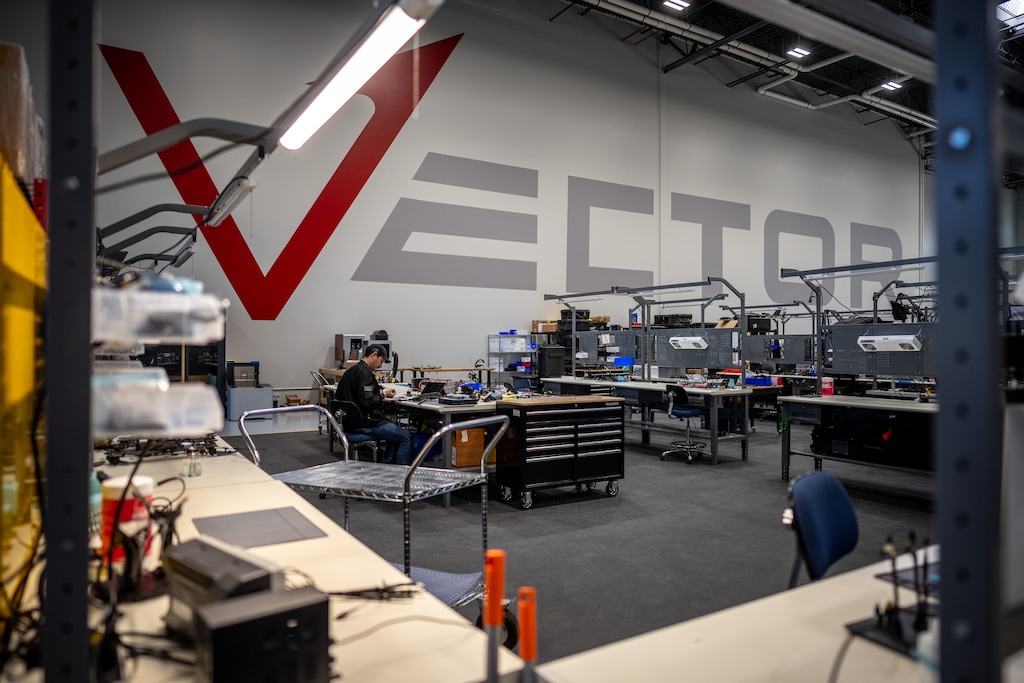
(Trent Nelson | The Salt Lake Tribune) Vector Defense in Bluffdale on Thursday, April 30, 2026.
The existing defense industry was one of them. Giants like Lockheed Martin and Northrop Grumman had already laid the groundwork, establishing a footprint and attracting a pipeline of employees interested in the field. Vector aimed to build off that, hoping to lure away hires “looking for a little bit different work experience.”
Vector also liked Utah’s looser regulatory framework and more convenient test-site options. He recalled a company in California whose employees had to travel a few hours away to test drones.
“We literally walk out our back door,” Yakulis said.
(Trent Nelson | The Salt Lake Tribune) Hammer F1 drones at Vector Defense in Bluffdale on Thursday, April 30, 2026.
Starks said the momentum in Utah comes as the Department of Defense rethinks how it spends its money and who gets a piece of it.
In the ’90s, the department chose to consolidate its contractors to try and build trust and conduct deeper research.
“But what it did is it killed the industry, because now you put the onus of all the innovation on a smaller group,” Starks said.
Now, Starks said, defense officials are trying to “create more capital opportunities” and “invest in more companies” to “incentivize companies to think differently.”
They seem to value “dual-use technology,” for both battlefields and commercial sale. Utah companies are doing that, he said.
For instance, Starks continued, Red Cat has a “whole suite of drones” that a soldier can use on the battlefield for intelligence and surveillance.
“But guess what? We can also fly it above Rice Eccles Stadium to detect movement in the airspace, to defend that when people are going and watching sporting events,” he said.
Hiring demand expected to keep pace
Beyond defense, the aerospace industry in general is growing as space flight becomes more approachable — and privatized.
NASA is no longer the sole U.S. entity launching spacecraft, and the space economy is drawing massive interest, said Jacob Hochhalter, a mechanical engineering professor at the U. who spent years working for NASA. Companies are exploring operating orbital data centers and manufacturing pharmaceuticals in the sky.
“All of these things that are starting to emerge that make economic sense that never did before, because it was just too expensive to get there,” Hochhalter said.
A report 47G commissioned from EDCUtah found the aerospace and defense industry supports more than 470,000 jobs in the state, including direct, indirect and induced positions. Starks said he doesn’t see hiring demand waning for “the next 10 years,” with innovations in warfighting but also civilian travel and transport, like the state’s burgeoning air taxi program.
(Trent Nelson | The Salt Lake Tribune) Vector Defense in Bluffdale on Thursday, April 30, 2026.
Utah’s colleges and universities are trying to meet that demand.
Last year, the University of Utah began its own aerospace engineering master’s program. In many ways, said Hochhalter, who helped start the program, the degree is a bit of a “rebranding of what we were already doing.”
Within the mechanical engineering program, the aerospace emphasis has long been the most popular, he added, but many of the state’s employers were asking for more specialization to meet their needs.
The U. also has its own drone-testing center, and Hochhalter added that students are increasingly interested in all sorts of autonomous systems, as local job opportunities abound.
No matter where they land, Utah has created a launch pad.
Correction • July 13, 2 p.m.: This story was updated on July 8 to correct the name of Fortem’s proprietary DroneHunter drone. This correction was added on July 13.