 Samantha Moilanen
In a few years, Utahns might trade bumper-to-bumper traffic on Interstate 15 for a quick lift home through the skies.
Utah officials have long pointed to the 2034 Winter Olympics as a potential debut for air taxis. But now, Utahns may be able to hail a ride in the sky much sooner than expected.
As early as this summer, electric aircraft will begin flying across Utah carrying packages and medical supplies, said Paul Damron, air mobility program manager with the Utah Department of Transportation.
“It’s really incredible,” said Aaron Starks, president and CEO of 47G, a Utah aerospace nonprofit. “How amazing is it that a family in Richfield can go catch a hockey game in 45 minutes? It just changes things.”
Those early flights won’t include passengers. They’re instead meant to test whether the aircraft can operate reliably — and safely — in everyday conditions.
That’s why the Federal Aviation Administration tapped UDOT to lead one of eight national pilot programs focused on bringing electric aircraft into different airspaces.
If the tests go as planned, in the final year of the three-year program, Damron said they will start putting people on board.
The move has some electric aviation enthusiasts like online platform The Hustle Brothers asking viewers, “Would you ride in one of these?”
How can you hail an air taxi?
Just like ordering a ride through Uber or Lyft, Damron said officials envision a similar concept where passengers can book a flight through an app.
Some aircraft companies are partnering with Uber to do that, Damron said, and others may create their own app.
“What they’re trying to do is make it available as just a regular mode of transportation through the application,” Damron said.
(Chris Samuels | The Salt Lake Tribune) An electric aircraft named ALIA by BETA Technologies taxis at Salt Lake City International Airport on March 10, 2025.
The aircraft will operate out of Utah’s airports for now, Damron said, with longer-term planning focused on where to place “vertiports” (small landing hubs designed for electric aircraft) and how to connect them into existing transit, so passengers can actually get where they’re going after they land.
“We’re going to need to make sure that these vertiports are positioned in places that there are additional modal opportunities, whether that’s through rail or connected centers, like TRAX stations,” Damron said. “We’re not going to be able to have them drop us off right at our house, that’s for sure.”
Transportation officials have previously pointed to empty parking lots as possible vertiport sites.
At first, flights will run between airports, mostly linking Logan, Salt Lake City and Provo, Starks said. Over time, as vertiports are built, the network will stretch into southern Utah.
The routes are expected to follow the same paths many Utahns already drive, with the aim of easing traffic, he said.
“For example, Saratoga Springs to Vineyard — being able to take passengers and commute over the lake allows them to then bypass about 50 minutes of traffic ...” Starks said. “And it’s a two minute flight from one end of the lake to the other.”
(Francisco Kjolseth | The Salt Lake Tribune) Mount Timpanogos is pictured in the distance near Lindon as a FrontRunner train passes Utah Lake on Saturday, May 24, 2025.
In the meantime, the aircraft also won’t actually drop packages at your doorstep.
Instead, Damron said, aviation companies will likely operate through partnerships with carriers such as UPS and Alpine Air, both of which have already expressed interest in electric aircraft.
Carriers like UPS already fly large volumes of packages into Salt Lake City International Airport, Damron said. Rather than transferring those packages onto trucks or smaller planes, they could instead be loaded onto an electric aircraft to move goods to other destinations across the state.
What do these air taxis look like?
The pilot program, known as uFLY, puts Utah at the helm of a five-state partnership with Oregon, Idaho, Arizona and Oklahoma — where aircraft will be tested everywhere from dense city corridors to remote, rugged terrain.
The results will give officials a clearer picture of how this technology could move people, packages and emergency aid.
But Utah has already gotten a glimpse of what that future could look like.
In May 2024, electric aviation company BETA Technologies teamed up with Utah’s aerospace group 47G to launch Project ALTA, an effort to build out a network of electric aircraft across the state.
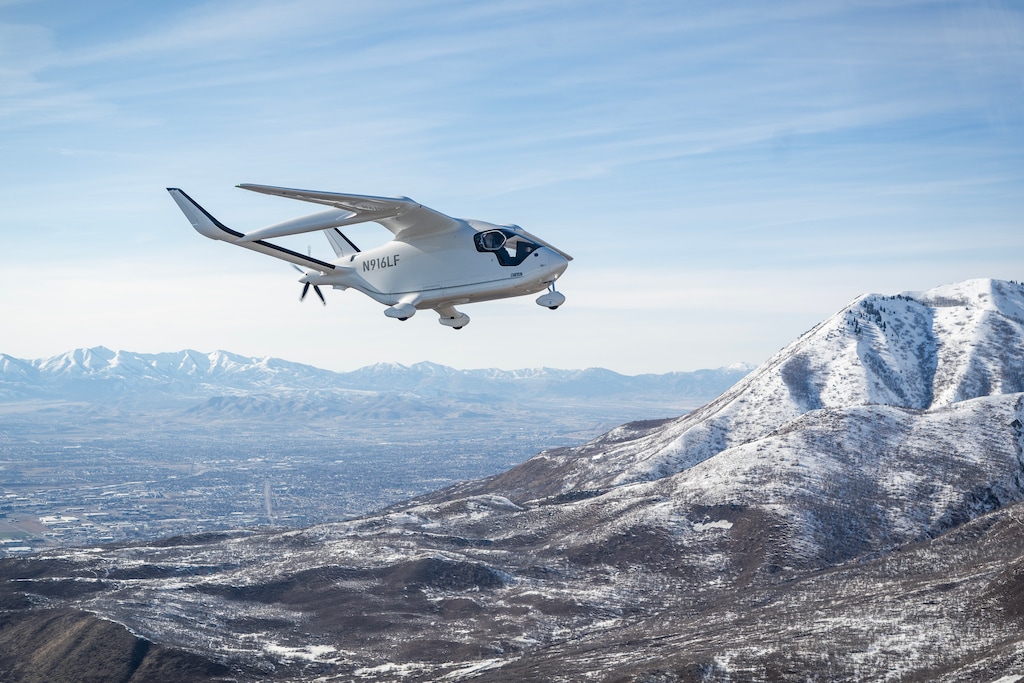
The Vermont aerospace company’s electric ALIA aircraft spent six days flying around Utah last March.
(Chris Samuels | The Salt Lake Tribune) A BETA Technologies electric aircraft in March 2025. The aircraft could begin carrying passengers in Utah within the next three years under a federal pilot program testing advanced air mobility.
While several aviation companies are involved in the pilot program, Damron said BETA’s ALIA aircraft is likely to be among the most common seen carrying passengers in Utah. It also already has a waiver from the nation’s aviation regulator to fly people.
The aircraft can carry up to five passengers, fly more than 350 miles on a charge and it can recharge in under an hour, according to BETA’s website.
Leaders envision a day when you could step aboard one of these aircraft in Logan, glide down the Wasatch Front and touch down in Moab — a journey that would take hours on the road, but could one day take much less in the sky.
It is the kind of travel imagined in The Jetsons, set in the 2060s. But in Utah, that version of the future may arrive decades sooner.
Earlier this month, Utah U.S. Rep. Mike Kennedy shared a Facebook post about the pilot program that featured a clip from the sitcom, describing it as “once a fantasy, now a reality.”
Starks said the shift could also change how people think about where they live.
“This kind of opens up a new way of thinking about affordable housing,” Starks said. “So we’re excited about all of these possibilities.”