 Brooke Larsen
St. George • As wildfires consume hundreds of thousands of acres across Utah this summer, Pine Valley is still recovering from a blaze that ravaged the small mountain town north of St. George last year.
The nearly 16,000-acre Forsyth Fire was a tragedy for the town of Pine Valley: 13 families lost homes. Firefighters have experienced PTSD. The local community and residents of St. George and other nearby cities miss visiting the Pine Valley Recreation Area — a favorite summer camping and hiking spot — that likely will not fully reopen until 2030.
The fire was not unexpected, though. During the Biden administration, the Forest Service identified Pine Valley as one of 21 areas at high-risk for fire across the West. The area has a higher wildfire risk than 99% of U.S. communities, according to the Dixie National Forest.
Drought, encroaching pinyon-juniper forests, the invasion of highly-flammable cheatgrass, low elevations and a mix of private and public land at the wildland-urban interface all make the area more susceptible to severe fire.
Fire has also long been the norm across the landscape, though.
“Most of Utah’s a fire-dependent ecosystem … so these ecosystems have developed in part because of fire,” Brad Washa, professor of wildland fire science at Utah State University, told The Tribune. “Now we’re building within those ecosystems.”
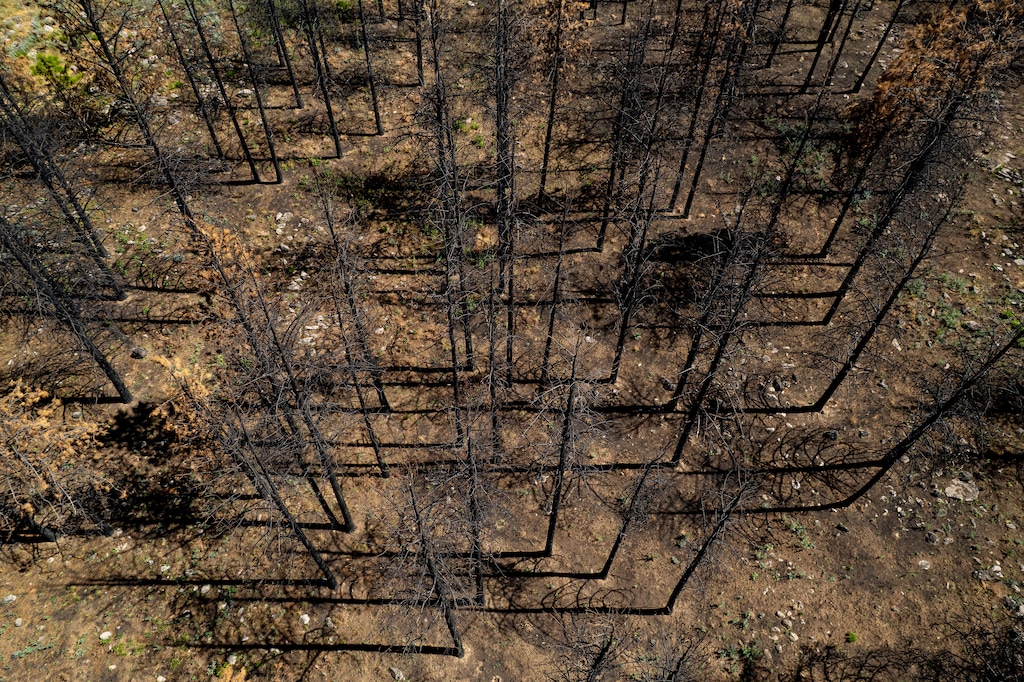
(Jud Burkett | Special to The Tribune) Charred trees from the Forsyth Fire surround homes that survived the blaze in Pine Valley, June 19th, 2026.
(Trent Nelson | The Salt Lake Tribune) Trees charred by the Forsyth Fire in Pine Valley Recreation Area on Wednesday, June 24, 2026.
(Trent Nelson | The Salt Lake Tribune) A tree charred in the Forsyth Fire in Pine Valley Recreation Area on Wednesday, June 24, 2026.
The ponderosa forests that cover the Pine Valley mountains adapted to fires burning every five to 25 years, Washa said. Those frequent burns would thin out other plants lower in the forest, and ponderosa’s thick bark could typically withstand a fire’s heat.
However, after over a century of fire suppression, white fur, piñon pines and juniper trees have started growing in greater density among the ponderosas. Those trees act as “ladder fuels,” Washa said, pulling fire from the ground up higher into the canopy. The extra vegetation also makes the fire burn more intensely.
“When the fire comes through those stands, no longer is it a low-intensity surface fire. It becomes a high-intensity crown fire,” Washa said. “Ponderosa can take some level of scourge where you have red needles in a canopy, but you can’t have the whole tree scorched out with a crown fire and expect it to survive.”
As Utah warms, fires in Utah have also grown more severe and the fire season has extended. Drought has also led to more dead vegetation, adding fuel to the fire. Scientists at Utah State University found that hotter summer temperatures will likely cause a 160% increase in area burned across the state by 2050.
While land managers can’t change the temperature, they can reduce fuel, said James Lutz, a co-author of the paper and a professor of forestry at Utah State.
“We know that prescribed burns are very effective,” Lutz told The Tribune. “We know that thinning followed by prescribed burns is perhaps the most effective.”
Previous prescribed burns and thinning on the national forest land adjacent to the town of Pine Valley helped mellow the blaze’s intensity, said Joe Rechsteiner, the Pine Valley district ranger with the Forest Service. But high winds blew embers past the 1,500-foot fuel break that the Forest Service had previously created between the homes and forest.
“We would have probably seen a lot more loss of structures had it not been for the fuel treatments around town,” Washa said.
How residents can prepare for a blaze
Beyond the preventative work of land managers, Washa also said people who live in the wildland urban interface have a responsibility to make their home as fire resilient as possible.
Some tips Washa shared for creating defensible space:
- Remove woodchips around the base of the house and replace with gravel or other non-combustible materials.
- Don’t have a pile of wood near the house.
- Screen out vents.
- Use firewise landscaping.
Some residents are also going beyond just the land around their house and looking at the structure itself. Keith Kelsch, a Washington County planning commissioner and builder who constructed his Pine Valley home with fire-resistant materials, has rebuilt three houses in Pine Valley and helped others remodel to make their homes more resilient.
(Trent Nelson | The Salt Lake Tribune) Keith Kelsch at his home in Pine Valley on Wednesday, June 24, 2026.
“This whole community is changing,” Kelsch said. “It was a serious wake-up call.”
Here are a few tips Kelsch shared for building and remodeling firewise homes:
- Seal off eaves with metal or fiber cement.
- Install a metal roof.
- Construct decks with non-combustible materials like concrete.
- Avoid vinyl, wood or plastic sidings. Instead use fiber cement, stucco or masonry.
The Pine Valley Fire Department is also offering free consultations to help residents prepare for the next blaze.
What the recovery looks like
While the community prepares for the next wildfire, the Forest Service and its other federal, state, county and nonprofit partners have been busy securing money, rehabilitating the landscape and repairing damage to campground and town infrastructure.
The forest service has not only had to rehabilitate the forest post-fire, but also repair damage from October flash floods that sent boulders, trees and loads of loose soil across campground roads and picnic tables.
In late June, the recovery work was visible: charred, dead trees that posed safety hazards for visitors were now stacked in piles throughout the campground. Dump trucks carried out sediment from the temporarily drained Pine Valley Reservoir. Wildflowers filled the landscape, and over 80,000 ponderosa saplings planted by the Forest Service had taken root.
(Trent Nelson | The Salt Lake Tribune) Dredging at the Pine Valley Reservoir on Wednesday, June 24, 2026.
(Trent Nelson | The Salt Lake Tribune) Debris and logging at Pine Valley Recreation Area on Wednesday, June 24, 2026.
(Trent Nelson | The Salt Lake Tribune) Purple lupine flowers grow under branches charred from the Forsyth Fire near the road closure at the Pine Valley Recreation Area on Wednesday, June 24, 2026.
Life has also returned on its own: purple silvery lupine flowers are sprouting up through the ash, deer roam the quiet campground and goshawks chicks have hatched.
“It’s just amazing, Mother Nature, how resilient she is,” Rechsteiner said.