 Brooke Larsen
The mountains were hazy. The smoky air smelled familiar.
More than 50 Pine Valley residents and volunteer firefighters gathered at the town’s fire station on June 19, sharing hugs and savoring cupcakes as they marked one year since the Forsyth Fire tore through their community. Attendees signed up for free “Firewise” consultations as smoke drifting in from blazes in Nevada and Iron County reminded everyone that another fire season was already here.
“I feel some dread, just because it’s hot and dry still,” said Claudia Davis, a volunteer EMT with the Pine Valley Fire Department. “Seeing smoke in the air, even though [the fire is] not nearby, just brought back those feelings.”
One year after the Forsyth Fire destroyed 13 homes and scarred thousands of acres around Pine Valley, recovery has meant far more than rebuilding houses. Firefighters have dealt with PTSD. Residents have navigated insurance disputes and post-fire flooding while the surrounding forest slowly regenerates and officials race to prepare the community for the next wildfire.
“None of us want to go through this again,” Davis added, “but I know it’s likely that at some point we probably will.”
On the one-year anniversary of the blaze, Marc Rose, the town’s volunteer deputy fire chief, reminded the crowd of “one of the most difficult days in Pine Valley history.”
“That fire swept through our area, tested our strength, challenged our resilience and changed many of our lives forever,” he said as tears welled in his eyes.
(Jud Burkett | Special to The Tribune) Pine Valley’s deputy fire chief, Marc Rose, left, chats with Pine Valley resident and former fire chief, Johnnie Nichols, right, during a community gathering to mark the one year anniversary of the Forsyth Fire at the Pine Valley Fire station Friday, June 19th, 2026.
(Jud Burkett | Special to The Tribune) Pine Valley Fire Chief Robert Hardy speaks to residents during a community gathering to mark the one year anniversary of the Forsyth Fire at the Pine Valley Fire station Friday, June 19th, 2026.
The Forsyth Fire spread hot and fast last summer as it incinerated homes, including two that belonged to volunteer firefighters. It tore through the beloved campground and hiking trails in the Dixie National Forest adjacent to the small mountain town 35 miles north of St. George.
“I witnessed firsthand the courage, determination and compassion that emerged during the crisis,” Rose said. “In the face of uncertainty, our community came together as one family — helping neighbors, supporting displaced residents and demonstrating the very best that Pine Valley has.”
They celebrated how far the community and forest had come. “Recovery is not measured only by rebuilding structures, but by the strength, unity and hope that continue to define our community,” Rose said.
It has not been easy, though. “[Fire] brings out the absolute best,” Dale Hagemeyer, former Pine Valley firefighter, told The Tribune, “and it brings out the absolute worst in society.”
Rebuilding
When the Forsyth Fire raged down the mountainside toward the town of Pine Valley, Hagemeyer was busy alerting residents to evacuate and laying lines around the inferno. He made a brief stop at his house to help his wife, Kelly, evacuate, loading up their dog, a Chinook named Denali, and a bin of memorabilia into their Subaru. Then he went back to his crew.
After working all night and the arrival of federal firefighters, he was dismissed. He checked on his home. It was “crispy” in the surrounding forest, Hagemeyer said, but the house still stood.
He munched on cereal as he looked at the smoky landscape out his window. “I think I dodged a bullet,” he remembers saying to himself.
(Bob Dalley) Dale Hagemeyer protects his Pine Valley community as the Forsyth Fire spreads on June 21, 2025.
That was the last bowl of cereal he’d eat in that house.
By the afternoon, 40 mph winds shifted and roared the blaze toward his neighborhood. “The force of those winds basically caught the first house on fire, and then it just blew like a blow torch, took the flames from that house and just blew it over to the next house,” Hagemeyer said.
Around 3 p.m., a neighbor called. His house was gone.
“That was one of the hardest things to internalize ever,” Hagemeyer said. “Your house is gone — not it’s on fire, it’s gone.”
With his firefighting credentials, he was able to enter the area sooner than others to assess the damage. He found a crater full of ash and twisted metal from melted appliances. “It was apocalyptic,” he said. “It reminded me of a war zone.”
During the fire, Hagemeyer and the volunteer firefighters were overwhelmed with donations of Gatorade, cinnamon rolls and cash. But once the smoke dissipated, salespeople, real estate agents and excavators came crashing in like waves, Hagemeyer said, trying to make money off the catastrophe.
It was daunting. Scorched trees and ash surrounded the land where his home once stood. And all Hagemeyer could salvage from his scarred property — mostly ceramic items, including snowmen ornaments Kelly inherited from her mom — fit into one five-gallon bucket.
(Kelly Hagemeyer) Dale Hagemeyer searches through the rubble of his burnt home in Pine Valley after the Forsyth Fire on Saturday, June 28, 2025.
“Some days you’re just like, I kind of want to go fetal position and not get out of bed because I’m overwhelmed,” Hagemeyer told The Tribune in August.
Hagemeyer and his wife decided to rebuild, though. The process has been long, frustrating, exhausting and expensive, they said.
The Hagemeyers have overseen the build themselves to save money, managing the painters, plumbers and electricians rather than hiring a general contractor. But workers haven’t shown up on time, and it’s hard to know who to trust.
The Hagemeyers’ insurance only covered about 60% of the cleanup and rebuild costs. The fire burned so hot that it cracked the foundation, but the insurance company didn’t factor that into costs since a foundation may survive a fire, Hagemeyer said. The concrete for the new foundation, footings and garage floor cost $90,000.
Then, after the concrete was laid, heavy rains sent mud and fire debris into the trench around the foundation that hadn’t been backfilled yet. The sludge was like mashed potatoes, Hagemeyer said. It cost the family another $5,000 to have the muck sucked out.
A year after the fire, though, their new house, constructed with fire-resistant materials like fiber cement, was nearly complete. Kitchen countertops and the final plumbing and electrical details were the last to-dos in late June. The Hagemeyers were exhausted and ready to be done.
(Trent Nelson | The Salt Lake Tribune) Dale Hagemeyer, in the yard of the Pine Valley home he lost in the Forsyth Fire, on Wednesday, June 24, 2026.
(Trent Nelson | The Salt Lake Tribune) A newly constructed home owned by John Robson, a volunteer firefighter, in Pine Valley on Wednesday, June 24, 2026.
(Trent Nelson | The Salt Lake Tribune) A home under construction in Pine Valley on Wednesday, June 24, 2026.
Other homes under construction that belonged to the Hagemeyers’ neighbors — including John Robson, another volunteer firefighter — also were rising up in the cul-de-sac that was covered in ash and the melted remnants of homes a year ago. While charred trees still filled the landscape outside the Hagemeyers’ window, silvery lupine also blanketed the surrounding fields in purple.
“We never got a fraction of that amount of lupine in the past,” Hagemeyer said. “It was just sagebrush out there, and I think there’s so much rich nutrients in the ground from all that ash.”
“Now it’s just gorgeous to look out there,” he continued. “You almost kind of stop looking at the charred trees and just only look at the flowers. It’s a silver lining.”
(Trent Nelson | The Salt Lake Tribune) Charred branches and lupines in Pine Valley Recreation Area on Wednesday, June 24, 2026.
Recovery in the forest
Just two months after the Forsyth Fire erupted in the Pine Valley mountains last year, the forest was already recovering. “There’s certainly a lot of tragedy that comes with fires,” said Joseph Rechsteiner, Pine Valley district ranger with the Forest Service, “but it is a natural part of the ecosystem.”
Baby trees, grasses and forbs were emerging. Deer had returned. Goshawks that Rechsteiner thought were “going to be toast” survived and returned to their nest, which was also spared.
(Rick Egan | The Salt Lake Tribune) Dry pine needles cover the forest floor in the Pine Valley Recreation Area after the Forsyth Fire on Wednesday, August 13, 2025.
(Rick Egan | The Salt Lake Tribune) Deer return to the Pine Valley Recreation Area shortly after the Forsyth Fire was fully contained on Wednesday, August 13, 2025.
(Rick Egan | The Salt Lake Tribune) Lupines grow after the fire in the Pine Valley Recreation Area on Wednesday, August 13, 2025.
After the fire, came the floods — another test for the wildlife. Heavy rains in October cascaded down the mountain side, plunging through the charred, loose soil and ripping out trees, including the one that held the goshawks’ nest.
The birds adapted and built a new nest in a nearby tree, now home to two chicks. “It’s just amazing, Mother Nature, how resilient she is,” Rechsteiner said.
The human infrastructure was still not faring so well a year after the fire, though.
Safely opening up parts of the recreation area has been a priority of Rechsteiner’s. Those who live in Pine Valley view the forest “as an extension of their homes,” he said in August.
However, the floods in October caused additional damage and the entire recreation area still remains closed. It will likely not reopen until 2030, but the Forest Service may open portions of it by 2028.
“We’re asking for money, we’re putting plans together, we’re doing analyses, we’re working with partners,” Rechsteiner said. “There’s a lot of moving parts to post-fire restoration.”
So far, the Forest Service has received nearly $3.4 million in funding to rehabilitate the forest and repair the extensive damages to the recreation area.
(Trent Nelson | The Salt Lake Tribune) Joe Rechsteiner at the entrance to Pine Valley Recreation Area on Wednesday, June 24, 2026.
(Trent Nelson | The Salt Lake Tribune) Joe Rechsteiner looks at flood debris in Pine Valley Recreation Area on Wednesday, June 24, 2026.
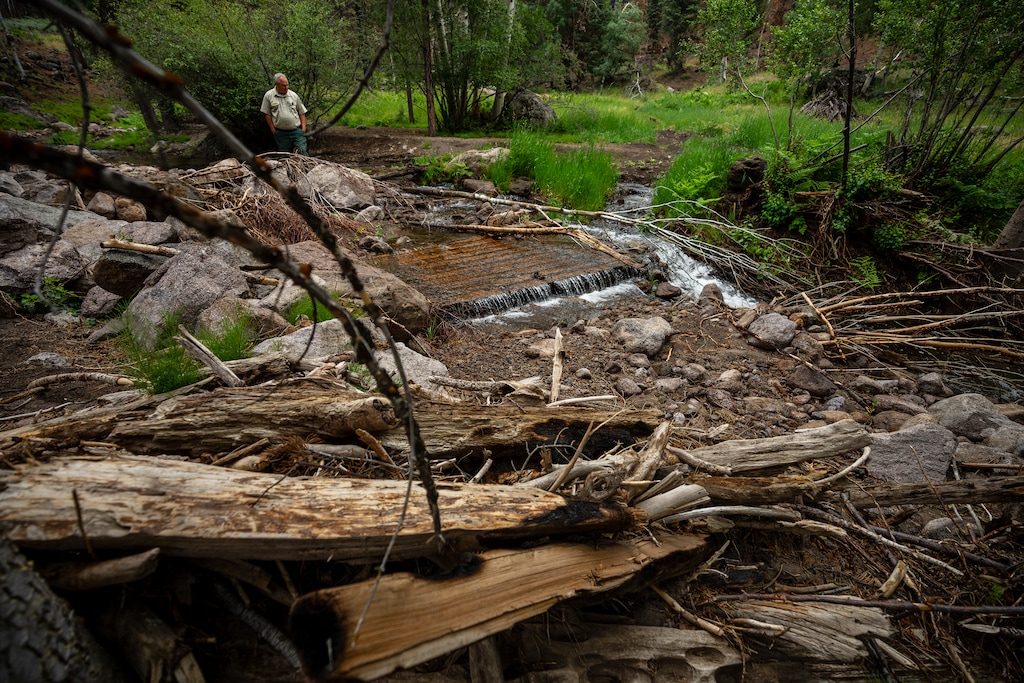
(Trent Nelson | The Salt Lake Tribune) Debris fills a campsite at Pine Valley Recreation Area on Wednesday, June 24, 2026.
In late June, picnic tables that had turned into strainers during the flood stood with charred branches and twigs woven through every crevice. A footbridge that once helped hikers cross a fork of the Santa Clara River laid underwater. And corrals where equestrians previously tied up their horses in one of the few equestrian enclaves in southwest Utah remained blackened and dilapidated.
“It’s a little bit of heaven that you don’t see around here,” said Lin Hokana, vice president of the St. George chapter of Back Country Horsemen. “It was lush and green and cooler and scenic. There’s no other equestrian campground on public land in this general area in southern Utah.”
The recreation area was also full of sediment. Massive piles of dirt and boulders that the floods washed away lined a section of road. The Pine Valley Reservoir was just an expanse of gray, sandy soil with a canal running along its side so water could still reach irrigators downstream.
But progress is being made: Heavy machinery dredged the reservoir basin one truckload at a time. A logging company that purchased most of the dead trees from the Forest Service has been busy chopping down the burnt ponderosa and stacking them in giant piles throughout the recreation area.
(Trent Nelson | The Salt Lake Tribune) Dredging at Pine Valley Recreation Area on Wednesday, June 24, 2026.
(Trent Nelson | The Salt Lake Tribune) Logging at Pine Valley Recreation Area on Wednesday, June 24, 2026.
The Forest Service and volunteers from Back Country Horsemen also plan to install metal corrals to replace the wooden ones in the equestrian loop of the campground. The horsemen group’s St. George chapter received around $52,000 in grants from the Utah Division of Outdoor Recreation, Washington County and the national Back Country Horsemen organization to cover costs.
In early April, Forest Service crews planted around 84,000 ponderosa seedlings in areas not being logged to help bring green trees back to the area. How fast those trees grow, though, will depend on how much rain and snow falls in an area that’s been in a sustained drought. “A lot of them are probably gonna get lost,” Rechsteiner said.
The state, through its Watershed Restoration Initiative, has provided over $320,000 and expertise to help stabilize soils, revegetate charred areas and stave off invasive species. In January, a contractor with the Utah Division of Wildlife Resources flew a fixed wing airplane full of several hundred pounds of seeds and dumped them over nearly 2,600 acres of the nearly 16,000 acres that burned.
“After a fire, you’ve lost all the cover of the soil, so the soil is directly vulnerable to wind and rain, and as that comes down … it can accumulate in the washes and drainages, resulting in flash flooding,” Gary Bezzant, habitat program manager for the division’s southern region, told The Tribune
The division planted grasses that will grow quickly, stabilize the burnt ground, retain moisture in the soil and provide food for mule deer — a priority for the division as the Pine Valley area is a critical summer range and migration corridor for the deer, Bezzant said.
Another goal of the planting was to prevent the spread of invasive cheatgrass, Bezzant added, which quickly takes over post-fire. But in June, the light brown grass was covering much of the recreation area.
It had already “cured out,” Rechsteiner said, leaving it dry and highly flammable.
“I’ve never seen cheat grass like this. … It’s everywhere,” Rechsteiner added. The combination of a hot March and early snow melt may have created ideal conditions for it to spread, he said. The Forest Service plans to monitor cheatgrass growth this year and treat it more next year.
The division hopes to see future successes as more seedings are done and seeds establish, Bezzant said. It will also look for opportunities for chemical control of cheatgrass in targeted areas.
The Forest Service has initiated a “Good Neighbor Agreement” with the division for $1.2 million of its rehabilitation funds for additional seeding, aerial straw mulching and repair and reconstruction work over the next year, Bezzant said.
(Trent Nelson | The Salt Lake Tribune) Trees charred by the Forsyth Fire in Pine Valley Recreation Area on Wednesday, June 24, 2026.
(Trent Nelson | The Salt Lake Tribune) Scars from the Forsyth Fire in Pine Valley Recreation Area on Wednesday, June 24, 2026.
(Trent Nelson | The Salt Lake Tribune) Scarring from the Forsyth Fire at Pine Valley Recreation Area on Wednesday, June 24, 2026.
Meanwhile, Washington County has been busy making sure the next storm that rushes down the mountainside doesn’t affect the residents below as significantly.
Beyond the dredging of the reservoir, county engineers and contractors are constructing detention basins to catch water and debris during future flash floods. They’ve also reconstructed culverts in town and diverted water away from homes.
The U.S. Natural Resources Conservation Service’s Emergency Watershed Protection Program has obligated $2.1 million in financial and technical assistance to Washington County for flood control projects, according to a spokesperson from the agency.
The county has to provide a 25% match of those funds, which it can meet with cash, donated materials such as rocks, or activities such as seeding paid for by the state, according to Todd Edwards, public works director for the county.
“I hope there’s not a major flooding incident like this again,” said Elliott Taylor, county engineer, “but just in case there is, the whole community will be a lot more prepared for an event like that.”
Flood anxiety and fire fatigue
A watershed typically takes three to five years to stabilize after a wildfire, Rechsteiner said.
If floods sweep through Pine Valley again, Hagemeyer doesn’t expect the government to bail them out, though. “We chose to live next to nature,” he said. To try to mitigate the effects of future flooding on their home, the Hagemeyers built their house higher out of the ground.
(Trent Nelson | The Salt Lake Tribune) Dale and Kelly Hagemeyer, at the Pine Valley house they have built after losing their home in the Forsyth Fire, on Wednesday, June 24, 2026.
But the community still worries about monsoon rains later this year. “There is some anxiety because Mother Nature may rise up,” Hagemeyer said.
Meanwhile, Hagemeyer and his neighbors are still grieving the disasters they’ve already endured. The day after the event at the firehouse, those who lost their homes and a few other neighbors gathered for a block party.
“There were a lot of tears shed,” Hagemeyer said. “Just seeing each other, it brings back a lot of emotions that people still have a year later.”
The Hagemeyers were the only ones who lost their primary home in the blaze, but others were still struggling with losing a family cabin full of memories.
Hagemeyer didn’t go to the event the night before at the firehouse. It’s hard to talk about the fire and relate to those who didn’t lose their home, he said.
“There’s a lot of what I call fire fatigue,” he continued. “We’ve been living it for a year, day in and day out, and we don’t really want to live it anymore.”