 Mark Eddington
Apple Valley • Three weeks after an alfalfa farmer’s deeper well threatened to drain Apple Valley’s aquifer dry, the immediate water crisis has stabilized. But officials in the town 30 miles east of St. George say they are still scrambling for a permanent solution.
Apple Valley Mayor Mike Farrar attributed the recovery to the farmer voluntarily shutting down his irrigation system, emergency upgrades to the town’s two wells and residents’ strict conservation efforts.
“Right now, with the changes we have made, the town has enough water — the aquifer is supplying enough to keep our water-storage tanks full as long as people continue to conserve — but we are not out of the woods,” Farrar told The Tribune Wednesday.
(Chris Caldwell | Special to The Tribune) Apple Valley Mayor Mike Farrar shows the improvements he has made to local water pumps Wednesday, July 1, 2026.
In mid-June, a farmer deepened an irrigation well and activated a large sprinkler pivot. Within a day, residents reported air in their water, and the water levels in the town’s wells, which previously supplied more than double the demand, began falling rapidly, Farrar said.
Soon, town officials were able to trace the water woes to the farmer, who got a state permit for a deeper well because he was no longer drawing enough shallow surface water for his crop due to the drought.
“He did everything legally,” the mayor said, “ and it was not his fault. But when he drilled deeper he was no longer into the groundwater but had punched into our aquifer.”
To stabilize the dropping aquifer, Apple Valley officials imposed strict water restrictions on the town’s 950 residents. All outdoor watering was suspended — except for providing for animals and livestock needs — and residents were urged to limit their baths or take short showers. Meanwhile, the local farmer permanently shut down his agricultural pivot, and the city is currently trying to raise $50,000 to reimburse him for his drilling costs, the mayor said.
In addition, the mayor continued, the town spent $150,000 to clean and extend pipes in its municipal wells deeper into the aquifer to draw more water. Eager to avoid paying a tab it can ill-afford, town officials are seeking emergency relief. The Utah Division of Drinking Water has offered Apple Valley a no-interest $200,000 loan, but Farrar said he is reluctant to take on more debt.
Easing restrictions
(Chris Caldwell | Special to The Tribune) The town of Apple Valley on Wednesday, July 1, 2026.
With the aquifer’s rebound to adequate levels, the town eased water restrictions earlier this week. While recreational outdoor water use remains banned, Farrar said residents may now water gardens and fruit trees sparingly, and preferably at night. Indoor water restrictions have also been lifted, though officials are still urging people to conserve.
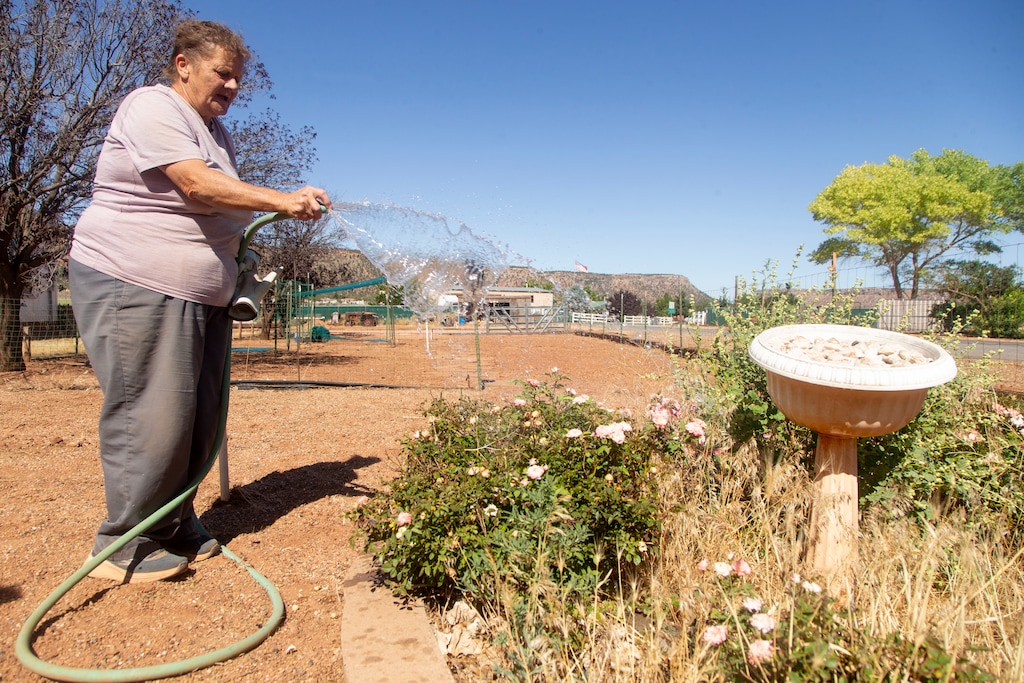
For Tammy Warner, who lives near the town hall, the new restrictions simply formalize the water-saving habits she adopted during the prolonged drought. She already stopped watering trees and catches roof runoff, though she still makes an exception for her late mother’s favorite rose garden.
“There are always going to be water issues here,” she said.
Water problems are nothing new in Apple Valley. In September 2023, a water pump malfunctioned, cutting off water to Cedar Point residents for several days. In January 2024, testing revealed that Cedar Point’s water system was contaminated with cancer-causing radium.
To resolve the crisis, the town secured a $3.37 million grant from the Utah Division of Drinking Water to build a six-mile pipeline. This project, completed last July, successfully connected Cedar Point to the town center’s safe aquifer.
The latest crisis “hasn’t been as bad” as the 2023 incident, said Cedar Point resident Lindsay Heaton. “Back then, we had the Red Cross bring in water bottles for everybody.”
Searching for new water
(Chris Caldwell | Special to The Tribune) The water tower in Apple Valley on Wednesday, July 1, 2026.
Apple Valley holds a combined 1.5 million gallons of water across three storage tanks. To shore up its future water supply, town officials are optimistic they can use $2 million in federal funds —secured recently with the help of Utah Rep. Celeste Maloy — to locate and tap into a new nearby water source.
The Washington County Water Conservancy District, which has helped the town in an advisory capacity, is partnering with the U.S. Geological Survey to conduct a detailed study of the area’s aquifer. District manager Zach Renstrom said finding another uncontaminated water source might not work out.
“The preliminary studies that have been done show that the aquifer and the recharge for the aquifer is very small and limited,” he said. “So the water just may not be there, and they are going to have to use the little amount they do have with extreme caution and protect it for drinking water.”