 Andrew Christiansen
After nearly a decade of planning and development, Utah’s largest solar and battery storage facility has begun operating in Emery County, adding a new source of electricity generation to one of the state’s longtime coal-producing and energy-exporting regions.
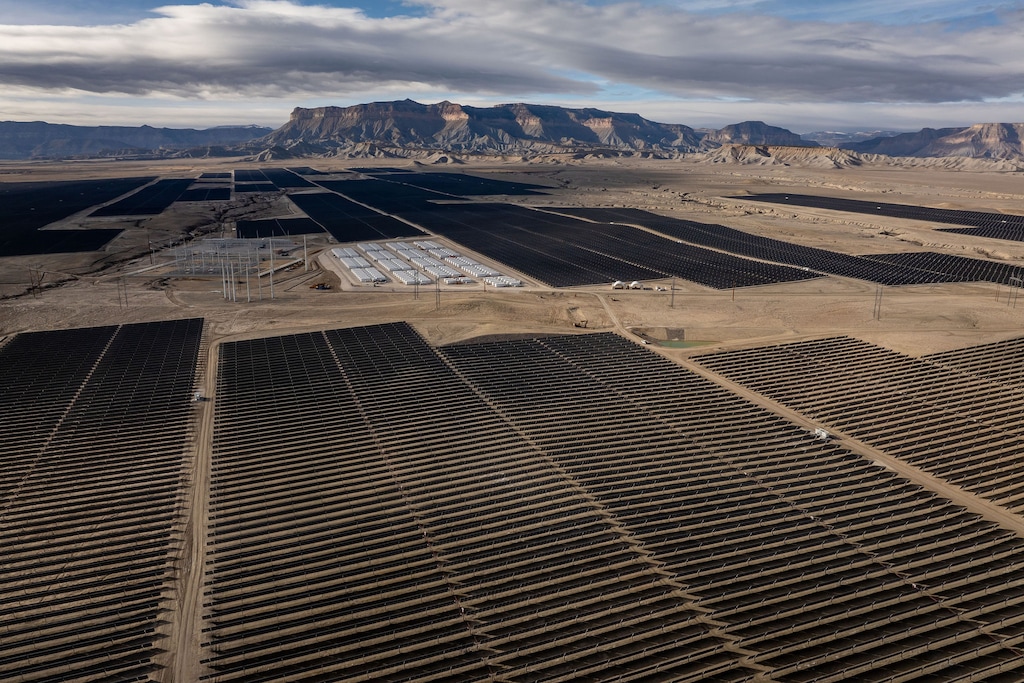
Led by Salt Lake City-based rPlus Energies, the $1.1 billion Green River Energy Center combines nearly 1 million solar panels with a 400-megawatt battery energy storage system, allowing electricity generated during the day to be stored and delivered later when electricity demand is higher. According to CEO Luigi Resta, the facility is expected to generate enough electricity each year to power the equivalent of roughly 10% of Utah households.
The project comes as state leaders push to expand electricity production to meet growing demand driven by population growth, economic development and the rapid expansion of data centers and other energy-intensive technologies. For Emery County, the project is also expected to generate tens of millions of dollars in property tax revenue over the coming decades, according to rPlus Energies.
The Green River Energy Center occupies about 3,200 acres of privately owned land north of the small Emery County town of Moore, roughly 65 miles north of Green River.
Gov. Spencer Cox joined local officials, contractors, landowners and workers Monday to celebrate the project’s completion, calling it the first major project contributing to Operation Gigawatt, his initiative to more than double Utah’s electricity production over the next decade. He said projects like the Green River Energy Center demonstrate how Utah can meet rapidly growing electricity demand by adding new sources of generation rather than debating which forms of energy should replace others.
“This is no longer about energy subtraction or energy changing,” Cox said. “It’s about energy addition. We need every single one of those electrons.”
(Andrew Christiansen | The Times-Independent) Gov. Spencer Cox speaks during Monday’s commissioning ceremony for the Green River Energy Center. Cox called it the first major project contributing to the Operation Gigawatt initiative.
Why Emery County?
Emery County’s existing transmission infrastructure, privately owned land and generations of experience producing energy made it a natural location for the Green River Energy Center, according to Resta.
“This project exists because of this country, this community and the long legacy of energy production here and it’s pretty incredible to see that legacy continue in a new way here today” Resta said during Monday’s ceremony.
Resta said the company views the project as complementing the region’s existing energy resources as electricity demand continues to grow, describing it as part of an “all-of-the-above” energy approach.
Emery County has long been one of Utah’s major energy-producing regions, with coal mines, power plants and transmission infrastructure that have helped supply electricity across the Western power grid.
Emery County Commissioner Dennis Worwood said the Green River Energy Center continues that tradition by adding another source of electricity generation rather than replacing existing ones.
“For the past 50 years or so, Emery County has been able to export its coal resources as electricity over these power lines that you see out here,” Worwood said during Monday’s ceremony. “Now we’re going to export some of our sunshine over these same power lines.”
(Photo courtesy of rPlus Energies) Solar panels at the Green River Energy Center stretch across the desert in Emery County, with the Hunter coal-fired power plant visible in the distance.
The facility occupies land that ranch owner Glendon “Woody” Johnson said had limited agricultural use because it lacked enough irrigation water to support crop production.
“There wasn’t much you could do with this land, except put cattle on it temporarily,” Johnson said. “It’s not good for much else.”
Johnson said leasing about 2,300 acres created a dependable source of income while allowing the ranch’s most productive farmland to remain in agricultural production.
“We couldn’t use it for farming, so I think it’s a great use of this land, and it benefits everybody involved,” he said.
Storing sunlight for later
The Green River Energy Center stores some of the electricity its solar panels generate during the day for use after sunset or during periods of higher electricity demand. Electricity from the facility flows into PacifiCorp’s regional power grid, which serves customers in Utah and five other Western states.
The project includes a 400-megawatt solar array and a 400-megawatt battery energy storage system capable of storing up to 1,600 megawatt-hours of electricity. It was originally designed with 400 megawatt-hours of storage before PacifiCorp expanded the battery component during development, a change Resta said reflected the growing importance of energy storage.
Although construction lasted roughly two years, about eight years of planning and development preceded it. Resta said moving the project from concept to completion required years of coordinating financing, utilities, landowners, regulators and other partners around a shared vision.
Building the facility required roughly 996,000 solar panels, 484 battery units, about 385 miles of underground cable, more than 133,000 steel piles driven into the ground and approximately 25 miles of interior roads.
(Andrew Christiansen | The Times-Independent) Rows of solar panels extend across the Green River Energy Center in Emery County.
Cox argued the years spent planning, permitting and securing approvals remain one of the biggest barriers to building large energy projects, saying the nearly eight years it took to get permission to build the project “never should have happened.”
“We all win when projects like this happen, but for a long time in this country we forgot how to build the big stuff,” Cox said. “We didn’t forget, we just stopped doing it. It got too easy to say no.”
Jared Ewan, construction manager for rPlus Energies, said completing a project of this scale requires contractors, suppliers and workers from across the region. He said rPlus intentionally relied on eastern Utah contractors throughout construction, including Emery County-based TSJ Construction, Carbon County-based Bodec Electric and BHI.
“We used as much of the community as we could,” Ewan said.
Economic impact
Beyond expanding electricity generation, the Green River Energy Center is expected to generate more than $55 million in property tax revenue over its first 20 years for Emery County, local schools and other taxing entities, according to rPlus Energies.
Worwood said the additional revenue is already giving local governments more flexibility. He said the county has invested more in emergency services, the Emery County School District has reduced property taxes and the county has adjusted its budget.
“It will bring millions of tax dollars in,” Worwood said. “Our job now is just to make sure we use the money wisely.”
Worwood said county leaders are discussing ways to invest the revenue in long-term infrastructure and other one-time projects that will continue benefiting residents after the property’s taxable value declines over time. Emery County Commission Vice Chair Jordan Leonard said that planning is important because large industrial facilities gradually generate less property tax revenue as they depreciate.
“We have to think about depreciation and make sure that we don’t overspend or encumber funds ongoing,” Leonard said.
Beyond tax revenue, rPlus and its project partners have committed $375,000 to endowed scholarship programs at Utah State University-Eastern. Since the scholarships launched in late 2024, more than 30 students from Carbon and Emery counties have received awards through the Local First and Energy First scholarships, according to the company.
rPlus also says it has donated about $79,000 since 2024 to community organizations, including the Emery County Fair, Ferron Fire Department, Castle Country Livestock Show and Huntington Elementary’s archery program.
(Andrew Christiansen | The Times-Independent) Gov. Spencer Cox, local officials, landowners and representatives from rPlus Energies gather for a photo during Monday’s commissioning ceremony at the Green River Energy Center in Emery County.
During Monday’s ceremony, scholarship recipient Hunter Pero said the financial support allowed him to spend more time focusing on his education while preparing for a career in Utah’s energy industry.
“Projects like these do more than generate energy,” Pero said. “They create educational opportunities, strengthen local economies and help ensure that our next generation can live, work and succeed right here in rural Utah.”
Vice President of Bodec Anita Bruno said the project also leaves behind a more skilled local workforce. She said more than 150 Bodec tradespeople worked on the project at its peak, many from Carbon and Emery counties, and gained experience in substation construction, battery energy storage and utility-scale renewable energy that they can carry into future projects.
Worwood said the project also provides something unusual for one of Utah’s driest counties: a major source of economic activity with little or no water use.
“It’s hard to bring in an industry that can bring in millions of dollars of income without taking any water.”
This story was first published by The Times-Independent.