 Andrew Christiansen
Grand County commissioners voted 4-3 Tuesday, May 19 to commit $500,000 toward a proposed Arches National Park shuttle pilot intended to reduce congestion at the park.
The vote does not finalize shuttle operations or select an operator. Supporters said the funding commitment allows Grand County and the National Park Service to continue developing a cooperative agreement and seek federal approvals before any pilot could begin.
The county’s contribution would combine with $1 million approved unanimously May 15 by the Utah Transportation Commission and a proposed $1.5 million contribution from the National Park Service toward a pilot system connecting downtown Moab with destinations inside the park.
Commissioners Trish Hedin, Jacques Hadler and Mary McGann voted against the funding allocation, citing concerns about public process and county finances.
The proposal has advanced rapidly since April, when Grand County commissioners formed a shuttle working group that has since met with National Park Service officials, Moab Mayor Joette Langianese and other state and federal partners.
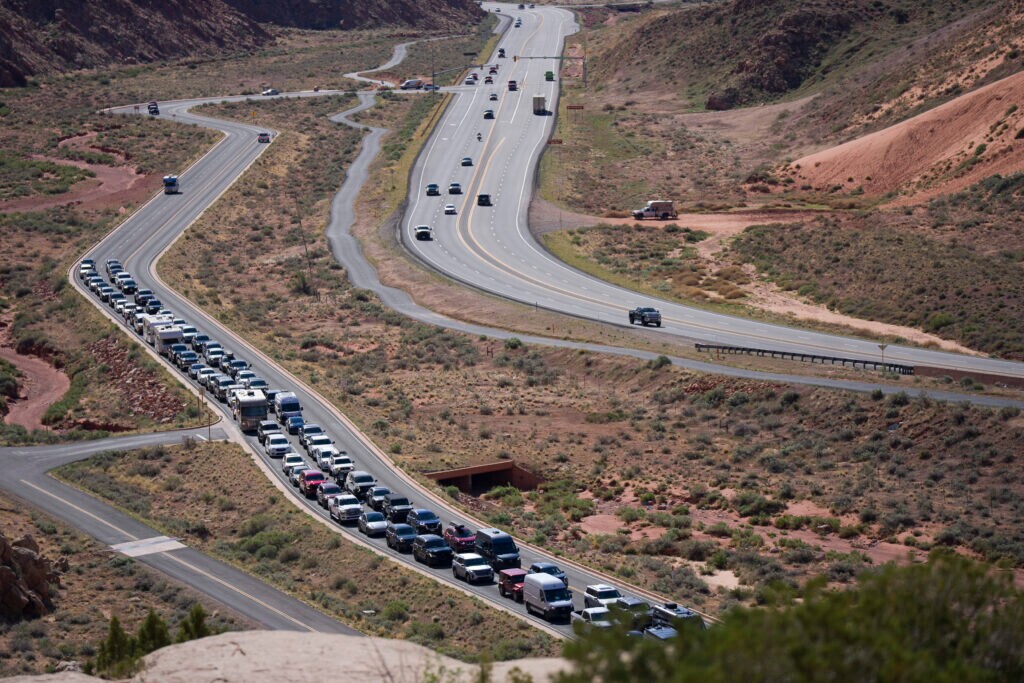
The renewed shuttle discussions followed the National Park Service’s decision to end timed-entry reservations at Arches for 2026 after four years of seasonal pilot programs. Supporters have framed transportation-based approaches as an alternative to timed-entry reservations.
The proposed pilot would operate during September and October of this year, then resume from March through June 2027, according to Grand County Commissioner Brian Martinez, who has led much of the county’s recent shuttle effort.
Martinez said the pilot would collect ridership and traffic data while testing whether a larger long-term shuttle system could reduce congestion at Arches.
“The National Park cannot solve for both economic and congestion challenges on the road,” Martinez said during the meeting. “As a gateway community, we have to pull up a seat to the table and actively manage our future.”
Pilot remains in early stages
Supporters of the proposal argue the current concept is more feasible than earlier shuttle concepts studied for Arches because it would start smaller, use less infrastructure and operate more flexibly.
The current concept, based partly on a preliminary shuttle feasibility analysis developed with assistance from Via Transportation, would use 12- to 15-passenger vehicles operating on a “hub-and-spoke” system between Moab and destinations including Panorama Point, Delicate Arch, the Windows area and Devils Garden.
However, many operational details remain unresolved, including route design, operations and logistics.
Via has not been selected as an operator, and any future shuttle contract would go through a competitive bidding process, according to Martinez.
Martinez said earlier shuttle concepts relied on larger buses and more extensive infrastructure inside the park.
“This is much more bare bones,” he said. “… If we start with something smaller and then we scale it, we’re going to have a much better chance of success.”
(Bethany Baker | The Salt Lake Tribune) Tourists visit Balanced Rock inside Arches National Park near Moab on Thursday, April 9, 2026.
NPS told The Times-Independent the proposed pilot still requires compliance, legal and Regional and Washington office review, along with final federal funding approvals, before operations could begin.
“This is a smaller pilot proposal than was previously assessed, so it could be more financially feasible to operate,” the agency’s Intermountain Region said in written responses before the meeting.
The agency said a one-year pilot could help officials better understand ridership demand, traffic reduction on entrance roads and in parking areas and visitor experience impacts inside the park.
“The NPS is committed to matching funds with Grand County and the State of Utah toward a one-year shuttle pilot,” the agency said ahead of the meeting. “We are exploring available fund sources, including Centennial Challenge, to support this initiative once county funding is approved.”
During Tuesday’s meeting, Southeast Utah Group Superintendent Lena Pace cautioned that the proposed federal funding has not yet been finalized.
“The [acting] National Park Service director has prioritized this project and is committing to participating and putting in the $1.5 million but that has not been confirmed,” Pace said. “… We do not have 100% certainty in that funding.”
NPS also said the county and agency have developed a draft Cooperative Management Agreement outlining shared responsibility for the pilot system, including funding and operations.
Agenda materials also said county and federal partners are exploring additional long-term funding sources beyond the pilot phase, including congressional appropriations, with the goal of potentially establishing a permanent shuttle system.
“There’s going to be a lot of obstacles as we get this put together,” Martinez told The Times-Independent. “This is not going to be an easy project.”
Funding questions become central
The proposed county contribution would come from transient room tax mitigation funds, which are restricted under state law and often used to offset county tourism-related costs, including allocations for the Grand County Sheriff’s Office and Canyonlands Solid Waste Authority.
Martinez argued recent tourism tax trends suggest the county could absorb the $500,000 contribution without reducing currently budgeted services. He added he expected the allocation would likely be incorporated into a midyear budget amendment next month.
During an interview with The Times-Independent, Martinez pointed to recent TRT and overall sales tax trends included in an April revenue update from Clerk-Auditor Gabriel Woytek and said collections had recently rebounded after much of the previous year trended below projections. Martinez argued the newer revenue trends suggested the county could absorb the additional shuttle allocation.
“We’re trending 23% above that line right now,” Martinez said. “… You can see a pretty stark difference between where we were before as far as our economy, and where we’re kind of moving now in these last six months.”
(Andrew Christiansen | The Times-Independent) Grand County Commissioner Brian Martinez speaks during a May 20 Grand County Commission meeting in support of a proposed Arches National Park shuttle pilot that he has helped advance.
But in responses to The Times-Independent, Woytek cautioned against relying too heavily on recent revenue trends and argued that using TRT mitigation funds for the shuttle would shift more county costs onto local taxpayers.
“By creating a new allocation of those funds that is not directed towards offsetting general fund expenses, the county commission has made a very clear statement that locals are to pay $500,000 for the pilot shuttle system,” Woytek wrote.
Woytek said TRT revenue could potentially come in high enough to support the additional $500,000 allocation while maintaining current budgeted appropriations. He said updating the county’s projections with finalized 2025 numbers would bring projected TRT collections close to the level needed to do that, though he emphasized the figures remain projections, said it was “too early to celebrate” and cautioned that the county’s broader 2026 budget picture remains uncertain.
Woytek also argued that even if TRT revenues continue improving, additional mitigation revenue could instead be used to reduce pressure on local taxpayers and other county tourism-related costs.
He noted the county reduced TRT mitigation allocations to the Canyonlands Solid Waste Authority and the Moab Museum by a combined $104,025 during the 2026 budget process and said assumptions about additional TRT revenue helping cover the shuttle allocation did not account for restoring those earlier reductions.
Opposition centered on cost, transparency and process
The proposal triggered nearly an hour of debate and 17 public comments focused largely on transparency, county spending priorities and whether residents had enough opportunity to review the shuttle plans before the vote.
Several commissioners and residents said they supported the concept but questioned whether the county should commit $500,000 before additional planning and public discussion occur.
Hedin said the county has increasingly relied on subcommittees rather than public workshops for major discussions, making it harder for residents to follow projects as they develop.
“People are feeling uncomfortable because we’re not doing it in the open,” she said.
Hadler and McGann focused heavily on the county’s broader financial picture, pointing to the commission’s difficult 2026 budget process, which included a hiring freeze, no cost-of-living raises for employees, reduced funding requests from departments and cuts to mitigation allocations for the Canyonlands Solid Waste Authority and the Moab Museum.
“We told a lot of people no … and then you turn around and you want to spend a half a million dollars on something that we don’t even know it’s going to do what it’s claiming to do,” McGann said. “It’s so fiscally irresponsible that I am shocked.”
(Bethany Baker | The Salt Lake Tribune) A parking lot is full at the WIndows Section inside Arches National Park near Moab on Thursday, April 9, 2026.
The debate also reflected broader disagreements over the recently ended timed-entry reservation system at Arches. Martinez and other supporters referenced a recent Grand County-commissioned study from the Kem C. Gardner Policy Institute estimating timed entry likely reduced Arches visitation, while opponents argued the reservation system successfully managed congestion without harming the local economy.
Many public comments echoed similar concerns about financial risk, transparency and the speed of the process.
Former Moab City Councilor Luke Wojciechowski said residents had not been given enough opportunity to fully understand and weigh in on the proposal before major momentum had already formed around it.
“Transparency means giving the public enough information early enough to participate meaningfully,” Wojciechowski said.
Former Moab Mayor Emily Niehaus urged commissioners to delay the proposal and argued timed entry remained a much less expensive congestion-management tool.
“I’m not asking you to vote no,” she said. “I’m asking you to table this item tonight, because there’s a lot of discussion still to be had about this spending of $500,000.”
Former Arches Chief Ranger Jim Webster, who spent decades working at Arches National Park, urged commissioners to slow the process and involve the public more directly before moving forward.
“People are scrambling to understand what this project is all about,” Webster said. “I think my advice again is to slow this thing down, engage the community more and be more transparent.”
Supporters said the county should move quickly while state and federal support exists.
Commission Vice Chair Bill Winfield and Chair Melodie McCandless said multiple local, state and federal agencies have spent months discussing the proposal and described the pilot as the result of years of conversations about congestion and transportation challenges at Arches.
Martinez argued Grand County needs to help shape transportation solutions at Arches rather than wait for congestion problems to worsen.
“It’s taken us over a decade to get to this point, and a shuttle to Arches National Park will benefit the people of Grand County for decades to come,” Martinez said. “I’m very proud of the collaboration from all the agencies that have helped step up, and I’m proud of everyone who has invested time and money to make this happen.”
This story was first published by The Times-Independent.