 Jessica Schreifels
He had been behind bars for 23 days when he got his first chance to ask for bail last summer.
Charged with 41 felonies tied to allegations that he possessed child sex abuse materials, the 44-year-old Utah County man had submitted letters to the court from those who knew him, and who assured a Utah County judge that he would be no risk to the community if he were released, despite the serious charges he was facing.
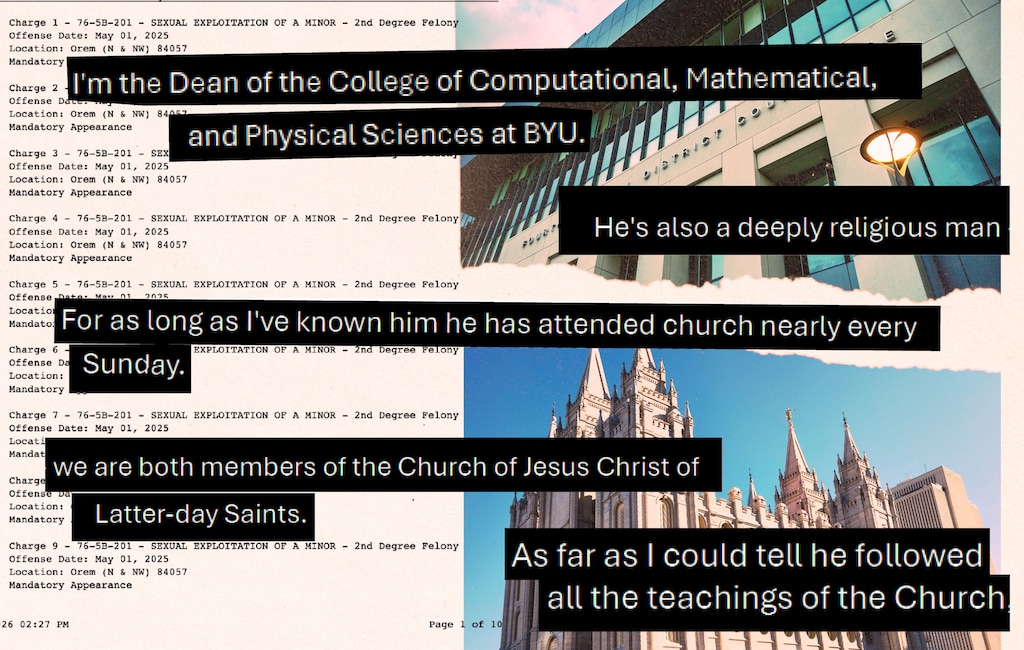
One was written by a Brigham Young University dean.
Grant Jensen began his letter by introducing himself as the dean of the College of Computational, Mathematical and Physical Sciences at BYU, the university owned by The Church of Jesus Christ of Latter-day Saints. He wrote about how he had known the defendant for 16 years, beginning when the man’s wife worked as his administrative assistant.
For as long as Jensen had known him, he wrote, the man had gone to church every Sunday — and followed all the teachings of the LDS Church, “avoiding all alcohol, tobacco, coffee, tea, smoking, drugs, etc.”
“I have no reason to believe he was not completely faithful to his wife,” Jensen wrote. “I believe he contributed generously (a full tithe). He accepted many assignments and served well. In our interactions he was always honest, kind, and trustworthy.”
What unfolded in that Utah County case reflects a broader practice in which Latter-day Saint bishops and other people connected to the church have vouched for defendants accused of serious crimes — even as the church itself has discouraged such interventions as potentially harmful.
And behind the scenes, a Salt Lake Tribune inquiry revealed, some Utah County prosecutors have taken an unusual step when letters like these appear: They contact Kirton McConkie, the outside law firm which represents the LDS Church, whose lawyers then instruct the bishop to withdraw the submission, the office confirmed.
That practice raises its own ethical concerns. One legal expert told The Tribune it is “wholly inappropriate” for prosecutors to try to limit this type of material from a judge making a weighty decision about whether to grant bail or how long someone should spend in prison.
While these types of letters are meant to attest to a person’s character, experts say this support can cause victims — or other church members — to feel betrayed when they see a leader supporting an alleged perpetrator rather than encouraging accountability.
That’s why the LDS Church instructs its local leaders to not become involved voluntarily in court cases involving members of their ward or stake, it said in a statement to The Tribune. It confirmed that when it learns that a leader has not followed church policy and submitted a support letter, “the Church contacts the leader and ensures he is aware of the policy and its purpose.”
“Sharing information in legal proceedings can be misinterpreted and may cause harm,” the church’s statement reads, “particularly to victims and their families.”
Courtroom arguments
At a bail hearing last August, defense attorney John Easton highlighted the BYU’s dean’s letter several times when he argued to 4th District Court Judge Kasey Wright — himself a BYU alum — that his client should have the chance to bail out of jail.
The Tribune generally does not report on individual cases of possession of child sexual abuse material, and because of this, is not naming the defendant at this time.
“I look at some of these letters — particularly a dean of a significant program at BYU college — that’s here willing to support him,” Easton said, according to a recording of the hearing. “Scoutmasters that have watched him interact with children. Very appropriate. There’s been no allegation of any personal physical touching that’s inappropriate in any way.”
(Brigham Young University) Grant Jensen, the dean for College of Physical and Mathematical Sciences at BYU.
But the allegations against the man are serious, Deputy Utah County Attorney Adam Pomeroy countered during the hearing. He is accused of not only possessing child sex abuse materials, Pomeroy said, but police also allege he had graphic chats online about his preferences in videos of young children and shared illegal materials he had obtained with others.
Orem officers began investigating the man in March 2025 after the messaging app MediaLab/KIK sent a tip to a federal hotline about sexually explicit content on an account that police say belonged to the man. One investigator wrote in charging records that detectives reviewed the child sex abuse videos linked to that account, and at some points turned off the audio because it was “so egregious and unbearable to listen to.”
Speaking about the letters that the defendant gave the judge, Pomeroy — also a BYU law school alum — said he noted that none of them acknowledged these serious allegations: “And you’re talking about deeply religious people, people involved in our community, people involved with youth. And there’s no actual indication that they truly understand what the defendant is charged with here.”
Pomeroy told The Tribune in a statement that he didn’t alert Kirton McConkie to Jensen’s letter because the dean wasn’t the defendant’s church leader. The case, he conceded, was “unique in that a BYU dean, name dropping the school, wrote in on the defendant’s behalf.”
BYU declined to comment for this story. Jensen did not respond to emails requesting comment.
‘Wholly inappropriate for prosecutors’
While Pomeroy didn’t tell church lawyers about this letter, some prosecutors in his office contact Kirton McConkie when bishops write letters, and generally they are then withdrawn.
A statement from the Utah County Attorney’s Office said this was a practice that began about 15 years ago, after lawyers at Kirton McConkie asked the office to notify them when a bishop filed a letter on a defendant’s behalf. However, there was never an “official policy” implemented — though the office acknowledged in its statement that some prosecutors have continued to comply with the request since then, particularly if the bishop’s document was sent on church letterhead.
The statement said Utah County Attorney Jeff Gray wasn’t aware of Kirton McConkie’s request until a Tribune reporter asked about it, and he didn’t know prosecutors in his office were still alerting the church’s law firm to letters written by church leaders in support of defendants.
Bruce Green, who teaches legal ethics at Fordham University’s law school, said that those who know a defendant and have truthful information should be encouraged to bring that information to a judge — including church leaders.
“It is wholly inappropriate,” he said, “for prosecutors, who are supposed to serve the public interest, to induce church leaders to withdraw letters sent to the sentencing judge if those letters are truthful, as presumably the church leaders’ letters are.”
Gray agreed that this specifically “raises concerns about a defendant’s ability to present information to the sentencing court,” according to his office’s statement.
“Now that he is aware of the issue,” the statement reads, “Mr. Gray is considering how to best address it.”
(Francisco Kjolseth | The Salt Lake Tribune) Utah County Attorney Jeff Gray speaks at a news conference last September.
Neither the Salt Lake County district attorney’s office nor Davis County prosecutors have a policy to contact church lawyers when a bishop or church leader sends a letter to a judge.
“We address any submitted letter in support of a defendant on the merits asserted,” Salt Lake County District Attorney Sim Gill said. “In other words, we treat everyone the same.”
Both Gill and Davis County Attorney Troy Rawlings said prosecutors in their offices used to see letters from bishops filed in support of criminal defendants more frequently than they do now.
But it does still happen: In another Utah County case where a father was sentenced last December for sexually abusing his young daughters, his one-time bishop wrote to the sentencing judge that the defendant was active in their church and served in “whatever capacity he was asked to participate in.”
The former bishop didn’t ask for leniency, but told the judge that he’d be praying for the judge’s “discernment” for the right sentence. “I believe he is a good man at his core,” he wrote about the father.
And in a Utah County case from 2019, a bishop himself faced sentencing after he was caught in an undercover police prostitution sting. His ward’s executive secretary — a priesthood holder who managed his calendar and sat outside his office while the bishop interviewed ward members — wrote a support letter, adding that he assumed the judge was also a Latter-day Saint, given that he went to BYU law school.
In the letter, the man shared stories about times when the bishop gave a sick woman a blessing, and how he was generous in paying for dinners or smoking brisket for their neighborhood.
‘Chilling for the whole community’
Experts say support letters like this from bishops and those affiliated with the church can cause feelings of betrayal for not only the victim, but the wider church community.
Jennifer J. Freyd is a professor emeritus of psychology at the University of Oregon who first introduced the concept of “institutional betrayal” in the 1990s. She said these letters supporting an accused defendant or perpetrator can feel like a “second concussion,” another wound on top of the harm from being victimized.
“It’s going to be chilling for the whole community,” she said. “If I learn that somebody who’s got institutional power in an institution I’m a part of is doing something harmful to someone else, I can still be betrayed.”
Nicole Bedera, a sociologist and researcher of sexual violence, said that the criminal justice system also engages in a type of “institutional betrayal” when it allows for admissibility of character evidence like support letters in cases involving sexual violence.
These types of letters, she said, are often written by people who don’t know if the person actually did what they are accused of. She questioned whether this information is appropriate for a judge to consider.
“There is no way that a church leader can know that someone wasn’t violent, that someone wasn’t breaking the law, that they would never do that again,” she said. “It’s outside of relevant information for the case.”
Bedera emphasized that victims who are depicted in child sexual abuse materials are often deeply harmed by this crime, particularly because they don’t know who has downloaded or looked at these images.
“Are they people who they know in real life? Are they all strangers?” she asked. “And so there’s this sense that the perpetrator could be anyone, and all of us.”
In the child sexual abuse materials case where the BYU dean wrote a support letter, the judge ultimately allowed the defendant to post bail. But he said he didn’t consider Jensen’s letter or others like it when making that decision.
Instead, he said, the law required him to weigh whether the man posed a danger to the community or was likely to flee.
In the end, the judge said, the letters — no matter who wrote them — were not part of the decision he had to make.
Tribune reporter Tamarra Kemsley contributed to this report.