 Jessica Schreifels
 Trent Nelson
Colorado City, Arizona • Just outside Short Creek, a group of women who were once wives of a self-proclaimed prophet recently revisited a desert camp where he had brought them years earlier.
They wore swimsuits — in defiance of the purity culture of the Fundamentalist Church of Jesus Christ of Latter-Day Saints they were raised in. Together, they laughed and sang what Nomz Bistline called “rage songs” against the prophet, Samuel Bateman.
Bateman had declared the spot a holy place. But the hideout had also been a punishment, Bistline said, where disobedient wives like her were sent away to sleep inside a storage trailer, near a plastic bucket latrine, for days or weeks at a time.
Their return came after Bateman was sent to prison for decades for sexually abusing younger girls he had called his wives.
And this time, they weren’t under his control.
“We went out there and desecrated it,” Bistline said in an interview with The Salt Lake Tribune. “It was very empowering, honestly.”
It’s among the moments where Bistline, now 27, felt she was breaking away from the man who led an offshoot FLDS sect — a false prophet who she said bullied her into marrying him. She was one of at least 20 “wives” that Bateman had demanded strict obedience from and had controlled, including 10 underage girls who he later admitted in court records he married so he could have sexual contact with them. The youngest was 9.
Bistline left him and his religion behind only after she had an awakening in a prison cell. She spent nearly two years behind bars after she and other wives kidnapped Bateman’s underage “wives,” who had been moved into foster care after authorities raided Bateman’s homes and he was arrested in 2022.
She tells her story in the new Netflix docuseries, “Trust Me: The False Prophet,” which has brought worldwide attention to Bateman’s sect, the abuse inside his group — and the women who ultimately helped expose it.
Bateman, now 50, rose to power among several polygamous FLDS families in 2019 after claiming that he was a new prophet. The man and his followers lived in two homes in the state border towns of Hildale, Utah, and Colorado City, Arizona, a historically tight-knit region known as Short Creek.
He will likely die in prison after he was sentenced in December 2024 to spend 50 years in prison for federal crimes related to sexually abusing underage girls. Now outside of his control, Bistline is confronting the lasting impact of his abuse — and what it means to build a life beyond the cloistered religion she was born into.
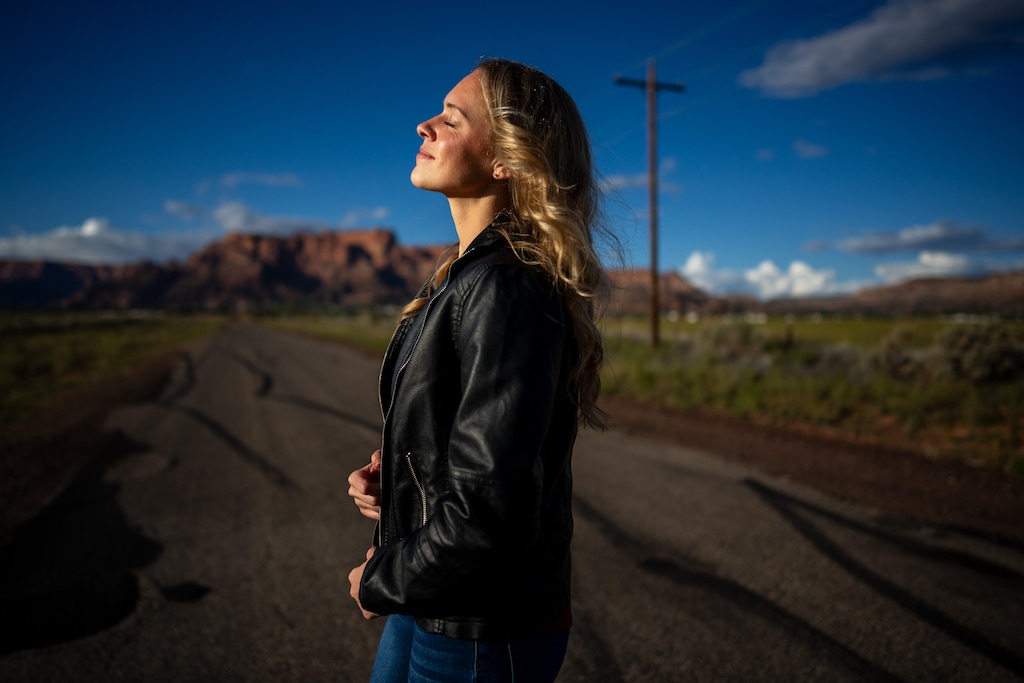
(Trent Nelson | The Salt Lake Tribune) Nomz Bistline in Colorado City, Ariz., on Tuesday, April 14, 2026.
She’s traded the traditional FLDS prairie-style dress for a more modern look — skinny jeans, sneakers and a leather jacket. Her light hair, once swept over her forehead and braided down her back, now falls free past her shoulders.
Bistline said she was bracing herself for “a lot of hate” with the Netflix series coming out. But she has received an unexpected wave of support and positive messages, she said, from people around the world who felt inspired by her journey to change herself.
‘I will obey’
Bistline was 20 when she was first introduced to Bateman in 2019. She wasn’t impressed by him — but she was told by him and others she “belonged” to him. The idea shocked her, she said, and she resisted the expectation that she would become one of his spiritual wives.
But Bateman kept pressuring her, Bistline recalled.
He texted and called her, she said, urging her to marry him. Bistline said she was also getting pushed by her caretaker — a male relative who acted as her guardian after her family was split up, when her father was banished from the FLDS community years prior. Her caretaker had also started to follow Bateman.
After more than a year of Bateman’s relentless pursuit — which included threats against her family, Bistline said — she gave in, and agreed to get married.
She was initially told she would be Bateman’s third wife.
She ended up being his 13th.
“He just broke every one of us down,” Bistline said, “and then started building us into what he wanted us to be.”
From the outside, Bistline looked like a dutiful, even devoted wife. Footage from the Netflix docuseries shows her sitting at Bateman’s feet, their hands intertwined as she looks up at him adoringly. In one episode, she reads a description of marrying Bateman and feeling God’s presence: “I do this cheerfully,” she said, “and there is zero resistance because I will obey.”
(Netflix) Bistline in the Netflix documentary series "Trust Me: The False Prophet."
But Bistline said she was feeling something else entirely inside.
“I remember writing in my personal journals about, if this is the fate God has for me, then I’m going to have to learn to love him and learn to accept him,” she said. “And this is my fate for eternity, and there was no choice but to just give in.”
Following a new religious leader
Bateman was able to seize leadership over this small group of FLDS families in the void left after Warren Jeffs, the longtime FLDS leader, was imprisoned after being convicted of sexually abusing his child brides at a Texas enclave.
(Trent Nelson | The Salt Lake Tribune) Samuel Bateman leaves the courthouse during a Utah trial for Warren Jeffs in 2007.
It was no secret in Short Creek that Bateman had said he had married young girls, and several residents started reporting him to authorities. That included Christine Marie and Tolga Katas, a couple who lived in town and started filming Bateman and his followers, hoping they would reveal details about abuse. That footage, and their stories of how they infiltrated the sect to expose Bateman, is central to the Netflix docuseries.
The couple gave their video trove to the FBI, and after authorities gathered other evidence from a disillusioned follower, they raided Bateman’s homes in September 2022. The man was arrested, and the underage girls who Bateman called his wives were taken by Arizona child welfare workers to foster homes.
Bistline described the raid as “very chaotic” and “very traumatic,” and said it came after a few tense weeks when Bateman, concerned about police, had forcefully urged her and other wives to “lie like hell” if authorities ever came.
(Trent Nelson | The Salt Lake Tribune) Nomz Bistline, pictured immediately following the arrest of Samuel Bateman, in Colorado City, Ariz., on Tuesday, Sept. 13, 2022.
Weeks later, from behind bars, Bateman gave a higher stakes instruction: He told his wives to go get the girls who were in foster homes. Child welfare workers had warned the group on the day of the raid that this was kidnapping — and a felony.
Bistline said she remembered thinking, “What’s going to happen to us?”
“I asked him that,” she said. “And he was like, ‘They did the worst thing already. They took me.’”
She was one of three adult wives who helped take the girls away from the group homes, with the help of Bateman communicating with them from an Arizona jail cell. Authorities found the girls less than a week later outside an Airbnb in Washington, and Bistline and the other adult women were arrested.
(Jake Bacon | AP) Bistline arrives at the federal courthouse in Flagstaff, Ariz., on Wednesday, Dec. 7, 2022.
Bistline — who, in court records, is identified by her full first name, Naomi —spent nearly two years behind bars, eventually pleading guilty to a felony. When arguing for leniency from a federal judge, her attorney wrote in court papers that she grew up living in fear that she would be “eternally condemned” if she did not follow what a religious leader told her to do.
“Naomi feels much shame for not being strong enough to stop the manipulation and abuse,” her attorney wrote.
Questioning her faith in jail
Being in jail took Bistline out of her sheltered, religious community for the first time — and out of a regimented life where even the pioneer-era style and color of her dresses were dictated by her faith leader.
She started reading self-help books, she said, and talking to other inmates. She began “figuring out there’s a whole big wide world out there that I knew nothing about.”
Bistline also started asking herself questions about Bateman, which led to bigger questions about her FLDS beliefs.
“It was very confusing. It wasn’t until I allowed myself to question even Warren Jeffs that the walls just crumbled,” Bistline said. “And question after question after question just started flooding in.”
“It was a very dark time for me,” she added.
Being skeptical of her faith and culture made her feel angry, and shameful. She mourned the loss of it, she said, and felt suicidal at times.
But, though she was incarcerated, there were bright spots: She started writing and drawing, and she said she became the lead singer in a band within the jail after she auditioned with the Miley Cyrus song, “Flowers,” a pop anthem about finding confidence without relying on someone else.
Despite being locked up, she said, she had never felt more free.
Finding her place in the ‘outside’ world
After Bistline took a plea deal, a judge sentenced her to time served in December 2024, and she was released the following February. She went back to Short Creek — but had left behind Bateman and the FLDS church.
“It was really scary for me,” she said. “I didn’t have enough knowledge of the outside world. … I went through the cult stuff, I went through the prison, and I learned and became content with it, and now here I am going out to the whole world.”
(Trent Nelson | The Salt Lake Tribune) Nomz Bistline in Colorado City, Ariz., on Tuesday, April 14, 2026.
For the first six months, Bistline said she struggled being somewhere so familiar, where certain places and memories could trigger panic attacks. She kept writing poems and songs, penning “rage anthems” that helped her make sense of what happened to her.
While she distanced herself from many who live in Short Creek, Bistline said she has found support in two other wives who have denounced Bateman. They talk openly now — something they weren’t able to do when they were in his group. They find dark humor in their shared experiences, she said, and call Bateman “every derogatory word you can think of.”
Bistline said she hopes to have a career in music or entertainment. She’s been studying psychology, trying to better understand what happened to her, and hopes to one day advocate for others. She’s modeling and recording music, traveled to New York to promote the docuseries, and spends time in the red rock desert where she lives hiking and riding a dirt bike.
“Everything is so phenomenal and amazing to me,” she said. “And I’m getting to where I love life.”
She wants to keep going — beyond Short Creek, the insular community where her life was once tightly controlled.
And when she leaves, she said, she won’t come back.