 Megan Banta
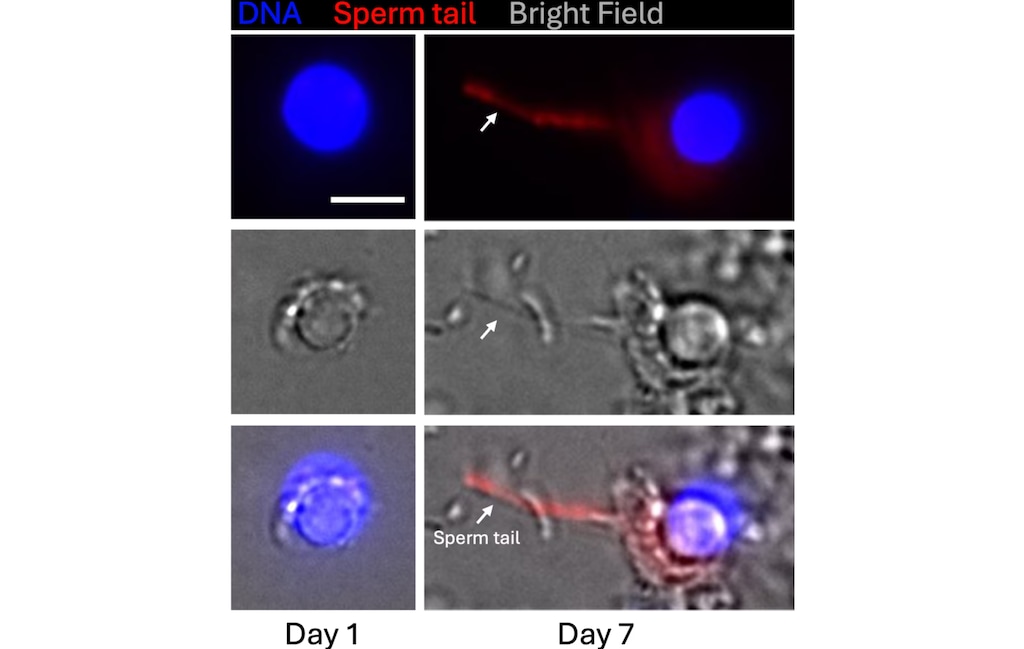
A Salt Lake City biotech company says it has used testicular tissue to grow human sperm in a lab, and successfully deployed it to fertilize eggs.
The research from Paterna Biosciences could address a “massive gap in male fertility treatment,” said Dr. Alexander Pastuszak, the company’s CEO and one of its three co-founders.
Sperm is a “huge part of the fertility equation,” said Pastuszak, a University of Utah Health urologist specializing in men’s reproductive and sexual health. He said that 25% of in vitro fertilization fails because of problems with sperm quality.
He noted the importance of shifting “the perspective on how important the male contribution is.” Otherwise, he said, “couples are still going to be pushed into IVF without the male being evaluated.”
But it will be years before the treatment is available for male partners, Pastuszak said, and it will only be outside the U.S. at first. Paterna plans to partner with IVF clinics and estimates the treatment would cost $5,000 to $12,000, according to a statement from a public relations firm representing the company.
Dr. Alex Pastuszak, a University of Utah Health urologist.
Scientists have tried for decades to produce human sperm outside the body. A French biotech company, Kallistem, said it achieved that feat in 2015, but outside research questioned whether the cells were fully developed. The company didn’t prove that the sperm could fertilize eggs.
Paterna first worked to understand what’s normal for sperm before trying to fix the abnormality of infertility, Pastuszak said.
That work began before the company launched and took years using funding from the National Institutes of Health and other sources to discover “the molecular programming and identity of all the cell types that are in the testicle and that contribute to spermatogenesis,” Pastuszak said.
Pastuszak is an associate professor of surgery at the University of Utah School of Medicine, and others with Paterna have connections to the university or related medical centers.
But there’s no tech transfer agreement, Pastuszak said, so the intellectual property they’ve developed through their research since forming Paterna is wholly their own.
The team of fewer than 20 used private funding – $3.5 million from angel investor funding anchored by IVI RMA Global, a global IVF clinic system, and $6.8 million in seed funding led by SpringTide Ventures that included money from the Utah Innovation Fund – for its work after forming Paterna about three years ago.
It did build on Paterna’s initial research and the understanding they developed of molecular programming when isolating sperm-making cells from testicular tissue to develop mature sperm cells, something Pastuszak said gave it an advantage over predecessors.
Kallistem essentially took the microenvironment that already exists in the testes and put it in a test tube, Pastuszak said, but that doesn’t leave scientists with much control as they try to coax the cells to develop.
Yet the “ability to very strictly control the micro environment” is critical, Pastuszak said, and Paterna worked to ensure that the stem cells could develop into fully fledged sperm.
Paterna’s advances were first reported by Wired magazine earlier this week.
It’s tough to judge their findings, said Jon Oatley, a reproductive biologist who heads veterinary research and teaches at Washington State University.
“The idea of making sperm in a dish is not new. It’s been done with multiple species,” said Oatley, who has spent 25 years studying how sperm are made. “The challenge has always been, are these really sperm – and can they create a viable embryo?”
The discovery might sound promising, he said, but peer review will be the real test.
Oatley added that there needs to be a lot of safety testing to determine whether the lab-grown sperm are normal. There have been other experiments with animals where sperm appear normal, he said, but the number of chromosomes is abnormal.
There’s still a lot of work to do before a treatment becomes available to the public, Pastuszak said. The team is working on adjustments, he said, before moving on to preclinical research and human clinical trials.
If everything goes well, he said, 2029 would be the first opportunity to market the treatment internationally – but not in the U.S. They’re still working with the federal Food and Drug Administration to figure out a path forward for that.
Said Pastuszak: “It feels good to be at a point where we are confident enough that the innovation that we’ve developed can keep proceeding, and as a result, really stands a fair chance now at impacting millions and hundreds of millions of men and couples.”
It’s also a big moment for Utah, he said, where innovation is putting the state “on the map in a ridiculously awesome way when it comes to biotech and deep technology that will impact healthcare.”