 Andrew Christiansen
Grand County commissioners have begun exploring a potential shuttle system for Arches National Park, voting April 7 to form a working group to sort through unresolved issues around funding, feasibility and federal involvement.
The concept, outlined in a preliminary proposal, frames the shuttle as a way to reduce congestion, improve safety on Highway 191 and in downtown Moab and protect park resources. But key details about how such a system would be funded, approved and operated — and what role the National Park Service would play — remain unclear.
The commission approved the move in a 4-3 vote, with commissioners Trish Hedin, Jacques Hadler and Mary McGann opposed.
The working group will include Commission Chair Melodie McCandless, Vice Chair Bill Winfield and Commissioner Brian Martinez, and is expected to involve Moab City Mayor Joette Langianese, NPS and other state and federal partners “to collaboratively develop a practical, affordable, and environmentally sustainable shuttle solution to address vehicle congestion at Arches National Park”, Martinez told The Times-Independent.
The action does not approve a shuttle system or secure funding, and decisions about transportation inside the park would ultimately rest with NPS.
Proposal outlines possible 2026 pilot
Martinez told The Times-Independent the vote creates a group to build on an existing feasibility analysis and outline next steps.
The meeting packet includes a shuttle concept developed with Via Transportation, the company that operates Moab Area Transit. The proposal outlines a “hub-and-spoke” system linking downtown Moab to destinations inside Arches, including Panorama Point, Delicate Arch, the Windows and Devils Garden, with 12- to 15-passenger shuttles running every 15 to 30 minutes.
The feasibility summary says a first-season pilot could launch as early as May 18 at a not-to-exceed cost of $3 million.
During the meeting, Hadler asked whether any funding had been secured.
“No, not yet. That’s what we’re working on,” Martinez responded.
The proposal states the pilot would aim to reduce backups at the park entrance onto Highway 191, improve Main Street pedestrian safety and generate data on ridership, congestion and safety. It also says the concept “does not replace or pre-empt” the park’s long-term planning process.
(Times-Independent file photo) Dozens of visitors gather near Delicate Arch in Arches National Park.
Martinez told The Times-Independent the working group will take the Via proposal and “develop a concrete list of action items to move the shuttle forward.”
“Next steps for the working group include addressing concerns, questions, and potential constraints, and establishing a realistic timeline, including the possibility of a 2026 pilot program,” he said.
Federal role and key questions remain unclear
The agenda summary states the effort stems from a March 13 meeting between county officials and Arches staff, where Park Superintendent Lena Pace proposed that Grand County prepare a shuttle proposal to present to NPS.
Karen Henker, spokesperson for the Southeast Utah Group of national parks and monuments, said the agency is aware of the county’s interest.
“We look forward to participating in discussions with local partners as these concepts are further developed,” Henker wrote. “Any transportation proposal involving the park would require evaluation to ensure impacts to park resources, visitor experience, and operations are fully considered.”
Henker did not address questions about whether the park requested a proposal, how it views the feasibility or timeline, whether funding is likely or what specific approvals would be required.
Martinez also did not provide additional detail on potential funding sources, whether a May pilot launch is realistic or what role the park has played so far.
In the meeting, Martinez said the concept builds on ideas that have been discussed publicly for years.
“These are not new ideas,” he said. “These ideas have been brought up for the last decade.”
NPS has previously studied transit options at Arches, including a 2011 congestion management study that found the park’s size and infrastructure needs could limit a shuttle’s effectiveness and make it costly to operate.
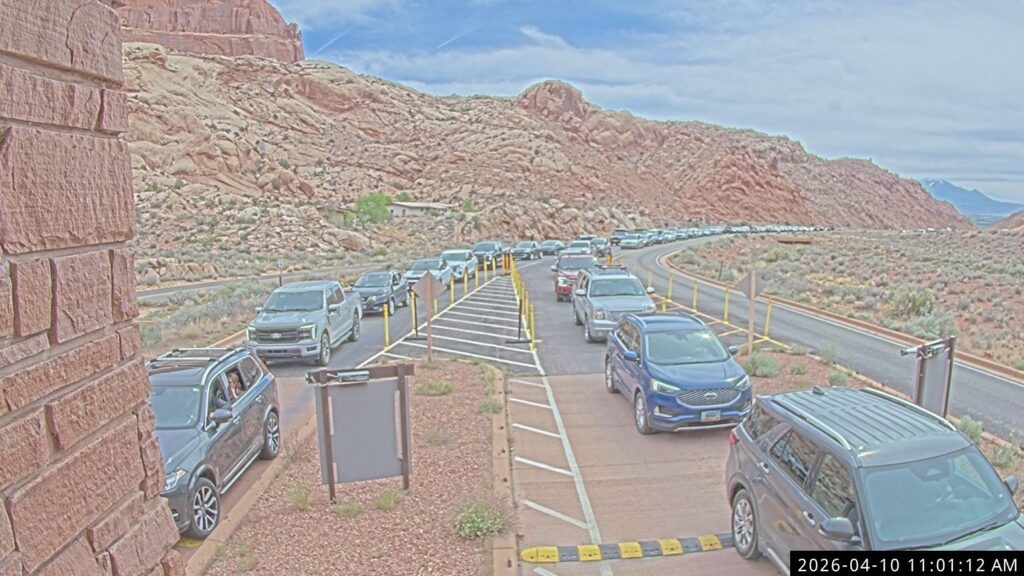
The renewed discussion comes as Arches will not use a timed-entry reservation system in 2026 after four years of seasonal pilot programs designed to manage congestion and protect park resources. The change has drawn mixed reactions locally, with some pointing to potential economic benefits and others raising concerns about congestion, safety and the visitor experience.
NPS has not said whether timed entry could return after 2026 or not.
Henker also said that right now, “visitors are encouraged to plan ahead, check current conditions before arrival, and remain flexible during peak periods to help ensure a safe and enjoyable experience.”
Commissioners divided on approach
The shuttle concept is one element of the county’s broader Access and Capacity Enhancement, or ACE, plan, a multi-pronged proposal that emphasizes infrastructure improvements, adaptive management and expanded access rather than mandatory reservations. The commission voted in November to adopt the ACE plan as its formal proposal for managing future visitation at Arches, and Martinez said during the meeting he authored the plan.
The plan outlines a combination of strategies, including a voluntary shuttle system, expanded trail connectivity, improvements to parking and traffic flow, and the use of real-time data and technology to manage visitation.
(National Park Service) Vehicles overfill a parking area in Arches National Park during in May of 2021 during a period of high visitation to Moab.
The commission’s discussion reflected clear disagreements about the shuttle proposal’s feasibility, cost and the county’s role in shaping access inside Arches.
Hedin said she supports exploring options but questioned whether the county should take a leading role on a project within federally managed land, particularly as NPS faces staffing and budget pressures.
“I think we need to stay in our lane,” Hedin said. “I’m not working for the National Park Service. I’m a Grand County commissioner.”
Hedin’s comments come after the Trump administration recently proposed reducing NPS operations funding by $736 million — more than 25% — in its fiscal year 2027 budget proposal, according to reporting by SFGATE, though those reductions would require approval from Congress.
She also questioned where funding for a pilot would come from and argued the commissioners on the working group did not reflect a range of perspectives.
Hadler raised similar concerns and said a shuttle could be a good option in the future, but called the current concept “a little pie in the sky” and said it would take far more than contracting with a company and identifying a price tag.
Supporters of the proposal argued the county should not dismiss a long-discussed idea before testing whether it could work. McCandless said people needed to come together to make decisions.
Winfield said the county has a responsibility as a gateway community to engage with federal partners and help pursue solutions, not defer entirely to NPS.
“We have a responsibility to our community,” Winfield said, adding that he does not believe the effort is intended to direct how the park is managed but rather to work collaboratively toward addressing congestion.
Winfield also pushed back on concerns about feasibility, arguing the county should explore options rather than dismiss them outright.
“We’re going to work on this right now as a group and see if we can accomplish something,” he said. “If we can’t, then we can’t, but at least we’re going to try.”
Martinez said past discussions with commissioners with different views like Hadler and Hedin have often ended with proposals being deemed infeasible, and described the current effort as an attempt to test whether a shuttle could work in practice.
“This doesn’t replace all of the cars, but what it does do is relieve the congestion in the park and make a better experience for tons of people here,” he said.
(Andrew Christiansen | The Times-Independent) Grand County Commissioner Brian Martinez speaks to Commissioner Trish Hedin about a potential shuttle system at Arches National Park at the commission’s April 7 meeting in what was a lively discussion.
Local leaders, stakeholders supportive but question feasibility
Langianese told The Times-Independent she supports the idea of a shuttle system and said it could benefit the community, but believes significant questions — particularly around funding and logistics — would need to be resolved before it could move forward.
She described the current proposal as premature, noting that key pieces, including how a system would operate inside the park, remain unclear.
“The main one is, where’s the money coming from?” she said.
Sam Wainer, executive director of the Canyonlands Natural History Association, a nonprofit that supports educational programs and visitor services at Arches, said he is not opposed to exploring a shuttle system but views it as one possible part of a broader solution, not something that appears ready to launch quickly
Wainer said the proposal raises major logistical and safety questions, including where riders would board, how stops would function and whether Arches has the infrastructure to support even a small system. He noted there are currently no bus stops, benches, shade or water infrastructure in many areas of the park to support shuttle riders, and said those kinds of improvements would require planning, approvals and funding.
“I think the timeline is too overly optimistic to be able to have a safe plan in place by May,” Wainer said.
Wainer said the park is interested in finding ways to address challenges related to congestion, visitor experience and resource protection, but cautioned that projects inside national parks take time and coordination.
“The park service wants to come to solutions as well, but it also has to move a little bit at the speed of government,” he said, adding that long-term efforts often require “moving at the speed of trust.”
This story was first published by The Times-Independent.