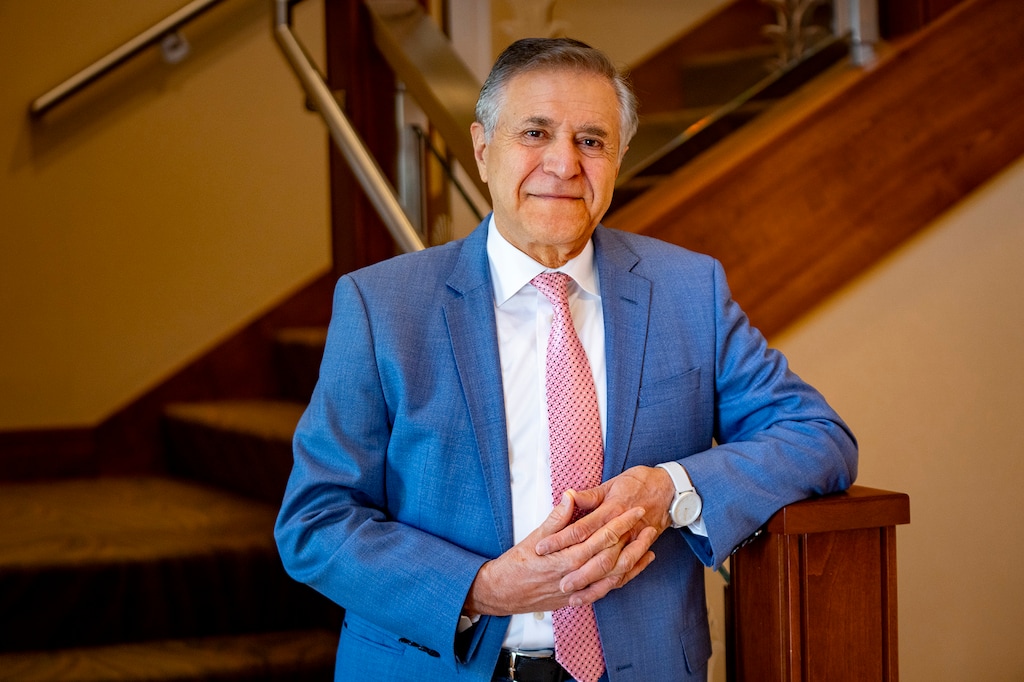
 Jose Davila IV
 Jordan Miller
With a little more than an hour to go before President Donald Trump’s Tuesday night deadline for Iran to open up a vital shipping corridor, Utah businessman Khosrow Semnani, who was born in the Middle East country, was wracked with anxiety.
“I’ve never been worried so badly as I am right now, to be honest with you,” he said.
Semnani, the man who opened Tooele County’s low-level nuclear waste facility, was particularly concerned about Trump’s threats to attack bridges and power plants in Iran, especially the nuclear generation facility in Bushehr.
“These are counterproductive. It pushes people of Iran to go to the regime as their own savior,” Semnani said. “That’s not what [American officials] want.”
Minutes after Semnani hung up the phone, Trump announced the United States and Iran had agreed to a two-week ceasefire. Questions about the deal have swirled since the announcement, especially as to whether Israel’s attacks in Lebanon would be halted and how shipping in the Strait of Hormuz would be handled.
In recent days, Trump’s rhetoric and bombing attacks from all sides — the U.S., Iran, Israel and Hezbollah, an Iranian proxy group based in Lebanon — escalated significantly ahead of Trump’s deadline for Iran to open up the waterway along the country’s southern coast. Trump threatened on Tuesday to wipe out Iran’s “whole civilization.”
The now-paused war, launched on Feb. 28, has killed at least 3,000 people and injured almost 40,000 more.
Utah’s Iranian community has been watching the conflict closely since it began. About 1,600 people in the Beehive State have Iranian ancestry, according to a 2024 population estimate. At least one nonprofit group, Iranians of Utah, caters to the community.
Hope for regime change
Semnani said most Iranian Americans in Utah oppose the clerical regime that came to power in the country after the 1979 revolution. He has spoken with American and European politicians about the Iranian government since 1981.
He still believes that the regime is “illegal, dictatorial and corrupt,” even as he is concerned about how the U.S. is wielding its air power in the conflict.
Arash Bakhshandehpour’s feelings are similarly conflicted and complicated. At the outset of the war, he welcomed the attacks and cheered when Iran’s former Supreme Leader Ali Khamenei was killed in an American airstrike.
“Imagine the desperation that you need to feel,” Bakhshandehpour, a Salt Lake City artificial intelligence consultant born in Holladay, said, “to have to celebrate where either you are living or family is living being bombed.”
But Bakshandehpour is “terrified” that Iranian protesters’ cries for help were answered in the form of Trump. He criticized the president’s behavior and called his statements “reckless.”
“We wanted regime change,” Bakhshandehpour said. “... However, what it takes for that to occur, the amount of civilian casualties and also cultural impact and cultural loss is really concerning.”
He argued that Trump’s threats to Iranian civilization should be targeted at the regime instead.
University of Utah ethnic studies professor Alborz Ghandehari, a son of Iranian immigrants to the U.S., said the war has hindered Iran’s democracy movement and put civilians at risk.
“What we’re seeing is everyday people in Iran, millions of civilians, are suffering,” Ghandehari said, “caught in between the violence that is being meted out by their state and the violence and destruction that is being meted out by this U.S.-Israeli war.”
Last year, Ghandehari published a book on the history of protests for freedom and democracy in Iran, the result of 10 years’ worth of research and conversations with a constellation of Iranian activists. He said American and Israeli bombs, even prior to Trump’s recent threats, have fallen on a girls’ school and health care facilities.
Numerous Iranian activists and political prisoners allied against the regime have called for an end to the war, he said, including 2023 Nobel Peace Prize-winner Narges Mohammadi, a feminist activist who is currently imprisoned.
Ghandehari argued that foreign military intervention merely results in the current government doubling down on its repression of civilians, like through the ongoing internet blackout.
Like many of Utah’s Iranian Americans, Ghandehari has only been able to connect with family and friends in the country through short, 30-second calls and messages that go unread for weeks.
“They say, ‘We’re surviving. We’re here,’” he said. “It’s very painful, because we still continue to worry knowing everything that’s happening.”
War ‘getting really scary’
Chants of “no war on Iran” and “stop the war” echoed throughout the steps of the Utah Capitol on Tuesday afternoon as about 50 people gathered to protest Trump’s actions in the country.
(Francisco Kjolseth | The Salt Lake Tribune) People gather on the steps of the Utah Capitol to protest President Donald Trump and the U.S. war with Iran, Tuesday, April 7, 2026.
Many carried signs pushing for the president’s removal through the 25th Amendment of the Constitution, which outlines how a sitting president can be removed from office by his cabinet. Others carried signs naming Utah’s congressional delegation, and one person carried a cardboard poster which stated simply, “stop killing people.”
Christine and Clair Tolman said they attended Tuesday’s rally because they felt they needed to do something, since things are “getting really scary,” Clair said.
“I have hope for humanity and the American people,” Christine said. “I don’t have any hope unless we get rid of the whole kit and caboodle — Trump and his cabinet and all the people who went along with it.”
“They’ve destroyed America from the inside out,” she continued. “Give us a chance to rebuild back to what we want it to be. I just hope it’s not too far gone.”
Sara Stringer, meanwhile, held up a hand-written sign with the message “Dementia Don needs to go,” scrawled in black ink as she stood on the Capitol steps. She said she attended Tuesday’s rally to because she doesn’t believe the United States “should be threatening genocide” against the Iranian people.
“I am really uncertain about the future and I think that’s terrifying for all of us,” Stringer said. “To think that we’re going backwards, with threatening other countries, and what this can set off. As a parent, I’m terrified especially.”
(Francisco Kjolseth | The Salt Lake Tribune) People gather on the steps of the Utah Capitol to protest President Donald Trump and the U.S. war with Iran, Tuesday, April 7, 2026.