 Mark Eddington
St. George • Of all the art that graced St. George’s City Hall Plaza during its grand opening on Friday, it was renowned sculptor Jerry Anderson’s bronze of a seminal historical moment that was the showstopper.
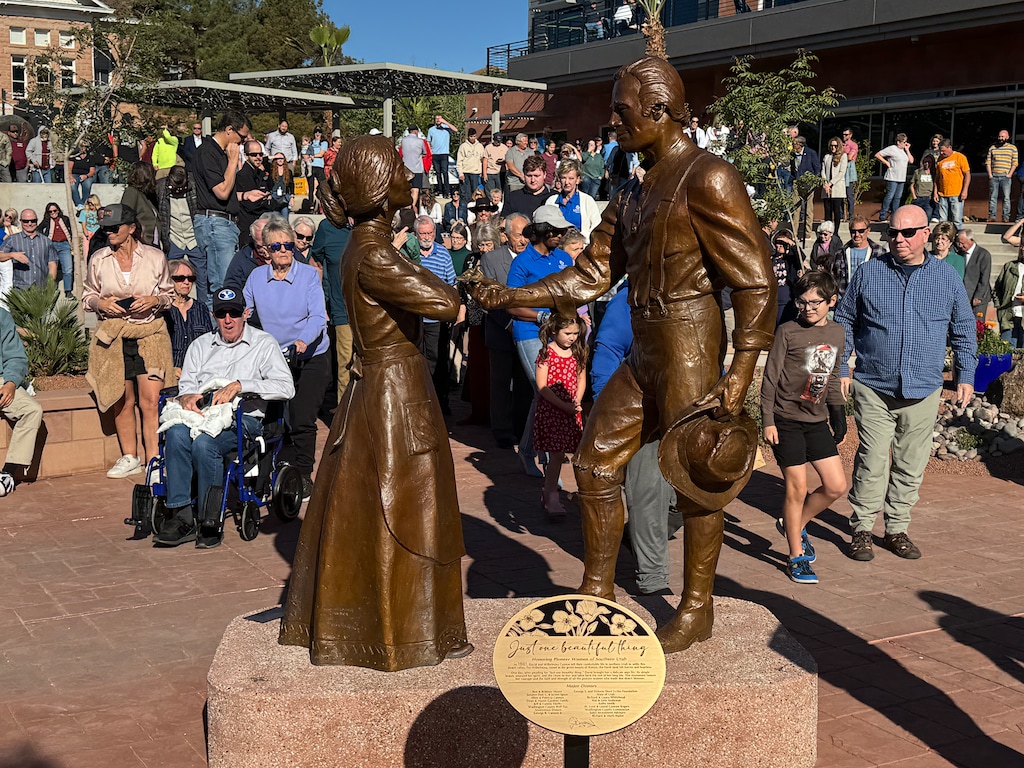
Titled “One Beautiful Thing,” the life-sized sculpture the city commissioned depicts David and Wilhelmina Cannon, the couple sent by pioneer-prophet Brigham Young in 1861 to settle the area.
As author and history buff Lyman Hafen explained at the plaza’s debut, Wilhelmina, exhausted by the harsh elements— sun, wind, floods, snakes, scorpions and mosquitoes —challenged her husband to find a single “good and beautiful” thing about the area to convince her to stay.
David, Hafen explained, returned one day and presented Wilhelmina a sego lily that so enchanted her she opted to remain.
“It is said that after that day, Wilhelmina Cannon had only praise for this place where she lived and labored until she was nearly 90 years old,” he said. “Her story and hardships stand, as does this monument, as a tribute to the many other pioneer women who made the desert blossom as a rose.”
Sculptor sought out sego lilies, too
(Mark Eddington | The Salt Lake Tribune) St. George Mayor Jimmie Hughes gives remarks during the grand opening of the St. George City Hall plaza, Friday, April 3, 2026.
Anderson, who is 91, joined Utah Rep. Celeste Maloy and a host of other dignitaries for the unveiling of his bronze memorializing that historical moment.
He told the crowd he found sego lilies on the edge of a cliff at an elevation of about 6,000 feet on Pine Mountain. He used them as models for the statue and ate the bulb of one, just as the pioneers had done.
“It was really good,” he said, “and I suggest that maybe you do that.”
While Anderson’s statute is the plaza’s star attraction, it has a stellar supporting cast.
Another piece at St. George’s newly minted $51 million City Hall, dedicated in January, was an oversized I Heart STG sign crafted from corten steel and stainless steel at Main Street and 100 South that greets visitors.
Seven hanging chairs are now situated in the breezeway between City Hall and an adjacent parking structure, and the Japanese Garden on the building’s northwest corner is a nod to St. George’s sister city in Ibiguwas, Japan. To the north, waterwise native plants are featured, among other adornments.
“We sit on the northernmost part of the Mojave Desert, and our park staff wanted a space that honors that rugged, unique identity,” said St. George Operations Director Marc Mortensen. [It’s] “a landscape that feels like home to anyone who loves this high desert terrain.”
Construction for the plaza, which Mortensen said is included in City Hall’s tally, was made possible by using $1.5 million in recreation, arts and parks (RAP) taxes. City crews designed and did all the landscaping on the plaza to keep costs down.
Art and ancestry top draws
The new plaza is part of St. George’s commitment to revitalize downtown to create a central gathering spot for the community. Its Friday launch coincided with the unofficial start of the St. George Art Festival, which is hosted in Town Square Park, located on the west side of Main Street, directly across from City Hall.
As much as he admires the plaza art, it was ancestry that drew Jeff Schmutz to the event. He is a descendent of David and Wilhelmina Cannon on his mother’s side. Adding to the historical allure, he and others noted, is that the Cannons once lived on the lot where the plaza and Anderson’s bronze now stand.
“It’s nice for the city to recognize these pioneer ancestors and honor the incredible sacrifices these people made so we can come and enjoy this,” he said.