 Jessica Schreifels
Infamous serial killer Ted Bundy has long been considered the person who killed 17-year-old Laura Ann Aime, who disappeared on Halloween in 1974 and was found a month later by hikers in American Fork Canyon.
Even Aime’s family had come to that conclusion, her younger sister, Michelle Impala, said. He was never charged in the Salem teen’s death, though he included her as he confessed to murders in Utah and other states just before his January 1989 execution in Florida.
But on Wednesday came confirmation: Newly tested DNA evidence definitely shows Bundy was Aime’s killer, the Utah County Sheriff’s Office announced.
“This case is now officially closed,” Utah County Sheriff Mike Smith said during a news conference.
It’s news Aime would be “really happy to know” after more than 50 years, Impala said.
“It’s really quite amazing that people even are still interested in Laura’s case,” the sister said.
Smith said investigators used “new forensics techniques” to confirm Bundy killed the teen. He said if Bundy were alive today, they would pursue criminal charges and the death penalty.
As part of this case, Utah County Sheriff Sgt. Mike Reynolds added Wednesday that the “full DNA profile of Ted Bundy” has now been recovered.
It can now be used by other police agencies to bring similar closure in other cases, he said.
(via Utah Department of Public Safety) Laura Aime, who was found dead at age 17 in 1974 in American Fork Canyon.
The new techniques Smith described involved advanced DNA technology that can separate mixed DNA profiles. The state’s crime lab acquired it in 2023, said Beau Mason, the Commissioner of the Utah Department of Public Safety.
That process allowed investigators to identify a male DNA profile from the fluid sample collected in the case. Investigators then entered the profile into a national database.
That resulted in a “hit” in Florida, Mason said. Utah officials worked with the crime lab there to match the DNA profile to Bundy.
Bundy had moved to Salt Lake City in the fall of 1974 to attend law school at the University of Utah. He had already killed at least nine women and attacked one more in Washington, Oregon and Idaho, and police in the Pacific Northwest were looking for a killer named Ted.
In Utah, he is believed to have killed at least five, and possibly eight, young women in Salt Lake, Davis and Utah counties.
[Read more: Ted Bundy killed at least 5 Wasatch Front teenagers as he went to law school and joined the LDS Church in Utah]
Before Aime’s family moved to Utah County, she had grown up in Fairview, riding bikes, horses and — at about 6 feet tall — enjoying basketball, Impala told The Salt Lake Tribune in 1989.
“We were really close,” she said. “She was five years older than me and she was a good big sister.”
On Wednesday, Impala said she was 12 when her sister was killed. They shared a room, she said, and rode horses together. She remembered how her sister fed her horse red licorice Nibs as a treat — and how the horse refused to eat them after Aimes’ had died.
(Trent Nelson | The Salt Lake Tribune) Michelle Impala speaks at a news conference announcing the connection of serial killer Ted Bundy with the case of her sister, Laura Ann Aime, a teen who went missing in 1974. The news conference was held in Spanish Fork on Wednesday, April 1, 2026. At left is Utah County Sheriff Mike Smith.
“I thought she was fun, because I’m just a little kid following her around. But we had a lot in common,” Impala said. “The love of animals, and just being outside, and doing the things you do when you live on a farm full of animals.”
Aime had been staying with friends in the weeks before her disappearance, her family told police at the time, so they hadn’t immediately reported her missing. Her body was discovered on Nov. 27, 1974, near the Timpanogos Cave visitor center.
Police initially thought the hikers had found another 17-year-old, Debra Kent of Bountiful, who had gone missing on Nov. 8, The Tribune reported at the time. Bundy also later confessed to killing Kent, whose body has never been found.
In October 1974, the body of 17-year-old Melissa Smith, the daughter of Midvale’s police chief, was found nine days after she disappeared.
Police said they were investigating whether Aime’s death was connected to Smith’s slaying, Kent’s disappearance and the attempted abduction of 19-year-old Carol DaRonch outside the Fashion Place mall in Murray on Nov. 8, 1974.
The cases were still unsolved in August 1975, when Utah Highway Patrol officer Bob Hayward stopped Bundy as he was driving his VW Beetle at night with the lights turned off. A search of the car turned up a ski mask, ice pick, strips of torn sheets and handcuffs — and Bundy matched the description of DaRonch’s kidnapper.
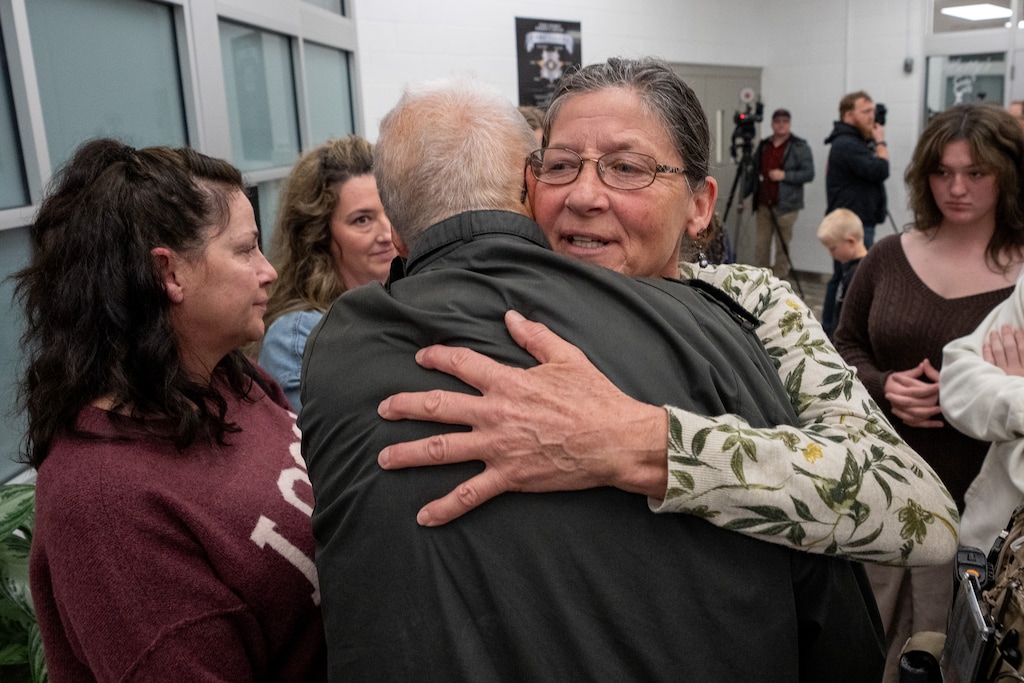
(Trent Nelson | The Salt Lake Tribune) Detective Jake Hall embraces Taura Stucki after a news conference announcing the connection of serial killer Ted Bundy with the case of Stucki's aunt, Laura Ann Aime, a teen who went missing in 1974. The news conference was held in Spanish Fork on Wednesday, April 1, 2026.
Bundy was eventually convicted, at age 29, and sentenced to one to 15 years in the Utah State Prison. But he was extradited to Colorado to stand trial on murder charges there, and he escaped not once but twice.
The second time he made his way to Florida — where he brutally attacked five Florida State University students, killing two. There, he also sexually assaulted and murdered a 12-year-old girl.
In the days before his eventual execution there, Bundy met with investigators from multiple law enforcement agencies. He had confessed to killing multiple women in Utah in a previous interview before Dennis Crouch, a Salt Lake County Sheriff’s Office homicide detective, talked with him.
When Crouch asked Bundy about Aime’s death, the detective told The Tribune, “The man could not look me in the eyes, he put his head in his hands and would not answer the question.”
(AP Photo) This 1979 file photo shows Ted Bundy, convicted murderer, in a Miami courtroom.