 Tamarra Kemsley
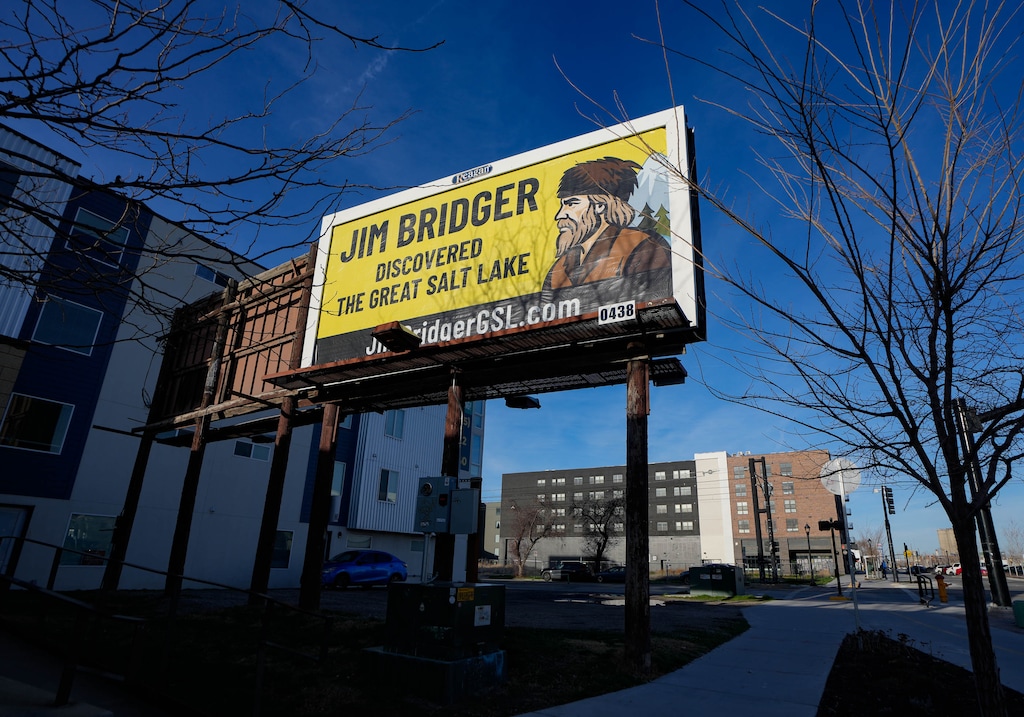
For Utah historians like W. Paul Reeve, it’s hard not to roll one’s eyes when encountering public pronouncements like “Jim Bridger discovered the Great Salt Lake” — as billboards scattered along stretches of Interstate 15 and other streets currently claim.
“‘Discover,’” the University of Utah professor said, “does a lot of heavy lifting in that sentence.”
After all, Indigenous peoples called the Salt Lake Valley home long before the 19th-century mountain man ever set foot there.
“For thousands of years before the Euro-Americans ever arrived,” Reeve said, “they used it as a resource, hunting and gathering in its marshes.”
But that hasn’t stopped billboard titan Reagan Outdoor Advertising from granting the honor of discoverer to the fur trapper.
The website referenced on the billboards acknowledges there’s controversy in naming Bridger, whose namesake Wyoming fort supplied Mormon pioneers and others, as the one to first uncover the lake.
It points to the presence of Indigenous peoples — including the “Timpanogos, Shoshone and Goshute” tribes — in the region far ahead of Bridger’s time.
“Their knowledge of the land and its resources was extensive,” the site explains, “and the Great Salt Lake and surrounding lands were well known long before non-Native explorers arrived.”
In addition to reporting the presence of Indigenous peoples before Bridger, it names French trapper Étienne Provost as a contender for the title.
“Nevertheless, Bridger’s 1824 journey remains the earliest well-documented account,” it reads, “earning him recognition as the documented discoverer of the Great Salt Lake by American explorers.”
As Dewey Reagan, president of the billboard company, told The Salt Lake Tribune: “It’s debatable whether Jim Bridger discovered the Great Salt Lake.”
The framing of these billboards betrays, Reeve said, “a Eurocentric perspective” that “presupposes your worldview is the worldview.”
More accurate would be calling Bridger the first “recorder” of the Great Salt Lake for Western audiences.
But why, if you’re a billboard company, weigh into a debate on settler colonialism and history’s framing at all?
The company’s president said the Bridger billboards, copied and pasted from a 2011 campaign (one, he emphasized, that did not create nearly the same level of conversation as it has this time around), are part of a marketing experiment. By polling audiences in the area before and after their installment, the firm hopes to prove to clients a broad reach with measurable impact.
“It was certainly not our goal,” Reagan said, “to promote prejudice.”