 Kolbie Peterson
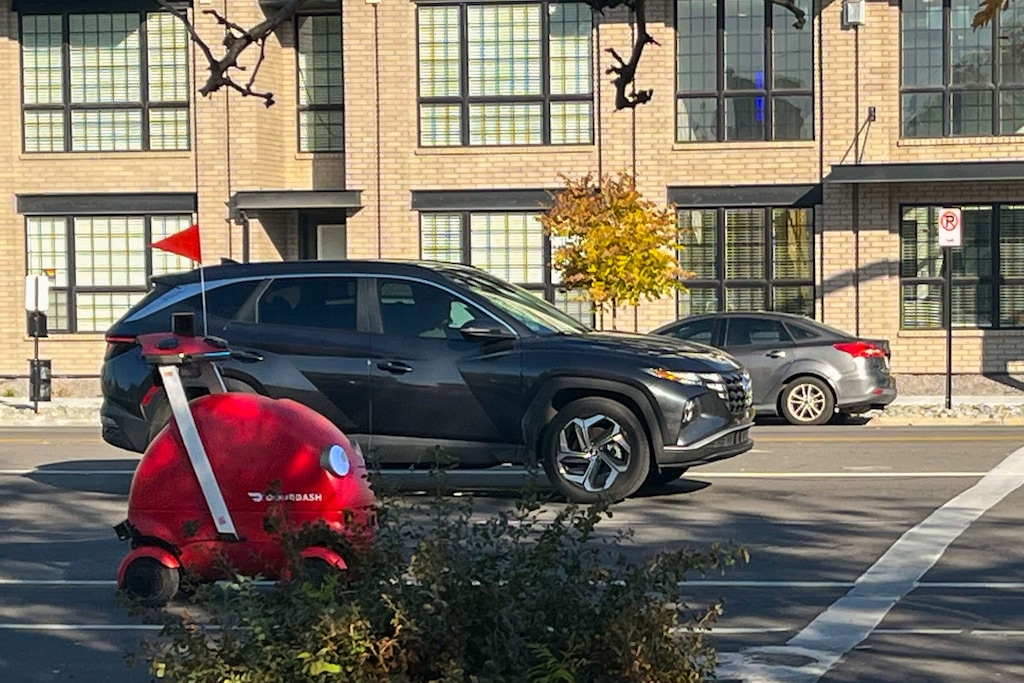
If you see a small vehicle on Salt Lake City streets that resembles a red beetle with wheels, don’t be alarmed.
It’s a new autonomous delivery robot from DoorDash, and its name is Dot.
The food delivery platform is running a pilot program for the robot in Salt Lake City, with the intent of teaching Dot how to navigate rain, sleet and snow while bringing customers their orders.
According to a news release from DoorDash, Dot already operates in “everyday” conditions on roads and sidewalks in other cities where it’s available.
“By piloting Dot in rain and snow in Salt Lake City, we’re building the safety case and operational knowledge needed to expand this technology responsibly — not just to more cities, but to more days of the year when people need it most,” said Ashu Rege, vice president of autonomy and head of DoorDash Labs.
“We’re looking forward to working with city leaders, bike advocates and the Salt Lake City community to ensure that Dot can develop the capability to serve all cities,” Rege continued.
Representatives from DoorDash met with the city’s Business Advisory Board in September and said the platform had a “hefty footprint” in Utah.
Anna Powell, senior manager of government relations for DoorDash, said during a presentation to the board that the company had 70,000 active “dashers,” or delivery people, in Utah.
She said Dot would be able to take orders that dashers would normally decline, freeing them up to take larger-scale, more lucrative orders.
“Dashers are and will remain essential to our platform, particularly as demand for local delivery grows,” Powell said. “Dot increasingly allows dashers to focus on the high-value orders that require human judgment and care.”
Powell said that Dot’s top speed is about 20 mph and that it operates mostly in bike lanes, but it can also navigate sidewalks, driveways and streets. She said the optimal delivery trips for Dot would be short, under 4 miles.
Dot’s cargo compartment is big enough to hold six large pizza boxes, Powell said, and it can hold up to 30 pounds of food.
Another DoorDash representative said during the presentation that Dot was designed with safety in mind, able to stop if a small animal is in its path, detect emergency vehicles, and avoid pedestrians who unexpectedly jump out in front of the robot or are using a crosswalk.
The 350-pound robot also comes with environmental benefits, since it’s fully electric. That representative said DoorDash’s Dot operations in Arizona to date were equal to automotive dashers burning 11,252 gallons of gas.
Another benefit to DoorDash customers is that whenever an order is picked up by Dot, the tip is refunded back to the consumer, the representative said.
Currently, Dot isn’t available to take orders in Salt Lake City, but you may share a road with one this winter.