 Sean P. Means
When demolition started on Salt Lake City’s longstanding Coachman’s Pancake & Dinner House last month, many wondered what would happen to its iconic sign.
A community effort to save it quickly came together, and so far, it remains intact.
The sign is one of many that belonged to Utah businesses come and gone, long outlasting their creators and eventually becoming cultural landmarks.
Here’s a breakdown of those landmarks and their unusual histories.
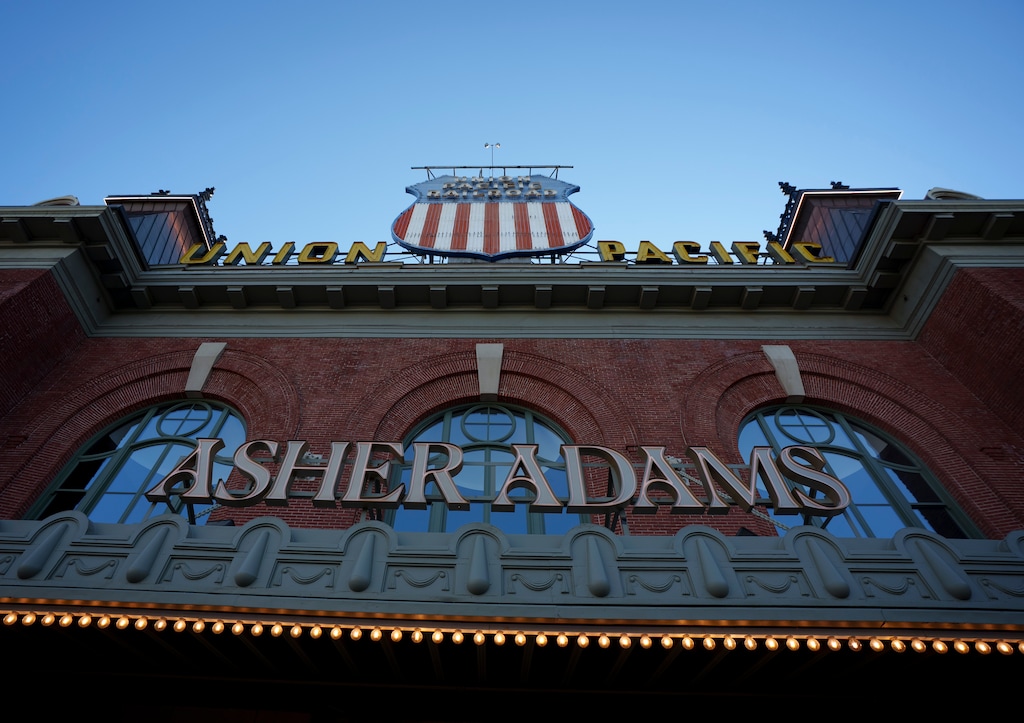
Union Pacific Depot
(Utah State Historical Society) The sign over the Union Pacific Depot, seen here in 1980, has been a Salt Lake City landmark since 1921.
The depot at the corner of 400 West and South Temple in downtown Salt Lake City opened in 1909, and the railroad’s red-and-blue shield was installed in neon there in 1921.
In 1986, the station’s final passenger train pulled in; Amtrak trains now use the intermodal hub a few blocks south and west.
Seven years later, when the band 10,000 Maniacs played an outdoor concert nearby, lead singer Natalie Merchant closed the show thanking Union Pacific railroad for giving her an interesting sign to look at while she performed.
The sign has remained at the depot building, denoting The Gateway shopping center when it opened in 2001 — and has hung over the entrance to the Asher Adams hotel since 2024.
Snelgrove’s double-scoop cone
(Rick Egan | The Salt Lake Tribune) The classic double-cone sign at the former Snelgrove's ice cream plant on 2100 South in Sugar House, in 2022.
Charles Snelgrove opened the first ice cream shop to bear his family’s name in 1929 at 850 E. 2100 South in Salt Lake City.
The iconic Snelgrove’s double-scoop ice cream cone sign, rendered in fiberglass, didn’t appear there for another 33 years, after the company built a manufacturing facility at the location.
In 1991, Snelgrove sold the plant to a distributor based in Washington state, and the national Dreyer’s brand continued to make ice cream under the Snelgrove label. That ended in 2008, and for years, the Snelgrove name could not be found in Utah.
The name came off the Snelgrove’s sign in 2015 and was placed in storage, The Tribune reported at the time, but the cone — immortalized in a 2002 Olympic pin — stayed in place.
Members of the Snelgrove family brought the brand back to Utah ice cream lovers in 2025; they now own seven locations statewide.
Another double-scoop cone sign, at 605 E. 400 South, was maintained by a local ice cream shop until 2008. That site is now a Jimmy John’s sandwich shop, and the cone was painted black to match the chain’s aesthetic.
Capitol Theatre arch
(Utah State Historical Society) The sign for the Orpheum Theatre (later renamed the Capitol Theatre) crosses 200 South in downtown Salt Lake City in 1917. The sign was removed in 1973, and reinstalled with new lettering on the north side of Trolley Square, where it remains today.
For 60 years, a wrought iron arch spanned across 200 South, midway between Main Street and West Temple, marking the entrance to one of Salt Lake City’s grandest theaters.
The Orpheum Theatre opened in 1913 at 50 W. 200 South, and was originally a vaudeville house, according to Salt Lake County’s arts and culture department. The arch went up shortly after the theater opened.
Movie pioneer Louis Marcus bought the Orpheum in 1927, renamed it the Capitol Theatre, and added movies to the programming. Talkies arrived in 1929 and the vaudeville acts were phased out.
The theater went into decline in the ‘50s through the ‘70s, and it took a $5 million renovation to bring the Capitol back in 1978. Today, it is home to Utah Opera and Ballet West, among other arts groups.
The arch was dismantled early one morning in May 1973, and moved to Trolley Square that day.
The arch, with altered lettering, now sits on the shopping center’s north side, a familiar sight to anyone entering the Whole Foods Market parking garage.
(Bethany Baker | The Salt Lake Tribune) The Trolley Square sign in Salt Lake City on Wednesday, July 1, 2026.
Villa Theatre
(Utah State Historical Society) A 1949 Salt Lake Tribune photo of the Villa Theatre in what's now Millcreek, just before the theater's opening. The theater stopped showing movies in 2003; the building now is home to Adib's Rug Gallery.
When the Villa Theatre opened on Dec. 23, 1949, at 3092 S. Highland Drive in what’s now Millcreek, a two-page ad in The Tribune called it “ultramodern.”
It boasted a giant, curved screen — 195 feet long and 88 feet wide — along with 1,300 seats inside, spacious lounges and 2½ acres of parking.
The sign was a marvel: 32 feet high, 29 feet wide, with 2,000 “pulsating” 40-watt electric bulbs and 1,400 feet of fluorescent tubing.
(Bethany Baker | The Salt Lake Tribune) The Villa Theatre sign in Millcreek on Tuesday, June 30, 2026.
Another 44 spot globe bulbs, each 150 watts, illuminated the side of the marquee — which, on opening night, touted the Tyrone Power swashbuckler “Prince of Foxes.”
The Villa was the first Utah theater to feature Cinerama, a short-lived, super-widescreen process that involved three projectors. Its widescreen made it a popular place to see the blockbusters of the ‘70s and ‘80s, such as “Star Wars” and “Raiders of the Lost Ark.”
As single-screen theaters gave ground to multiplexes, the Villa fell into disrepair in the 1990s — and closed for good in 2003. About a year later, Adib’s Rug Gallery moved in, and has kept the Villa marquee largely intact.
Vincent Drug
(Palak Jayswal | The Salt Lake Tribune) The historic 'Vincent Drug' store sign outside new Midvale location of Cactus & Tropicals.
The drugstore on Midvale’s main drag (7696 S. Main, to be exact) has had many lives.
It started in 1911 as a saloon, The Tribune has reported, rented out space to a mercantile, and converted to a drug store when Prohibition hit. After a few ownership changes, Norval Vincent took over operations in 1927, and added a soda fountain with a long counter and nearly two dozen stools.
Norval Vincent died in 1952, and his son Richard took over. Twenty years later, Richard’s younger brother Kent took over — and kept it going until 2005.
The old-timey feel of the signage, along with the remnants of the soda fountain, made Vincent Drug a desirable location for movie and TV production. Scenes from “Halloween 4” and “Halloween 5” were shot there, along with the miniseries of Stephen King’s “The Stand” and the TV series “Touched by an Angel.” Most famously, the 1993 baseball classic “The Sandlot” shot scenes there.
The Vincent Drug sign remains a Midvale landmark, and the storefront recently gained a new tenant: Cactus & Tropicals, the Utah plant store and garden center, opened its third location there in January 2025.
Salt Lake Costume knight
(Francisco Kjolseth | The Salt Lake Tribune) Cory Barker of Rainbow Neon Sign Co. prepares the Salt Lake Costume Co. sign, as it goes back to its original location at 1700 S, 1100 East on Monday, Dec. 23, 2019, in what is now called the Salt Lake Costume Apartments.
The Salt Lake Costume Co. was founded in 1889, and for nearly seven decades sold Halloween and theatrical costumes out of locations in downtown Salt Lake City.
In 1958, they moved to the Sugar House neighborhood — and announced their presence at 1700 South and 1100 East, with a massive neon sign depicting a knight on horseback.
The company disbanded in 2005, and when developers revamped the costume company’s building into a 19-unit apartment building, it took a change in Salt Lake City building law for the sign to survive.
As The Tribune reported in 2020, the city used to place hard limits on building owners who wanted to move signage for redevelopment, changing their use or even to make repairs.
The Salt Lake City Council passed an ordinance in late 2018 to let property owners save some signs by letting them be restored, recreated or reinstalled — on their original sites or even at new ones. The Salt Lake Costume Co. neon knight was one of that ordinance’s first tests.
The sign was reinstalled at the same corner in December 2019, and remains there today.
Other survivor signs
(Bethany Baker | The Salt Lake Tribune) The Classic Ritz Bowling sign in South Salt Lake on Tuesday, June 30, 2026.
• A restored version of the Classic Ritz Bowling sign, depicting a 90-foot-high bowling pin, was installed in 2017, two years after the bowling alley — which opened in 1958 — was closed. An apartment complex was built in its space.
(Bethany Baker | The Salt Lake Tribune) The Stark Steering sign in Salt Lake City on Tuesday, June 30, 2026.
• The Stark Steering sign was built in the 1950s and restored in 2016, according to The City Journals. The former auto shop at 1075 E. Hollywood Ave., in Sugar House, is now an office building.
• Nu-Crisp Popcorn, at 960 E. 2100 South in Sugar House, was believed to have put up its sign in the 1970s, The Tribune reported in 2015, after the company closed up shop. The building remains vacant, and the rusted sign remains.
(Bethany Baker | The Salt Lake Tribune) The Nu-Crisp Popcorn sign in Salt Lake City on Tuesday, June 30, 2026.
Sean P. Means has been reporting and editing for The Salt Lake Tribune since 1991 — including 25 years as movie critic. Since 2018, he has reported on arts and culture reporter, and breaking news — and was part of The Tribune’s COVID-19 reporting team. He reviews movies for MovieCricket.net and X96’s “Radio From Hell” program.