Note to readers • This story is jointly published by nonprofits Amplify Utah and The Salt Lake Tribune to elevate diverse perspectives in local media through student journalism.
Addison Cambia’s dance career was looking promising in April of 2025 — a few weeks from earning her bachelor’s degree at the University of Utah in modern dance, and starting a 10-month contract with a dance company in Berlin — when a skiing accident derailed everything.
She tore her ACL and meniscus in a gnarly fall that left her unable to dance. The injury put her dance career on hold before it started and “ completely shifted my views of dance post-grad,” she said.
Then she came across Dance Class for Humans, a nonprofit organization that supports freelance dancers and connects them with dance groups like Repertory Dance Theatre and Ririe-Woodbury Dance Company. The community, Cambia said, gave her time and, along with her physical therapy, helped her start healing. She began applying to graduate schools and danced between jobs, working as a pediatric physical therapy tech and a waitress only when it “suited her body.”
“That was a space where I felt like I could moderate my own healing with my knee very easily,” she said.
Before the accident, Cambia said she was used to training in a university setting alongside professionally ambitious dancers, many of whom would later perform across the country and around the world. The dance class, she said, was immediately welcoming as a less competitive learning space.
“[I was] surrounded by a lot of different bodies and dancers that I wasn’t familiar with,” she said. “The dance world is so secular, so it was wonderful that I’ve met so many folks who have been around, been dancing and here’s another place where we get to meet and create.”
The class also started in an academic setting. Dance Class For Humans began as a research project in 2023 by then-graduate student Samantha Stone, who also taught Cambia in her program at the U.
The program has become something larger than she thought it would be, Stone said. She designed her thesis to show how dancers have the expertise to experiment with each other in differing disciplines, from contact improv to ballet barre technique. To prove the thesis, however, she said she needed data, time, classes and, most importantly, people.
“I organized it, and I called it ‘Dance Class for Humans Who Merge,’” Stone said. “My argument was that … people who train in dance have the capability to connect different environments or studies or niches, because they have the social skills and comfortability with the unknown.”
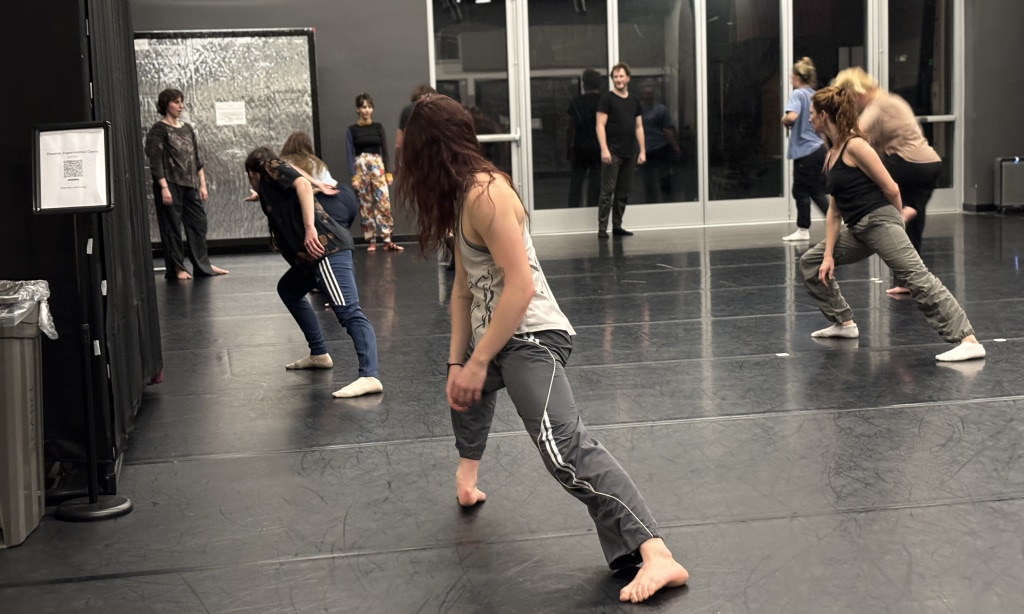
Now, having moved to nonprofit status, dancers attend Dance Class for Humans at studios in Gillmor Hall at Westminster University to collaborate, connect and move together every Monday and Thursday of each season in the fall, spring and summer. The classes are a pay-what-you-can model, which allows dancers the flexibility to take part as they begin their professional careers.
(Kara Komarnitsky) A teacher demonstrates some moves at "Dance Class for Humans," a program run regularly at Gillmor Hall at Westminster University.
‘Perspective and point of view’
By the end of the class’s first year, more than 30 people had signed up. Stone said she began searching for collaborators in the community because she found people needed a communal, low-stakes space to learn and move together.
The dance classes soon outgrew its studios at the University of Utah. In 2024, Meghan Wall, associate professor at Westminster’s dance department, took over to keep the momentum going.
She said her dancers at Westminster and beyond needed a space that’s accessible and welcoming, and can introduce collaboration early on in student and graduate dance careers.
“It truly felt reciprocal,” she said. “We are small, emerging – our program is barely five years old, [and] very different than any other program in the state.”
Wall added that having the dance class on Westminster’s campus provided a place where dancers could experiment.
“It’s all about perspective and point of view,” she said. “And so the more I can expose the students to diverse ideas, the better their whole artistic lives are. So it seemed really synergistic.”
Stone moved to North Carolina in 2024 to teach at Appalachian State University. Stone said she has stayed in the background, as the group’s new management continues the same grassroots and community-oriented foundation.
Access to community
Kara Komarnitsky and Lauren Wightman, who were students in the program, took over as class organizers in 2024.
“It’s a huge labor-of-love model,” Komarnitsky said. “We just make friends and we dance hard. We’re experimenting with a gift economy model to keep it accessible and to compensate people in ways that make sense.”
Dance Class For Humans relies on donations, so the program can accommodate dancers like Cambia, who may not have the money for dance classes elsewhere, to keep coming back, she said. Cambia has been a student for Dance Class for Humans for two years, and has also taught two classes in the last few months.
“It’s allowed me to experience dance in a much more communal, grounded and authentic way,” she said. “It’s definitely encouraged me to hone my individual voice and do things for the sake of my own artistry and practice, rather than at the cost of an institution or a company.”
That’s what the program’s current organizers have in mind, Wightman said.
“Our classes are way more inclusive, and one of our priorities is that it’s not intimidating to come,” they said. “The real emphasis on inclusivity creates a kind of sense of community that I don’t really experience in any other dance class.”
Stone, from her vantage point in North Carolina, said she has seen the community aspect of the program grow since she began the project.
“This feeling of growing something, that … keeps affecting people and does not rely on me to be there — that’s amazing,” she said.
A new sustaining money flow
Not long after Stone moved, Komarnitsky said, the Salt Lake City Arts Council suffered budget cuts, so grant money became harder to come by. In stepped a local organization, loveDANCEmore, to work with the class as mentors and take the program under its umbrella. Komarnitsky said the owner of loveDANCEmore, Sam Hanson, saw that Dance Class for Humans was succeeding at something they had been wanting to do for years.
“LoveDANCEmore has always wanted to create a sustainable, community dance class,” Komarnitsky said. “We were succeeding, and Sam was like, ‘Can we support you?’”
Both organizations continue to advocate for accessibility and community, which Cambia said is important to her as a young dancer. She began a master’s program in physical therapy in May and said she plans to continue attending dance classes as a way to keep herself sane during school.
“I will desperately need a route to dance,” Cambia said. “And Dance Class for Humans is perfect for my schedule, for my budget, for my heart.”
Note to readers • This article was written by recent University of Utah journalism graduate Laney Hansen for the Spring 2026 Voices of Utah capstone class. It is published as part of a collaborative including nonprofits Amplify Utah and The Salt Lake Tribune.
Correction, Aug. 24, 12:27 p.m. • Gillmor Hall, the location of Dance Class for Humans, was misspelled in an earlier version of this article.