This story is jointly published by nonprofits Amplify Utah and The Salt Lake Tribune to elevate diverse perspectives in local media through student journalism.
Centerville • Bonnie Hooper sits at an easel in a sunlit studio in Centerville, blending deep blues into a landscape, while her husband, Gary Hooper, works nearby, carefully adding detail to a painting of boats floating on still water.
The couple, each 70 years old, work independently in separate spaces inside their home, amid half-finished canvases and dried palettes. They work close enough, though, that they can share feedback.
Bonnie and Gary didn’t expect retirement to lead them to painting. Bonnie worked as a Southwest Airlines flight attendant, Gary was an account executive. They focused on their careers while raising four sons — and their lives were centered around work schedules, parenting and daily responsibilities, leaving little room for creative hobbies.
Bonnie said art had always been something she was drawn to, even if she didn’t have time to explore it.
(Marin O'Brien | Amplify Utah) Husband-and-wife painters Gary and Bonnie Hooper, in their separate art studios in their Centerville home.
“I’ve always wanted to paint,” she said, “but raising a family and working full-time meant I couldn’t pursue it earlier. I just wanted to make beautiful paintings for our house.”
After retiring, she began painting more seriously, setting up a small studio space in their home. She started experimenting with color combinations and landscape scenes, often painting for hours without a set schedule. Gary began shortly after, even though he had never drawn or painted before.
“We tried to keep it light at first, just for fun,” Bonnie said. “But then we started entering competitions, and our art began to sell. That gave us a push to do more.”
Gary said starting from scratch was an unfamiliar feeling.
“I didn’t even draw until I retired,” he says. “For the first five years, I was just kind of doing it.”
Early on, Gary said, he focused on learning basic techniques through workshops and local art classes where he learned composition, shading and color theory. Those early sessions helped him understand how to structure his work. He also began attending small art events, to watch other artists work.
Gary felt encouragement when a neighbor saw one of his paintings — a depiction of boats sitting in the harbor, something Gary created for practice — and asked to buy it. Gary borrowed that painting back to enter it in a local competition, where it received an award.
“There’s still doubt sometimes,” he said, “but creating something you like makes you happy. Then you want to do more.”
Both of the Hoopers were developing their style, but in different directions. Bonnie began focusing on more abstract work, often layering colors in loose, flowing patterns. Gary leaned toward structure and detail, especially in landscapes and realistic scenes.
(Marin O'Brien | Amplify Utah) The art wall in the living room of Gary and Bonnie Hooper's home in Centerville. Some of the paintings were made by them, while others are works that inspired them.
Finding a path later in life
Samantha Wisell, an arts career coach at the University of Utah, said people often bring skills from previous careers when they move into creative work.
“When anyone has a creative experience and professional skills, it creates a smoother transition,” Wisell said. “In the general creativity realm, it’s never too late to be creative.”
Wisell says people shifting into art later in life may worry about their skill level, financial stability or starting over in a new field.
“Your previous career isn’t wasted,” she says. “It can actually make you stronger as an artist.”
Data from the National Endowment for the Arts shows that 84% of adults 55 and older participate in creative activities — either creating their own art or attending arts events or both.
AARP, the national organization focused on aging and retirement, reported in a 2022 article that retirees often start new creative paths after leaving the workforce. Some begin painting, photography or other artistic work later in life, often, after spending decades in completely different professions. The organization noted that retirement often becomes a transition point where people explore interests they previously delayed due to work or family responsibilities.
Emily Lawhead, curator at the Utah Museum of Fine Arts, said she has seen artists enter the field through many different paths, including later in life.
“It’s not unusual for artists to fall into this career later on,” she said.
Lawhead pointed to artists who develop their work outside of traditional art school, often through workshops, self-teaching and community-based learning over time. She said many artists build their skills gradually rather than through one formal path.
One example is Amor Muñoz, a former lawyer whose work will be included in the UMFA’s Salt Series exhibit. Muñoz did not attend a traditional art school, but developed her practice through programs, experimentation and collaboration with other artists.
“There’s no clear path, and you have to keep making good work,” Lawhead says. “It’s a grind, but that’s how your art gets seen.”
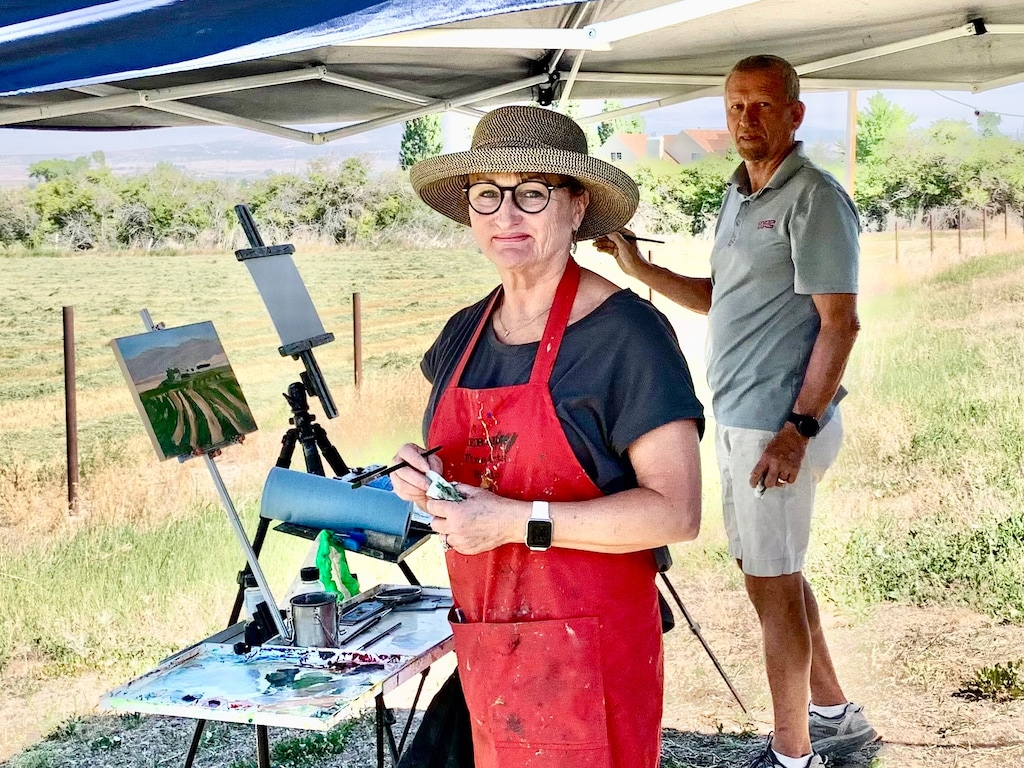
(Bonnie Hooper) Married painters Bonnie and Gary Hooper, from Centerville, Utah, do some plein air work on a trip to Amboise, in France's Loire Valley, in 2015. The Hoopers each took up painting after retirement.
Continuing to create
Bonnie and Gary continue to enter festivals, attend workshops and sell their work. Painting has become part of their daily routine, with both of them spending hours in their studio spaces depending on the day and project.
“If we had a huge room, we’d like to paint together,” Gary says. “But we need our own space because of all our supplies.”
Their studios are filled with different materials. Bonnie’s space often has color studies and layered abstracts in progress, while Gary’s includes more structured landscapes and reference sketches. Even though they work separately, they like to compare finished pieces and talk about what they are working on next.
Music often plays while they paint. Bonnie listens to pop music, while Gary prefers news programs, classical music or golf podcasts. The different sounds reflect their individual work routines.
They also share their art with family. Their four sons and eight grandchildren give feedback on pieces, and have purchased several works over time.
“They were amazed,” Gary said. “Friends and family didn’t know we were artists, so the encouragement has been really positive.”
Looking back, both say they don’t regret starting painting later in life. Bonnie said the timing felt right.
“You can’t rewind your life,” she said. “But this chapter is amazing.”
Gary agreed. “We’ve had the freedom to explore, experiment and find joy in art.”
Marin O’Brien wrote this story as a journalism student at the University of Utah. It is published as part of a new collaborative including nonprofits Amplify Utah and The Salt Lake Tribune.