 Jason Batacao
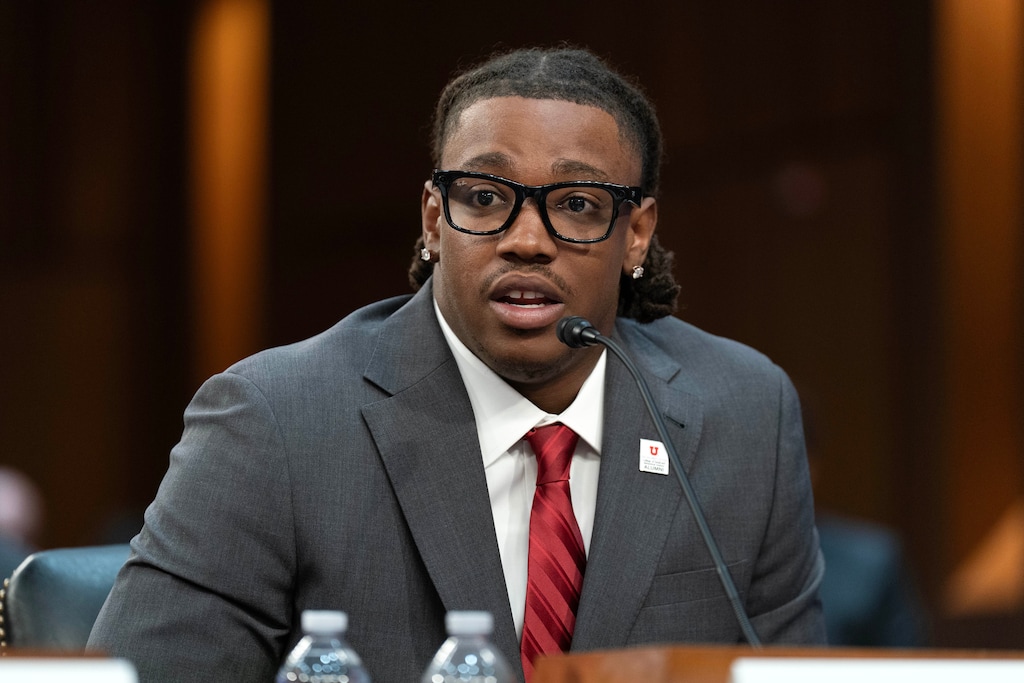
Utah football player Lance Holtzclaw testified before a Senate committee on Wednesday, expressing support for greater transparency in student-athletes’ pay.
The senior defensive end appeared before the Commerce, Science and Transportation Committee, as lawmakers considers the “Protect College Sports Act,” which would create new rules for name, image and likeness (NIL) payments, revenue sharing with student-athletes, and the NCAA transfer portal.
Holtzclaw served as a witness for student-athletes, sharing his experience with the transfer portal, NIL payments and agents during his collegiate career. He was among several witnesses to speak in Washington, D.C. The others included former Alabama coach Nick Saban, Notre Dame Athletic Director Pete Bevacqua, former West Virginia President Gordon Gee and Pac-12 Commissioner Teresa Gould.
(Jose Luis Magana | AP) From left, former University of Alabama football coach Nick Saban, University of Notre Dame director of athletics Pete Bevacqua, and West Virginia University President Gordon Gee, Pac-12 Commissioner Teresa Gould, and University of Utah football player Lance Holtzclaw appeared before the Senate committee.
When asked about NIL transparency, Holtzclaw advocated for financial numbers to become public to create a fair market for college athletes navigating the transfer portal.
“I take this back to educating our student-athletes, and I think that’s really the forefront of what we need to do, and that’s going to help us a lot,” Holtzclaw said. “Student-athletes are going to be able to publicly ... see different values, and [be able to] compare and contrast, to see if what they’re getting and if their deals go along with what they think that they should be getting.
“It gives them a public platform to be able to see that visually.”
Sen. John Curtis (R-Utah) asked Holtzclaw why a national regulatory framework would help student-athletes in college football and in other spaces.
“I think what it does is it creates standardization and regulation, and it keeps everybody on the same page regarding what we can and cannot do,” Holtzclaw said. “It makes things a little easier in some respects. The way I would look at it is that it eliminates a lot of the gray area.
“That’s a big part of what we should do when we’re dealing with people who don’t always have the knowledge of what they can and cannot do and who may not know the legal frameworks at all times.”
Holtzclaw also shared his experiences watching teammates lose NIL money because of unregulated sports agents working on their behalf.
“Agents get paid through what college athletes get paid,” Holtzclaw said. “Them trying to influence the decisions of student-athletes will influence [the agents’] pay.
“Those ridiculous amounts of money that are being taken from student-athletes are a disservice to the game.”