 Jason Batacao
When the NHL announced the move to Salt Lake City in 2024, Avremi Zippel’s hockey knowledge could fit on top of a puck.
He knew there was ice and sticks and a few brawls. He had heard of the Colorado Avalanche, but they were a distant neighbor, nearly 500 miles and a steep mountain range away.
So, when a friend insisted that hockey was the “best sport in the world to watch live,” Zippel was skeptical.
“I’m a lifetime Utah Jazz fan,” Zippel, who is a local Rabbi, said. “And I thought calling it [that] sounded a little ambitious at the time.“
Over the last two years, Zippel’s tune has changed.
His two sons, ages 9 and 11, have become avid hockey fans, too. They haven’t touched their basement basketball hoop in months. Instead, they’ve used rackets and tennis balls to emulate their favorite Mammoth players on the ice.
“I now have to concur with my friend,” Zippel said. “He’s absolutely right — it’s the best sport in the world to watch live. It’s taken the grip of the city with a level of excitement and intensity that’s amazing.”
Mammoth fans can be seen clad in Mountain Blue and Rock Black outside of the Delta Center.
Local breweries are filled on game nights, with Mammoth fans chugging beers and chirping at the TV.
“I think it’s tapped into an entirely different level of just, energy and raw passion that you feel in and outside the arena,” Zippel said. “I love it.”
Mammoth officials said they have worked intentionally — from branding to in-game entertainment — to build up a tradition quickly in Utah.
“We had a thesis that there was already this mad hockey fan base lying and waiting here,” Utah Mammoth President of Hockey Operations Chris Armstrong told The Salt Lake Tribune. “But to say we underestimated the reach of that impact would be factual.
“We’ve been pleasantly surprised in all the right ways.”
Now those fans will get their first taste of the Stanley Cup playoffs at home, when the Mammoth host the Vegas Golden Knights on Friday.
Laying the groundwork for tradition
(Rick Egan | The Salt Lake Tribune) Utah Mammoth celebrate after a goal at the Delta Center.
The blue behemoth prowled across the ice with its glowing eyes and 3D-printed white tusks, as a group of eight fans waved from the back of the beast inside of Utah’s rink.
Thousands looked on — some with awe and others with a bit of laughter — at the machine that’s been dubbed “the Zammoth.”
It’s a rebuilt Zamboni from the 2002 Olympics, made to look like a mammoth. Just introduced before the start of the playoffs, it’s already something Utah officials believe will roam the team’s rink for years to come.
“While we might be the latest team to join the NHL, we want to be at the forefront of the experience,” Elaina Pappas, the head of marketing for the Utah Jazz and Mammoth, said.
“With the Zammoth, we took a concept that was old and reimagined it. And, just like with everything we do, we wanted it to feel intentional.”
For Utah, building a “hockey culture” with the Mammoth starts with the 16,000-plus fans attending a matchup in Salt Lake City, Pappas said.
“The in-game experience is our biggest opportunity to build really lifelong fandom and hockey culture,” Pappas said. “There’s more than just the guys on the ice; there’s 16,000 people behind them that are really pushing that culture and that experience onto each other.”
But what exactly does that mean? Well, the Mammoth have tried everything a fan could imagine.
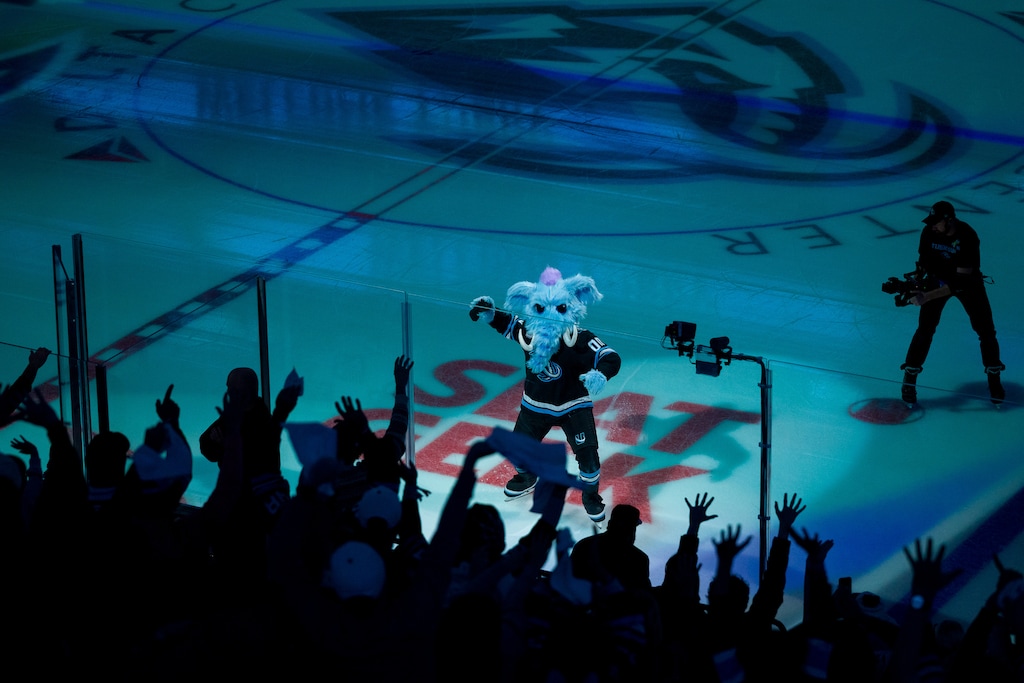
During pre-game introductions, blue beams project images onto the ice to make sure there’s no dead air. The team’s mascot, Tusky, waves a Mammoth flag.
A mammoth tusk arch descends from the roof, giving players an ice-age themed tunnel through which to enter the rink.
Way up in the Delta Center’s rafters is a custom four-note goal horn that blares every time the Mammoth score.
“We want this experience to feel that it was not only built for hockey, but it was built for Utah Mammoth fans,” Pappas said.
“At the end of the day, we want to do things the Utah way, so that when we release something like the Zammoth, it’s hitting on all cylinders, both locally and within the brand that it’s inherently tied to.”
(Trent Nelson | The Salt Lake Tribune) Fans celebrate a goal as the Utah Mammoth host the New York Islanders in November.
But some traditions have to be self-created over time.
“Let’s go, Utah!” chants have become a regular occurrence for fans in attendance. Other fans have pledged their allegiance to Mammoth goalie Karel Vejmelka, shouting “Veggie, Veggie, Veggie,” any time the Czech star stops the opposing team.
Traditions like that happen with time.
“I think it’s always that balance of having their fans guide us and then us meeting them where they’re at to just build on their experience and their love and their fandom and their passion,” Pappas said.
“You don’t want to force things on people. You want to be authentic, and also you want to remain true to your brand.”
Building an instant winner
When presented with the idea of moving the NHL to Utah several years ago, Armstrong and Mammoth owner Ryan Smith saw the opportunity that lay ahead.
“We had a market that was already primed for hockey based on the rich legacy, going back to the Salt Lake Golden Eagles to the Utah Grizzlies,” Armstrong said.
There was also an instant chance to build a winner, he said, because of the foundation laid out by the Coyotes before the franchise was sold for $1.2 billion.
(Trent Nelson | The Salt Lake Tribune) Utah Mammoth right wing Clayton Keller (9) and Utah Mammoth right wing Dylan Guenther (11) celebrate a goal by Guenther as the Utah Mammoth host the Los Angeles Kings, NHL hockey in Salt Lake City on Monday, Dec. 8, 2025.
“As you’re building an organization, and you’re building a brand, having a team with winning potential within that same timeframe was certainly helpful,” Armstrong added.
The Mammoth currently have six first-round prospects developing outside the organization. Utah has also invested in its young stars like Logan Cooley, who signed an eight-year, $80 million contract last fall.
Clayton Keller, considered the Mammoth’s best player, still has two years remaining on the deal he signed back in 2019.
Armstrong views his team as a hybrid between an expansion franchise and a relocation team.
“I think our comparables are Seattle and Vegas, as the most recent expansion teams before us. I think what both of those organizations proved is that you can have success early on,” Armstrong said.
Vegas, as an example, won its first Stanley Cup in 2023, tying an NHL record for the fastest expansion team to win the championship in just six years
A chance to win early on was compelling for Smith Entertainment Group.
“Another attractive part of starting a new franchise in Utah was that you can hopefully achieve a faster return on investment,” Armstrong said. “It’s not just from an economic standpoint, but your investment in building your brand and creating your fan base.”
Utah’s players and fans have seen that pay off work out in both ways. The Mammoth are in the playoffs as a wild card after just two years in Salt Lake City.
In its first season, Utah also sold out all of its games. The Mammoth have also opened up a multi-million dollar practice facility in Sandy. SEG also made improvements to the Delta Center, cutting down on bad sightlines with more improvements on the way.
“I think coming here, it’s really brought the city together,” Cooley said of Utah’s first playoff appearance. “I think the buzz around the city is going to be great, hopefully there’s maybe a screen on the outside for fans to watch if they can’t get in.”
Liam O’Brien, also known by fans as “Spicy Tuna,” said he can’t go anywhere without seeing Mammoth logos around the city.
“This is a place where it’s kind of becoming the big sport,” O’Brien said. “I think it belongs here.”
And Armstrong is eager to see where this franchise can go in the years to come.
“There’s no substitute for winning,” Armstrong said. “It’s what we are all here to do and aspire to do every single day. As it relates to our fans, winning a playoff series and to hopefully one day win the ultimate prize, those are payoffs for their fandom.”
‘Like learning a whole new language’
Zippel fondly remembers the team’s first home game at the Delta Center.
“There was a time where this wasn’t even a fantasy,” he said.
But that night, Salt Lake City officially became a hockey town.
(Bethany Baker | The Salt Lake Tribune) A Utah Mammoth fan watches the team play during a SLC Puck watch party at A Bar Named Sue in Millcreek on Monday, March 16, 2026.
“We don’t have a ton of historic nights around here,” Zippel said, “but that opening night, for the city, was like, ‘Well, I guess we’re all hockey fans now.’”
With two years of fandom now under his belt, Zippel has fully come to understand what the Mammoth are all about.
He’s learned about “the do’s and don’ts and the customs and various practices that are part of being a hockey fan,” he said.
Zippel added: “It’s like learning a whole new language. It’s like learning a whole new world. There are so many idiosyncrasies about being a hockey fan that are so different from every other sport.”
Now he — and 16,000 other fans — are excited to learn what the NHL playoffs are all about, too.
“How many more times in your life are you going to have a chance to go to the first hockey playoff game in the history of a city?” Zippel said. “We’re all kind of treasuring these firsts as they come.”