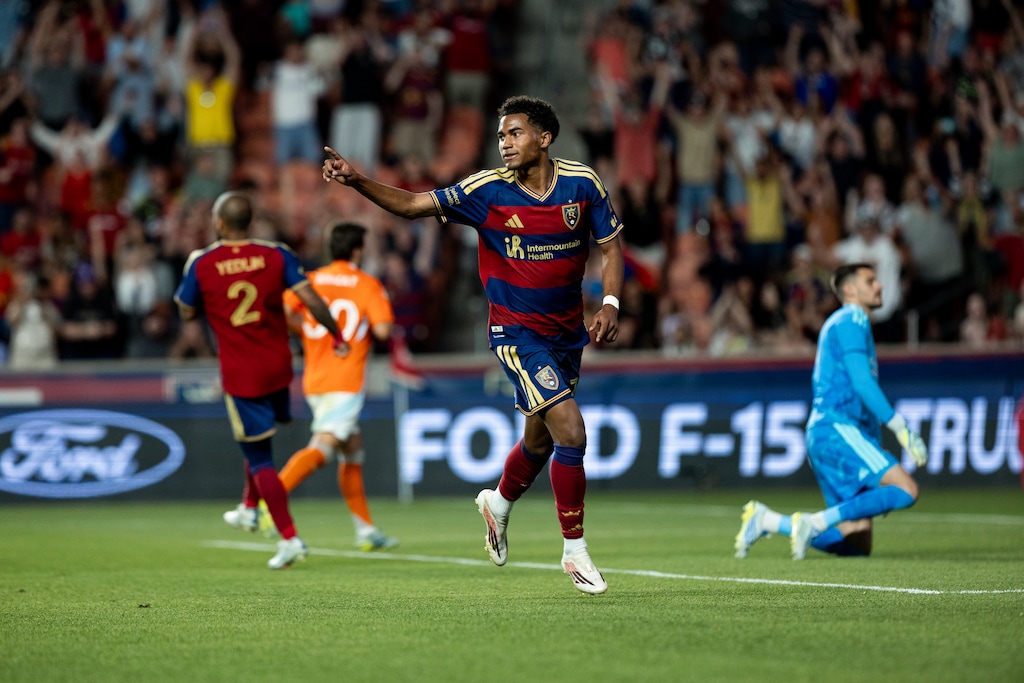
Eagle Mountain native Zavier Gozo now holds the title of the biggest transfer fee in Real Salt Lake history.
And his $15 million move to English Premier League side Crystal Palace on Aug. 18 obliterated the old record.
The previous high-water mark for an RSL Academy sale was Gavin Beavers, who was sold to Danish side Brøndby for a reported $1.5 million in 2025.
The impact of a move of that magnitude on RSL and its player-development pipeline is undeniable.
But what exactly will those ripples look like?
The pipeline behind the price tag
Jason Kreis knows a thing or two about the Utah soccer scene. He was announced as RSL’s first player in 2004 and managed the team from 2007 to 2013, leading it to an MLS Cup in 2009. He now works across RSL, its academy, the Real Monarchs and Utah Royals as president of soccer operations.
As a former MLS MVP from Omaha, Nebraska, Kreis knows better than most that great soccer players can come from anywhere.
Gozo is further proof of that — a kid from Utah can reach the top leagues in the world. And Kreis believes it’s only the beginning.
“There are others out there that are in Utah,” Kreis said. “So we’ve got to be really, really good and adept at identification and development of the players in Utah at younger ages, which is one of the reasons why we now have a U-13, 14 and 15 team that are all solely Utah-based.”
Gozo’s story backs up the urgency.
He entered the RSL Academy at 14 in 2021 and made his MLS debut two years later at 16 — the third-youngest player in RSL history to do so. Less than three years later, he’s preparing for his first Premier League season.
Two current RSL players could be chasing a similar milestone.
Midfielder Luca Moisa joined the academy from Las Vegas in 2021 at 13 and made his MLS debut earlier this year at 17. Right winger Aiden Hezarkhani came to Utah from Irvine, California, in 2023 at 16 and debuted in 2025 at 17.
Hezarkhani presents the clearest path to following Gozo both on and off the pitch. He fills a similar role in the formation and scored a pair of goals early in the season before squad rotation and a toe injury forced some absences over the summer.
Notably, Hezarkhani has not played with the Real Monarchs at all in 2026, a telling sign that the coaching staff trusts him at the top level.
Hezarkhani was the first name mentioned by RSL Academy Director Jon Spencer when asked who comes next after Gozo. Spencer dreams of a not-too-distant future when RSL fields a starting 11 made up entirely of academy products.
“As we’ve continued to grow and mature as a club, it’s our intent to really be pinpoint focused on what our goals are: winning together through development,” Spencer said. “The development piece is (still growing) — we haven’t achieved anything yet. We’re not a finished product.”
(Bethany Baker | The Salt Lake Tribune) Real Salt Lake forward Aiden Hezarkhani (39) kicks the ball during the game between the Real Salt Lake and the San Diego FC at America First Field in Sandy on Saturday, April 18, 2026.
Winning in recruiting
Kreis says the development pathway has been more clearly defined in recent years and is now well-traveled, showing young players how they can move from the academy to MLS.
Gozo’s move takes that path a step further as a Premier League side brings in a teenager from Utah.
“Now we have the ability to essentially say to all of the recruits that we’re trying to bring into our academy, ‘Not only do you have a pathway to the first team, but we’re also a club that is willing and able to sell players to the very best leagues in the world,’” Kreis said.
Kreis credits ownership for additional investments, including putting money into an actual national scouting network. Spencer points to three new performance coaches at the academy, added specifically for player development, part of his goal of making RSL “unstoppable by design.”
But Gozo’s sale isn’t just a development story. To Kreis, the investment into the academy is now bringing money “back into the system” — which Kreis said is a “big deal” for Miller Sports and Entertainment, RSL’s ownership group.
That matters because the battle for teenage talent has gotten fiercer and is starting younger and younger.
“The kids that we are identifying and trying to bring in from a national perspective are also being identified and trying to be brought into all of the big academies: Philadelphia, San Diego, Dallas,” Kreis said. “So we have to have a better story to tell, and I think after this Gozo sale, I think we do have a better story to tell.”
Spencer put it more bluntly: “Gozo is the advertisement” now.
Hungry to improve
So what turns a player into one worth a $15 million transfer fee? Of course, there’s talent — and lots of it — but Kreis says it ultimately comes down to character.
“The hunger part, I think this is where there is a lot of lacking amongst young talented players,” Kreis said. “This idea that you’re really hungry, you really crave development, you’re really pushing the envelope all the time to improve yourself. I think there are so many young, talented players in our country that fall off because they don’t have the motivation or drive.”
Do Hezarkhani, Moisa and the other young players in RSL’s pipeline have that same hunger? If so, RSL may have more Gozo-sized transfer fees in its future — and those players could help bring the Claret and Cobalt their first trophy since 2009.
In the meantime, though, Kreis says there’s no reason the club can’t turn around and reinvest the funds from the Gozo sale before the Sept. 2 transfer deadline.
“We’ve lost one starting-caliber player, but if we could gain two, well, then I would argue that we’re in a better position to win,” Kreis said. “I think that we have some holes that we need to fill before the window closes. And if we do a good job of that, then I think we’ll be right there.”
For many fans, that’s the real test of the Gozo windfall: Can RSL turn its biggest-ever transfer fee into immediate production? The answer could go a long way toward determining whether this is the season the Claret and Cobalt make a deep playoff run or suffer another first-round exit.