 Addy Baird
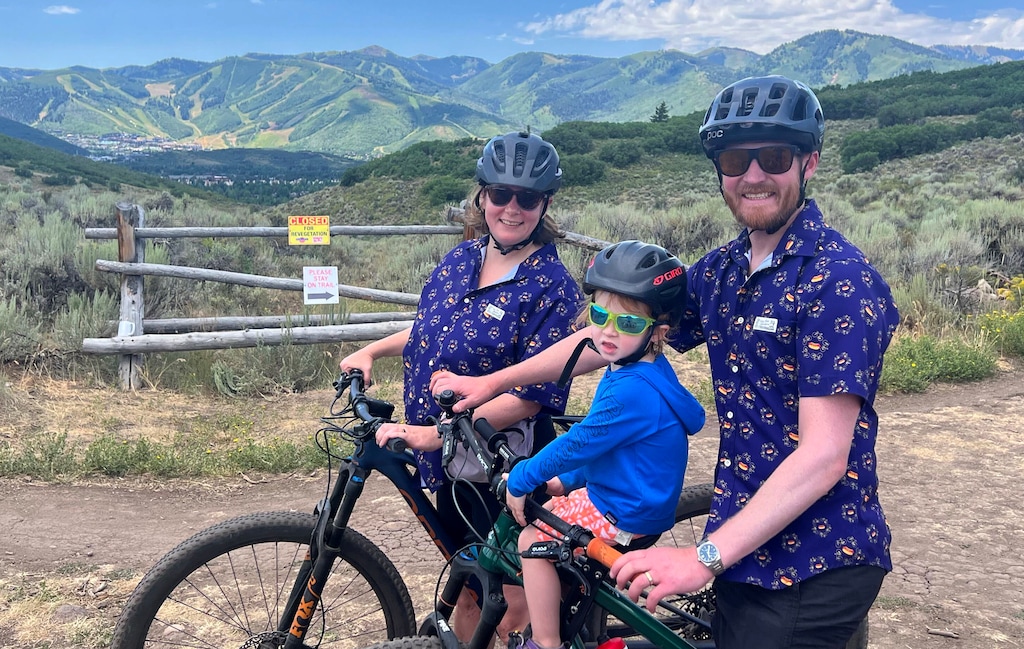
When the COVID-19 pandemic hit, Sophy Bishop and her husband decided they wanted to be closer to the outdoors after years in Boston. He got a job in Salt Lake City, and they moved to Utah in 2021.
“We love to ski and hike and mountain bike and all that stuff,” Bishop said. “So many people are drawn here for the environment of the mountains and all the national parks.”
Those thousands of newcomers, she thinks, are more likely to vote like her — blue — and could be a major factor in changing Utah’s political landscape, particularly if the growing state gains a fifth congressional district after the 2030 census.
“It’s just the shifting winds,” she said. “I feel like younger people, younger [Latter-day Saint] people, might be kind of easier to influence towards the Democratic side. It seems like there is perhaps an opportunity for change if we invest in that outreach and hit the messaging right.”
Utah seems poised to send its first Democrat to Congress in six years, with analysis from the nonpartisan Cook Political Report and polls showing former U.S. Rep. Ben McAdams comfortably leading Republican nominee Riley Owen in the new 1st District’s deep-blue political puddle around Salt Lake City. (McAdams lost his reelection bid in 2020 after one term in the House.)
Many Democrats and strategists in the state feel Utah is approaching a potential turning point — and that building coalitions among voters like Bishop and longtime Utahns who care for the environment could be key to building progressive power in this longtime GOP stronghold.
Opposition from across the state to the proposed Stratos massive data center campus in Box Elder County showed how influential and motivating grassroots movements can be, said Utah House Minority Leader Angela Romero, a Democrat who represents parts of west Salt Lake City and West Valley City.
(Chris Samuels | The Salt Lake Tribune) People protest the massive Stratos data center campus planned in Box Elder County at the Capitol in Salt Lake City, May 14, 2026. Democrats see opportunity in building coalitions with people concerned about data centers and other environmental issues.
“The community came together and said, ‘No, we’re not going to take this,’” Romero said. “Hopefully the Democratic Party figures out a way to engage those people to vote Democrat, and I think that’s when you’ll see the change.”
Gabi Finlayson, a founding partner at Democratic consulting firm Elevate Strategies, said she’s seen the data center and other environmental issues engaging Utah voters — particularly those who have moved to the state in recent years — more than anything else.
“A lot of them, at least from what we’ve seen, are more interested or excited by issues like public lands issues or environmental issues,” Finlayson said. “But I think for folks that have moved here recently, trying to get them invested in local politics has been really difficult.”
National Democratic groups support McAdams and say they’re watching Utah — but the state, some observers and operatives argue, isn’t ready for the kind of outside support some other red states are receiving.
McAdams’ race is a stark contrast to Texas, where Democratic Senate candidate James Talarico is raking in millions, and to newly hot races drawing attention in states thought of as deep red, like Nebraska and Kansas.
“That’s the downside of being a safe seat like that, or what is perceived as a safe seat, is that there’s no urgency to either protecting you or helping you flip an incumbent,” said James Henson, director of the Texas Politics Project, who teaches government at the University of Texas at Austin.
And while “Democrats are looking for inroads in the Mountain West, whether it be Utah, whether it be Colorado,” said Paul Iskajyan of the New Democrat Coalition Action Fund, the fund has not run any polling in Utah to get a more accurate or wider sense of the field.
(Erin Hooley | Pool) Republican Riley Owen, left, and Democrat Ben McAdams, candidates for Utah’s 1st Congressional District, debate at Salt Lake Community College, Sept. 29, 2026, in Salt Lake City. They agreed on the need to bolster the Great Salt Lake. “I'm heartened to see that this has become such a bipartisan issue,” Owen said.
National analysts caution against seeing a tint of purple in Utah just yet.
‘“Purpling’ feels like a strong word because Utah’s a much redder state than Texas is, for example,” said Erin Covey, House editor at the nonpartisan Cook Political Report. Its analysts rate the Republicans in Utah’s three other House races as “solid” wins.
For a Democrat to win a statewide race in Utah, she said, it would take “a bigger shift than you need to see in Texas.”
Shifting Latter-day Saint voters
Republicans have held every level of power in Utah for decades: The state has not had a Democratic governor since 1985, and the GOP has held a supermajority in the Legislature for decades, with enough seats to pass any bill without needing a single Democratic vote.
Richard Davis, a political science professor emeritus at Brigham Young University, traces Republican dominance to the Roe v. Wade ruling in 1973 that established a national right to abortion under the 14th Amendment.
At the time and for decades since, Davis said, as leaders in The Church of Jesus Christ of Latter-day Saints have talked about social and political issues like abortion and same-sex marriage in General Conference sessions, the church’s stances have shaped how the state’s majority religious group votes.
Starting in the 1970s, “you had this idea that you could not be a good member of the church and be a Democrat,” Davis said. “How could you possibly support a party that allowed abortion?”
But recent years have demonstrated that the church is changing, and Utah is changing with it: As of 2023, Utah is no longer a Latter-day Saint-majority state. Meanwhile, the politics of Latter-day Saint voters have been shifting, and a recent study found that no group has moved leftward politically more in the past 20 years than Latter-day Saint voters.
Miriam Packard is a nonprofit grant writer and a Latter-day Saint. A mom of five, she and her husband moved to Utah last year because it was more affordable than California, she said, and offered good opportunities for her kids. But she was nervous, she said, “because I am a registered Democrat.”
Packard described herself as moderate — in a room of Democrats, she feels conservative, and in a room of Republicans, she feels like the most liberal person in the room. In Utah, she found more people who aligned with that feeling than she expected.
(Courtesy of Miriam Packard) Miriam Packard stands at Antelope Island in the Great Salt Lake in February. Packard, a registered Democrat and a member of The Church of Jesus Christ of Latter-day Saints, believes the leftward swing among many LDS voters is a result of the Republican party changing and leaving them behind.
And the leftward swing among many Latter-day Saint voters, she argued, isn’t a result of the church changing but of the Republican Party changing and leaving Latter-day Saint voters behind. The church “could either follow [the Republican] party, or it could stick to its guns,” she said. “I like to think that the church stuck to its guns.”
Multiple national analysts said they see Utah’s swing as more a rejection of President Donald Trump’s brand of Republicanism than of the party itself.
“What makes Utah interesting is it’s never been a real MAGA state,” said Jim Kessler, executive vice president for policy at Third Way, a moderate Democrat think tank. “It’s had a lukewarm relationship with Donald Trump.”
Republican Sen. John Curtis won his seat in Utah without Trump’s endorsement in 2024 — which Kessler described as a rare feat in a national landscape of GOP races largely dictated by the president’s blessing.
Republican members of Congress in Utah draw more votes than Trump, Covey said.
“I think that’s because there are a significant number of Republican LDS voters … who are turned off enough by Trump to not vote for him when he’s on the ballot,” Covey said. But, she cautioned, “It’s certainly not a majority.”
Indeed: A 2025 study found that although Latter-day Saint voters are less overwhelmingly Republican than they once were, they had warmed to Trump significantly. In fact, more Latter-day Saint voters than ever openly supported the president.
‘We’re tied to the land’
This, in part, is why Romero cautioned that she doesn’t want her party to take the state’s changing landscape for granted.
“We can’t expect people just to come to us,” she said. “I’ve seen a shift in our demographics, and I see people leaning more unaffiliated. They don’t want to even necessarily be associated with a political party, because I think they’ve lost that trust.”
(Bethany Baker | The Salt Lake Tribune) House Minority Leader Angela Romero, D-Salt Lake City, speaks as a crowd gathers to voice opposition to a proposed data center campus in Box Elder County during a protest at the Utah Capitol In Salt Lake City on Saturday, May 23, 2026.
Rachel Lewis Jepperson, a registered Republican who ran for a nonpartisan seat on the South Jordan City Council last year, said she saw that issue as she campaigned. Many Utahns don’t feel represented by either party, she said, “so there may be people leaving the Republican Party, but that doesn’t make someone a Democrat.”
While talking with residents in South Jordan’s Daybreak, where there are younger voters and younger families, she found that the population skewed more liberal. But in more established neighborhoods, she said, the density of registered Republicans was significantly higher and older voters tended to be more tapped into the party.
“As much as I think we feel like the younger generations are stepping up,” she said, “it’s still the older generations that are voting and participating and are at the caucus meetings and are voting in primaries and really truly choosing who’s in office.”
Still, the progressive group Run for Something sees an opening in Utah’s shifting demographics and growth and is backing three candidates in the state this election cycle — two of them running unopposed, and all in blue Salt Lake City.
“We know that there’s an opportunity here for us to really build the bench and soften the ground, if you will, and build infrastructure for 2030 and beyond,” said Johanna Silva Waki, the organization’s executive director.
Utah State University student Kris Pfeiffer, who moved to Utah from Navajo Nation initially in 2011, said organizing around progressive causes in the state has often felt like an uphill battle — but he, too, thinks residents’ responses to the Stratos data center, the shrinking of Bears Ears and Grand Staircase-Escalante national monuments and the struggles of the drying Great Salt Lake demonstrate how to be effective.
“We’re tied to the land,” he said. “It’s our moral obligation to make sure she thrives … so seeing people who came together from different political backgrounds about the data center, there’s hope.”
In 2028, Republican U.S. Sen. Mike Lee is up for reelection. Finlayson said although she would love to see major Democratic groups spending in the state against Lee, she thinks a winning strategy would include engaging people who care deeply about Utah’s land.
(Courtesy of Sophy Bishop) Sophy Bishop and her husband Tim Johnson ski at Deer Valley earlier this year after moving from Boston to Utah in 2021 to get closer to the outdoor recreation they enjoy. Bishop thinks similar newcomers could be a major factor in changing Utah’s political landscape.
She hopes Democrats can work with “the national hunters and anglers, League of Conservation Voters, backcountry outdoorsmen — a lot of that type of energy,” she said.
In such a coalition, she said, “you don’t actually have to, in any way, agree on anything else other than the end goal, which is like Mike Lee should not be our senator. So I think there are a lot of people that are interested in that.”
‘The politicians are picking the voters’
Drawing lines through a state as square as Utah might seem pretty straightforward, but as the state’s recent redistricting disputes show, nothing could be further from the truth.
Despite the success of an anti-gerrymandering ballot amendment in 2018, state lawmakers implemented congressional maps that a court determined were, in fact, gerrymandered. A judge approved the maps being used in the November election, including the Democrat-leaning 1st District.
“Gerrymandering is no different in Utah than it is anyplace else in the sense that it robs people of their ability to have their voice heard,” Utah Democratic Party Chair Brian King said in a recent interview.
This, he said, not only makes it more difficult for Democrats to get elected but also demoralizes the party’s base.
This is a familiar dance to those in the Lone Star State, Henson said, noting that Austin legislators on both sides have wielded the redistricting pen to their advantage.
“It’s not an accident that you have this one Democratic district that is very safely Democrat,” he said, “because those Democratic votes might be helpful somewhere else if the lines were drawn differently.”
Former U.S. Rep. Karen Shepherd, who represented Utah as a Democrat for one term from 1992 to 1994, has dedicated her life in recent years to ending gerrymandering.
She said it’s the most important thing for Democrats to reckon with in the state — more than Trump, more than environmental issues, more than anything: “I honestly think our only hope,” she said, “is to stop the gerrymandering.”
“Right now, in more than half the states in the union,” Shepherd said, “the politicians are picking the voters. We’re not going to change anything until the voters pick the politicians.”
Note to readers • This article was produced in collaboration with Main Street Media Cooperative, which offers the services of experienced journalists to help local outlets report about the effect of changes in Washington on their communities.