 Andy Larsen
For most of the last 18 months, Darryn Peterson was often considered the most likely prospect to be the first pick in the NBA draft.
Somewhere in the midst of his freshman season at Kansas, though, his stock slipped ever so slightly. He wasn’t always available, confusingly so. When he did play, he lacked his usual burst. He didn’t garner many assists, and his shooting numbers weren’t quite as dominant as expected. The Jayhawks were bounced in the NCAA Tournament’s second round.
Maybe those were the reasons Peterson wasn’t the Washington Wizards’ pick at No. 1 on Tuesday night. Instead, Peterson dropped to the Utah Jazz, who selected him with the second-overall pick.
So I wanted to look into the questions about Peterson for myself. Are they based on fact or fiction? After all, if he can answer them, he’s expected to be one of the great players of his generation.
Peterson’s health
(Yuki Iwamura | AP) Darryn Peterson is interviewed after being chosen by the Utah Jazz in the first round of the NBA basketball draft, Tuesday, June 23, 2026, in New York.
After a largely healthy high school career (he broke his foot in eighth grade, but didn’t suffer long-term effects), Peterson missed 11 games last season, and unexpectedly missed significant portions of others. The reason for the absences varied — a hamstring injury, then mysterious cramping, then the flu. It was weird.
In interviews since, Peterson has put most of it on season-long cramping issues that started with full-body cramps in September. (As ESPN wrote, “First his legs started cramping. Then his stomach, back, arms and hands”) They were severe enough to put him in an ambulance after Kansas coach Bill Self’s boot camp.
Peterson explained that blood tests after the season pointed to high levels of creatine, a supplement, in his system as the root cause.
Some doctors who heard Peterson’s explanation came away with doubts, though. The Deseret News spoke to two of them, who tried to make sense of Peterson’s explanation, and suspected that Peterson really meant “creatinine” or “creatine kinase,” two more naturally occurring metabolic products. Dr. Brian Sutterer, over on Yahoo! Sports, guessed the same. If you’re willing to put your faith in an anonymous Reddit poster claiming to be a doctor, there’s a theory that Peterson had an episode of rhabdomyolysis, which is marked by elevated levels of creatine kinase.
No matter the cause, the question is: Is this likely to be a chronic problem for Peterson? Will he continue to have elevated levels of … whatever creatin-prefixed molecule that has marked his struggles?
I think the evidence points strongly to no. First of all, he finished the season healthy, playing a full allotment of minutes in Kansas’ final five games, the conference tournament, and the NCAA Tournament.
Peterson is, of course, incentivized to do so, but he insists he’s healthy moving forward. “In the upcoming Summer League, [I’m trying to show] that I’m back to being me. I wasn’t completely myself at Kansas,” he said. He also told reporters that his pre-draft workouts, with teams and otherwise, were about “getting pushed to extreme limits. Obviously, after the year I had at Kansas, I had to push myself to another level. The workouts were super intense.”
Utah Jazz President of Basketball Operations Austin Ainge agrees, specifically pointing to his medical testing. “Our doctors went through everything at the [NBA draft] combine,” he said on draft night. “All the tests that were ordered, we feel very comfortable.”
Literally the only thing that has me the slightest bit worried, given all we know, is something Danny Ainge said on the team’s first post-draft call to Peterson: “Defense and conditioning: it’s a cheat code,” the Jazz CEO told the draft pick in a video the team shared on social media. Fine advice, but it wouldn’t have been the first thing I told Peterson, given his history.
“I got you [on] both,” Peterson said nonetheless. “I got you.”
Peterson’s mentality
This concern comes in a few forms.
First, Peterson admitted the full-body cramp he experienced at the beginning of the season led to some real fear about a recurring episode, and this time with more people watching.
“Whenever I felt anything like that come on, my initial thought was that it might get to that again,” Peterson told ESPN. “And I can’t let that happen and be embarrassed and have that on TV and all that.” It explains why he’d unexpectedly ask to come out of games, despite seeming in no pain.
But it’s also clear from his interviews that he feels he’s solved the cramping issues, and has regained confidence in his body. “I’m feeling better than I ever have. So just going out there and being me again is super important to me,” Peterson said Tuesday. Given the reasons above, I’m optimistic this has been sorted out as well.
Second, there’s a concern about Peterson’s personality. He’s not the traditional alpha-dog stereotype that demands attention with his celebrations, trash talk, social media presence, or the like.
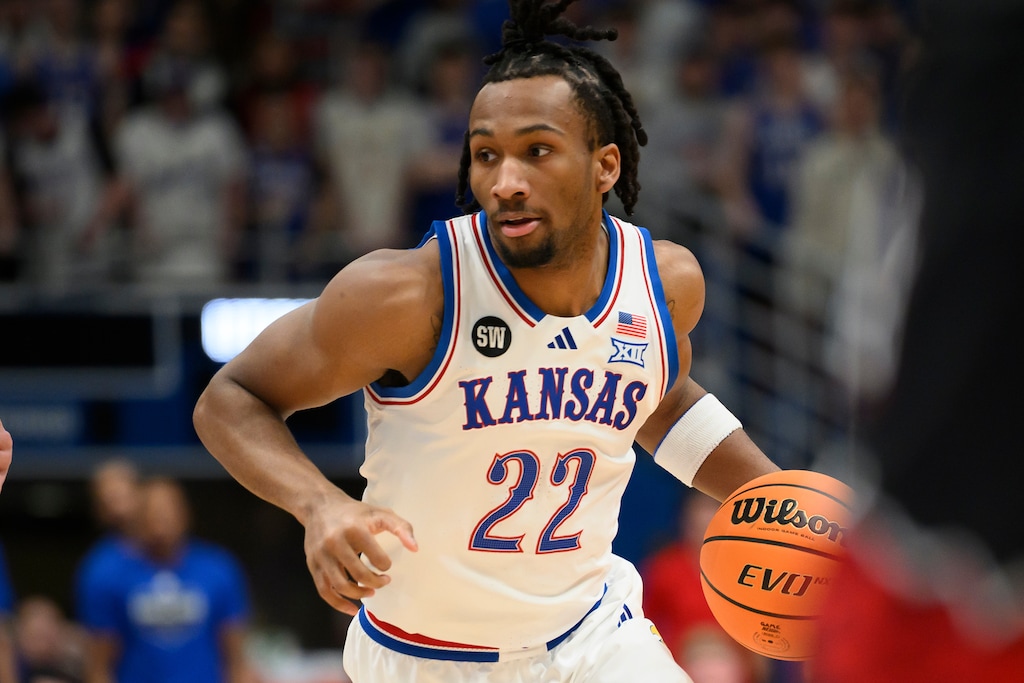
(Charlie Riedel | AP) Kansas' Darryn Peterson dunks during the first half of an NCAA college basketball game against Houston in the semifinal round of the Big 12 Conference tournament March 13, 2026, in Kansas City, Mo.
Austin Ainge described Peterson’s personality on the SEG+ draft night broadcast this way: “He’s on the quieter side. He’s serious, but quick to smile. He’s not going to talk your ear off. But he’s got that look in his eye. He’s not scared of a moment on the court, and I’d say he has that quiet confidence.”
There was a moment in the pre-draft process where Peterson was asked why he didn’t celebrate his massive dunk over BYU, perhaps his best highlight of the season. “This was when they were saying I didn’t care about basketball — but I didn’t get the foul call, so I had to get back,” he said. “Coach probably would have tweaked had I stayed under yelling and they scored.”
Extremely good point. In general, I think we’ve seen all types of personalities succeed in the league at the highest levels: Nikola Jokic is a very different person from Shai Gilgeous-Alexander, who is very different from Steph Curry, who is very different from LeBron James, who is very different from Kobe Bryant. There’s not one archetype for personality anymore, and that’s healthy.
And then there’s the fact that he’s clearly responsive to slights — for example, about being drafted No. 2. “Obviously I wanted to be the No. 1 pick, but I went No. 2. So now I’m prepared to go to Utah and get to work,” Peterson said. “There’s always been a chip on my shoulder, so I wouldn’t say it added anything else. But now it will always be in my mind for my whole career.”
Third, there’s been some ongoing debate about Peterson’s natural competitiveness on the court. It’s something I was worried about when I saw him play live during a game at Highland High School in Salt Lake City last year. He was clearly the best player on the court, but played pretty casually. He seemed content to play off-ball at Kansas. He also lacked the clutch moments that others have more clearly displayed.
But if you want to point to the hallmarks of basketball hustle in terms of actual, tangible production … Peterson has that at a higher level than the other elite prospects in this draft. He averaged 1.4 steals and 0.6 blocks per game at Kansas. BYU’s Dybantsa, as an example, averaged 1.1 steals and 0.3 blocks. Peterson’s defensive film is pretty darn strong, and you’ll see him trying to turn over his opponents at a far higher rate than Dybantsa or Cameron Boozer. For a guy scoring 20 points per game, it’s impressive.
Peterson’s playmaking
The only real statistical red flag on Peterson’s profile is his playmaking numbers: averaging just 1.6 assists per game is really, really low for top guard prospects. Everything else is positive, sometimes hugely so, but passing looks iffy from this angle.
“This year, people kinda got away from my playmaking ability, just because I was off the ball so much,” Peterson said at the NBA combine, discussing what he most wants to prove people wrong about.
It makes sense Peterson feels that way, because he was a really strong passer in high school. When he played on-ball more often while at Prolific Prep, he averaged 5.3 assists per game and honestly looked great in doing so, including in the game I watched here at Highland High.
But obviously, college basketball is harder. So how much of the decrease in assists was due to Peterson struggling with the level, and how much was due to his role?
This is reasonably up for debate. The pessimistic view can be summed up by the argument at 100guaranteed’s Substack, where it’s noted: “It’s difficult to find any positive analogs for this low assist rate amongst guard-sized players.” Instead, Peterson took a large diet of tough outside shots, and even though he made a large percentage of them, it’s still concerning that he wasn’t able to reliably get to the rim very often.
The optimistic view is well described by analyst Ben Pfeifer in a video titled “Get Darryn Peterson some Help.” Essentially, the thinking goes that Kansas was actually pretty bad this year beyond Peterson, that Self’s spacing schemes did him no favors, and that NBA spacing will be significantly better.
I think the truth is probably somewhere in between, but I tend to lean towards the optimistic side. The projected Jazz starting lineup is Peterson alongside Keyonte George (24 points per game), Lauri Markkanen (27 ppg), and Jaren Jackson Jr. (23 ppg) — three massive scoring and shooting threats. Peterson will benefit from having those players finish his plays and by the fact he won’t be asked to playmake against defenses homed in on him.
I don’t think it’s likely he’ll ever be a true point guard in his career. I imagine something more akin to Devin Booker, where you technically can play him as your team’s lead PG, but would probably prefer not to.
Funnily enough, I think there’s real interplay between these concerns. Pressure mounted on Peterson as he missed games, which probably pushed him to take more difficult shots when he did play as he chased the No. 1 overall pick, which probably didn’t improve his on-court chemistry with his teammates, which probably meant he didn’t feel totally comfortable out there, which probably led him to play less often. It’s a vicious cycle.
And despite this cycle, he still … oh, he still posted the best Box Plus-Minus for a guard in college basketball last season, and one of the best for a freshman ever. He’s just so absurdly talented.
The possibility certainly exists that these concerns end up limiting Peterson’s career, and he never lives up to his true potential. But after digging in, I just don’t think those odds are any greater than the variance inherent in any NBA prospect.

Andy Larsen, a lifelong Utah resident who graduated with a math degree from Salt Lake City's Westminster College, is now The Tribune’s data columnist (after previously covering the Utah Jazz). When he's not writing about numbers in our world, Andy enjoys playing soccer, tennis and chess.