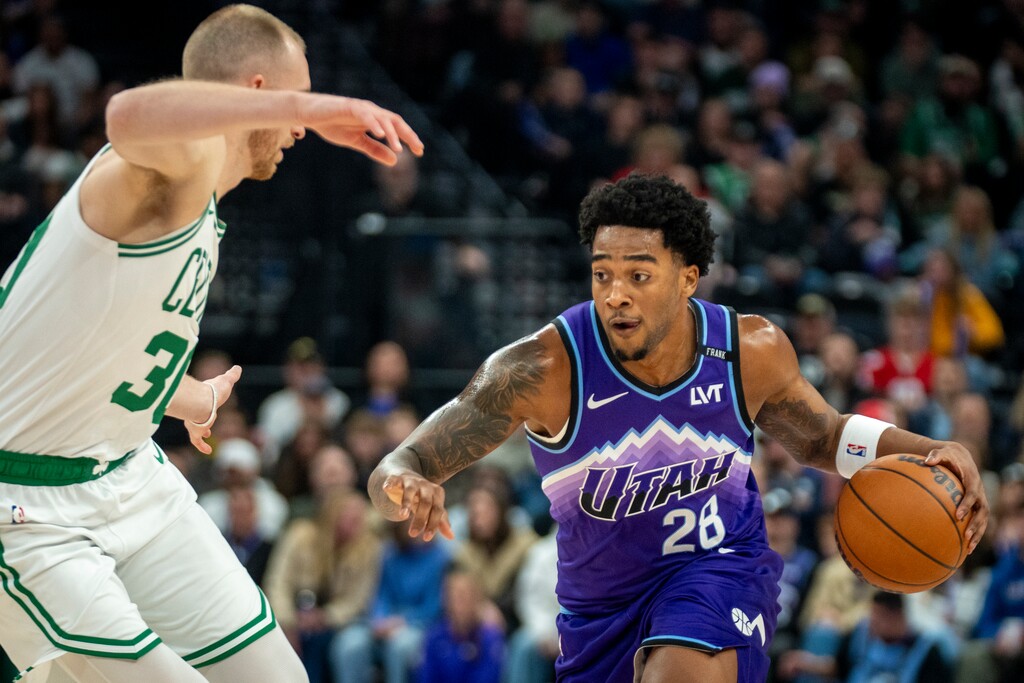
 Kevin Reynolds
Brice Sensabaugh was dancing, both in his head and with the ball, and the play developed before him.
A New Orleans defender raced in from his left. A sliver of open space cleared to his right, just enough to maybe fire off a pull-up or get a look at the rim.
Sensabaugh debated for a bit, taking a few rocking dribbles as he decided whether to play to his strengths with a contested three or test his playmaking ability.
A second later, he launched a 34-footer off his right hand. Buried it. It’s a decision that says plenty about how he views his NBA future.
“It’s a balance, but shooting is going to be my driving force,” he said after scoring 20 points against the Pelicans. “I’m looking to play and to be a valuable piece on this team in the future. For me, option one is to shoot. Option two is to shoot.”
Sensabaugh is one of several young players operating in basketball purgatory in March — auditioning for Utah’s 2026-27 playoff push. For the first time in years, the Jazz know their core — with Lauri Markkanen, Jaren Jackson Jr and Keyonte George all leading the way. But who the organization surrounds them with is still anybody’s guess.
Sensabaugh thinks he has a compelling case. He’s a former first-round pick who can fill it up with the best guards in the league. He poured in 43 points against the Chicago Bulls in early January and averaged nearly 19 ever since. But his game also comes with downsides for a third-year pro. Chief among them: a propensity to put the ball on the floor and a defensive repertoire that may not meet playoff muster.
It makes Sensabaugh’s decision in an otherwise meaningless February game so important. He knows his deficiencies. So he’s leaning hard into his best skill, hoping 3-point shooting will be his ticket onto Utah’s win-now team.
“I have to keep searching for those catch-and-shoot opportunities,” he said. “I want to improve everything except my shooting, to be honest. But like I said, shooting has to be the driving force.”
(Trent Nelson | The Salt Lake Tribune) Utah Jazz forward Brice Sensabaugh (28) as the Utah Jazz host the Sacramento Kings, NBA basketball in Salt Lake City on Wednesday, Feb. 26, 2025.
For Utah, there’s a glut of guards who are fighting for their roles over the last month of the season. Behind George, second-year player Isaiah Collier and rookie Ace Bailey are trying to solidify their spots. Veteran John Konchar came in at the trade deadline and former lottery pick Cody Williams is eating up minutes. Sensabaugh is floating in the mix.
The likelihood that Utah takes all of those players into next year is low. CEO Danny Ainge put that feeling into overdrive when he said Utah couldn’t have “too many” developmental players on a playoff roster.
“You can always have one developmental player or two,” Ainge recently said on a local radio station. “But not too many, that’s for sure. We need to make some decisions.”
Head coach Will Hardy added to that sentiment later.
“Our fan base feels a light at the end of the tunnel because they will still be fans of the Jazz next year. But as far as who is on the team, those things are very fluid,” he said. “You should be trying to maximize the opportunity right now, because there is nothing promised.”
So the tryout is on. And out of that group, Sensabaugh could appear safe. He’s the fifth leading scorer on the team and the best scorer off the bench. He’s averaging 12.7 points a night, and it’s consistent. He tallied 20-plus points in 14 games.
But the other numbers are increasingly harder to ignore. The 3-point shooting is down, from 37% to 34%. He’s taking a heavier dose of contested twos, which he shoots at only 43%.
Maybe most concerning, the Jazz are worse when he’s on the floor by two points. It’s hard to be a winning player that way.
“I feel like [he’s] maybe taking too much off the dribble,” Hardy said. “I feel teams really respect his shooting and are not letting him get as many catch-and-shoots. I do think there are times he can make it a little easier on himself by taking a few more catch-and-shoots, even if they are lightly contested. Brice is a good shooter.”
(Rick Egan | The Salt Lake Tribune) Utah Jazz head coach Will Hardy chats with Jazz forward Brice Sensabaugh (28) in NBA action between the Utah Jazz and the Detroit Pistons at the Delta Center, on Friday, Dec. 26, 2025.
Sensabaugh has a plan to alleviate some of those concerns. At times, he can pass more if teams are taking away his shot. “Use my gravity,” he said. Creating for himself doesn’t always have to be the default.
On defense, he wants to improve on the ball, allowing fewer easy buckets at the rim. “Effort is going to be the thing that puts us over the top,” he said. If he prioritized it, the Jazz could be better when he’s on the floor.
“There’s been a couple plays in the last month where he will put his body in front to take charges. I’d like to see more consistency as a help defender,” Hardy said.
Sensabaugh went to work last offseason, putting together four-on-four games with coaches to visually see where he could position himself on defense. His teammates urged him to do more, knowing it might be the difference for his future.
“We all know about his scoring ability,” Williams said. “But just his willingness to guard has been a big jump. He knows we are looking for him on offense, trying to feed him the ball. So for him to stay solid on defense, keep guys in front of him, he can get out and score.”
But as the calendar turns to March, Sensabaugh believes the Jazz’s ultimate decision will likely center on his shooting. One day, he wants to be an above-average defender. Maybe he will even be a playmaker.
For now, though, Sensabaugh wants to stack more decisions like he made against New Orleans: leaning into his strengths to plead his case.
“Putting the ball on the floor is going to be important for the evolution of my game one day,” he finished. “I’m a growing player. But, like I said, option one and two, for me, is to catch and shoot.”