 Jason Batacao
Provo • BYU’s wide receiver room is in a state of flux.
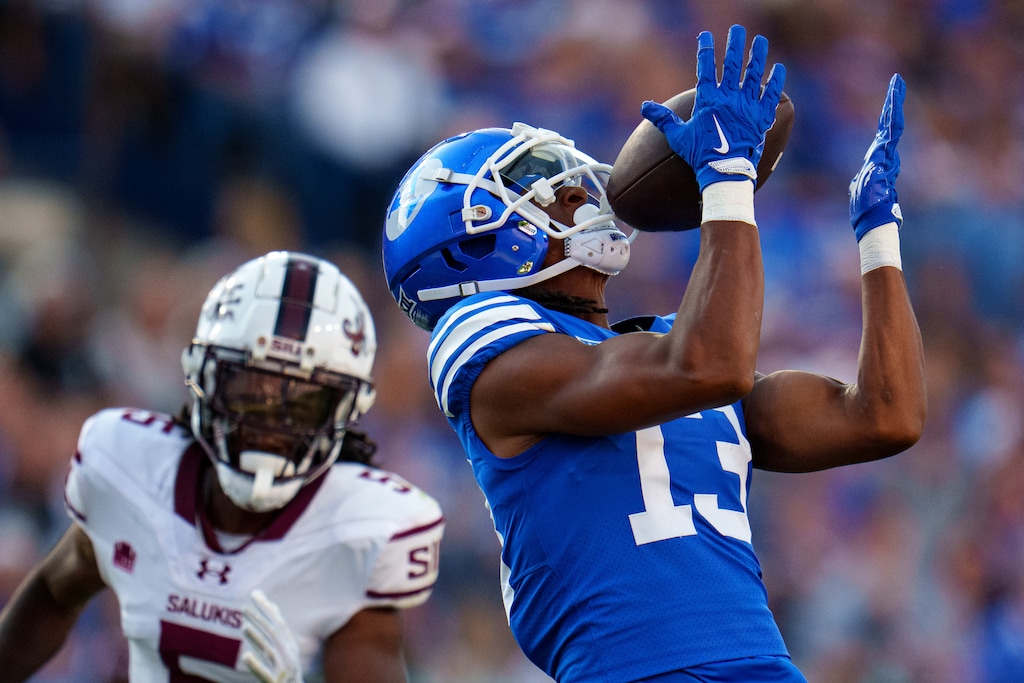
Following the arrest and expulsion of Parker Kingston, and the departures of wide receiver Chase Roberts and tight end Carsen Ryan, who are headed to the 2026 NFL Draft, BYU will have to replace its top three pass catchers from 2025.
But Fesi Sitake has been here before.
“There’s been a couple years where we knew who our guys were and they were already proven,” the Cougars’ passing game coordinator and wide receivers coach said. “But most years, there’s always a spot where one or two guys need to step up, and without fail, someone always does.
“We’ve lost — between Chase and Parker — probably 85% of our perimeter production.“
So who will do that this season?
In the tight end room, that answer is pretty straightforward. BYU brought in USC transfer tight end Walker Lyons — the brother of highly-coveted BYU quarterback recruit Ryder Lyons — this offseason.
Lyons had 20 receptions for 223 receiving yards and two touchdowns as a sophomore with the Trojans.
“We’ve known how talented he is,” Sitake said of Lyons. “It was fun to watch him start to really flourish post mission at USC, and he looks really, really good right now. We haven’t put pads on, so we don’t know how influential he’ll be in the run game like Carsen was, but we’re confident that he can do well.”
Notre Dame safety Xavier Watts, left, tackles Southern California tight end Walker Lyons (85) during the second half of an NCAA college football game Saturday, Nov. 30, 2024, in Los Angeles. (AP Photo/Ryan Sun)
The Cougars are also banking on Oregon transfer Roger Saleapaga to be the other half of a “dynamic duo” alongside Lyons, Sitake said.
Where things will get tricky is replacing Roberts and Kingston on the perimeter.
So far in spring practice, Sitake said veteran receivers Jojo Phillips, Cody Hagen and Reggie Frischknecht have stepped up early on.
“Those three were kind of expected to know the offense and pick up the rifle,” the coach said. “... The standard hasn’t changed. I haven’t tempered my expectations. Even though there are new faces, they know the best guys are going to play.”
Sitake has also leaned on them for leadership.
“I don’t have to really say a lot,” Sitake said. “Those guys feel it. They know it. They know when there’s a void of leadership and experience, and they’re the next man up. They kind of have to step up.”
Another name Sitake mentioned was Tei Nacua, the younger brother of Samson and Puka Nacua. The wide receiver had limited production in his second season, appearing in only five games after redshirting in 2024
“Tei has done a phenomenal job,” Sitake said. “I think he’s turning a great corner from winter conditioning and two practices. He’s turned a huge corner.”
Sitake has had to temper his expectations about the youngest Nacua, whose brothers shined in Provo after transferring from Washington and Utah, respectively. BYU picked up Tei straight out of high school.
“I’ve had to remind myself a lot, there’s growing pains with players,” Sitake said. “Every year, Tei is progressively maturing, getting better, changing his body and knowing the playbook.
“He’s playing with a level of confidence that he hasn’t had in his first two years.”
For now — with just a little over a week of spring practices under the Cougars’ belt — Sitake is continuing to watch and wait for someone to separate themselves from the pack.
And he’s excited to pick the next group of BYU’s starting receivers.
“If you don’t play with the standard that we have in our room, then it’s next man up,” Sitake said. " I love the challenge of seeing who’s going to step up. It’s on me to make sure I get them right and [make sure] they’re in the right position.
“The standard hasn’t changed.”