Less than two years after an accident left him with a broken pelvis and sacrum, Moab wingsuit pilot Joe Lohmuller is heading to represent the United States on one of the sport’s biggest stages.
The 6th FAI World Wingsuit Flying Championships begin Oct. 8 at Skydive Elsinore in Lake Elsinore, California, bringing competitors from around the world together for a week of performance and acrobatic wingsuit flying.
For Lohmuller, the event is the culmination of more than a year spent almost singularly focused on getting there.
“I have had 13 and a half months of giving this my all with one focus,” Lohmuller said.
The push began under unlikely circumstances.
On April 5, 2025, Lohmuller was seriously injured in an accident that broke his pelvis and sacrum and severed his urethra. Twelve weeks later, on July 2, he was jumping again.
During his recovery, Lohmuller said he held onto something a doctor in Moab told him shortly after the accident: he would be back on his feet in about six weeks.
“It was one of the worst experiences ever,” Lohmuller said. But he focused on physical therapy and on how fortunate he had been to survive without more permanent injuries.
Then came a phone call from his friend and former teammate, Clark Robinson, asking whether Lohmuller wanted to compete again.
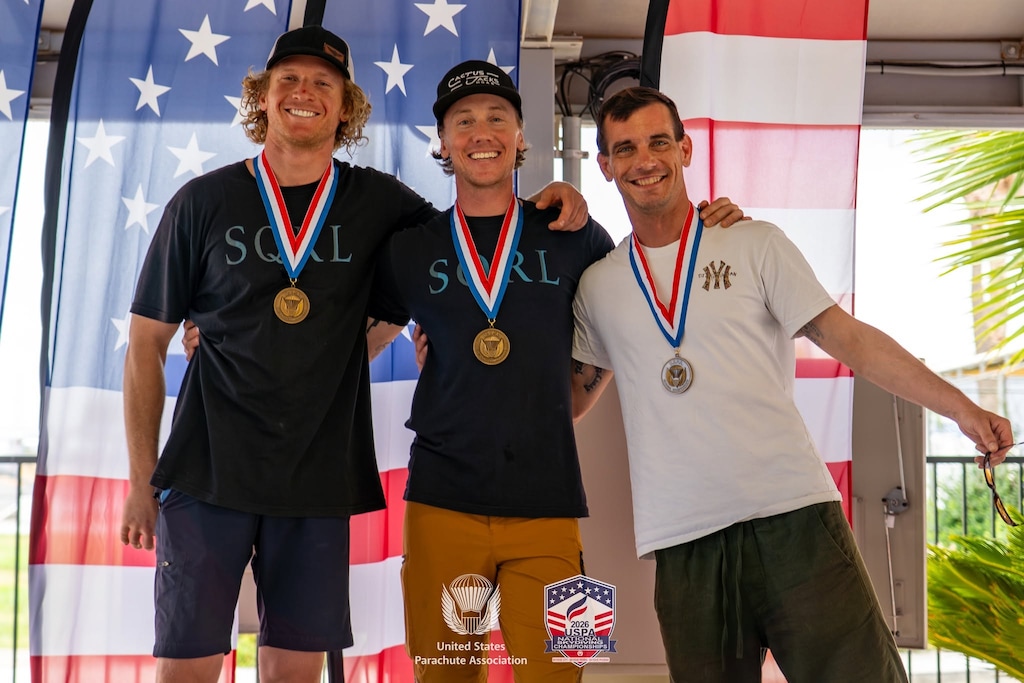
Despite needing another surgery, Lohmuller agreed. After recovering, he trained for about 10 days with Robinson before competing at the 2025 national championships. They won, earning a place on the U.S. Parachute Team and a path to the following year’s World Championships.
From there, training accelerated.
Lohmuller and Robinson spent weeks at a time jumping and training in horizontal wind tunnels, where wingsuit pilots can practice body positioning and maneuvers in a controlled environment.
(Courtesy photo) Alex Knaub, dark suit, films Joe Lohmuller and Clark Robinson at the 2025 National Championship.
During one three-week session, Lohmuller said the pair logged 18 hours and 25 minutes together in the tunnel — which he estimated was equivalent to more than 500 skydives. They continued training throughout the year, including another tunnel session in Slovenia this past summer.
In the final weeks before Worlds, Lohmuller planned to complete four or five jumps each day.
“Just trying to sharpen the ax,” he said.
Acrobatic wingsuit competition combines precision with choreography. Competitors complete compulsory rounds built around prescribed maneuvers and free rounds where teams develop their own routines.
Lohmuller compares the latter to pairs figure skating, with judges evaluating the quality of the flying, the routine and the camera flyer, who is also part of the team.
At nationals, Lohmuller said his team set a national record with 49 “docks,” or completed grips between flyers, surpassing the previous record of 37.
But executing those maneuvers requires more than individual skill.
Finding the right team, Lohmuller said, can be a “magic act,” requiring people with compatible skill, commitment, finances, schedules and personalities.
“Flying with someone is like dancing with someone,” he said. “There’s certain people you can do it really well with when you have chemistry together, and certain people you just can’t do it with.”
When that chemistry works, he said, it becomes something worth appreciating.
“There’s literally nothing more special than just having somebody that wants to fly with you,” Lohmuller said.
That perspective is informed in part by loss. Lohmuller has lost friends in the sport and these experiences have shaped the way he thinks about the people he flies with and the time they have together.
“You just learn to appreciate what you have when you have it,” he said. “You don’t see terrible things coming, but in my line of work, they happen from time to time.
“You have to just let it influence you in a good way of being appreciative and being positive, ” he added.
For all the speed involved, Lohmuller describes wingsuit flying in unexpectedly meditative terms.
“I just call it ‘fast yoga,’” he said. “You’re just trying to achieve the perfect body configuration … and it’s these tiny little movements that turn into what you’re doing.”
With the competition imminent and pressure mounting, Lohmuller said he is going to keep his approach simple.
“Eventually there is nothing left to prepare for. I’m just going to go out there, do my best and try and have some fun.”
This story was first published by The Times-Independent.