 Gordon Monson
BYU and Utah fans typically like stories told separately about their football teams — for routine rivalry reasons.
They are them, we are us. We are us, they are them.
In few other cases does a distance of 50 miles — between these two — seem more like a thousand. Maybe 100,000.
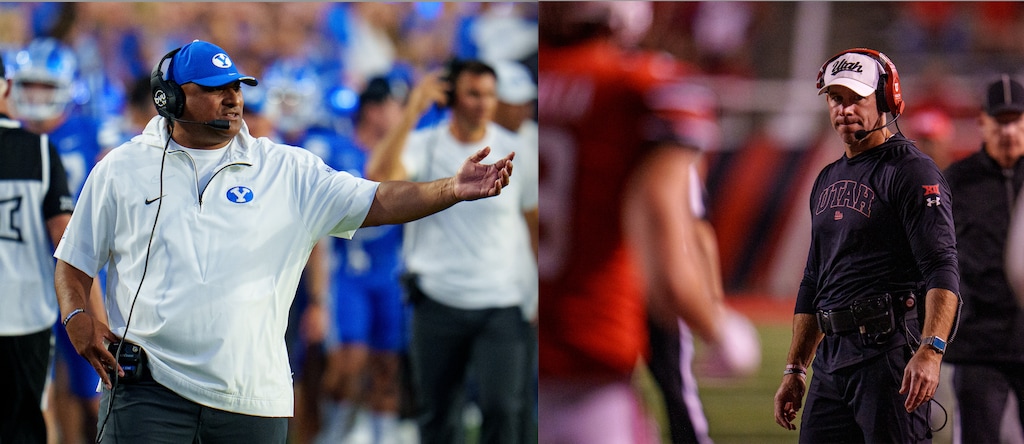
But this season, those tales can rightfully converge, can be passed along blended together, long before the Saturday in November when the blue and the red mix on the field, at least in one significant regard — the comparing of the compelling contrast of coaches. Forgive the alliteration, but there’s one more: See Sitake and Scalley.
Both are familiar names around these parts because they’ve been here for ages. Morgan Scalley, born and raised in Utah, has been decked out in red since he entered college as a Ute in 2001, playing safety for Ron McBride and Urban Meyer.
He didn’t just play for McBride; he championed the cause of retaining the coach when other administrators at the school wanted him gone. He wrote a letter to those administrators, representing his teammates, pleading for Utah’s top dogs not to offload Ronnie Mac. They did not listen.
When Meyer came in as the new guy, he looked around the room, keenly perceiving which players were important for him to connect with. Scalley was one of them, the primary one. He was made a team captain because he was a leader, both on the field and in the locker room.
Scalley’s 2004 team, his senior year, famously rolled to an undefeated season, a season before Sitake arrived at Utah as a linebackers coach. Scalley returned in 2006, first as an administrative assistant, and from there, he climbed up the Utes coaching ladder. Sitake climbed, too, from coaching linebackers to defensive coordinator to assistant head coach.
That was back during Sitake’s hiatus from BYU, the school for which he also was a team captain, a student under the wing of LaVell Edwards, who singled out the fullback as a future coach, a young man he pictured as not just a coach, but the head of a program. The legend was prophetic in that way. Sitake, after winding around to different programs, including, as mentioned, the Utes, wound up back in Provo, where he said he always belonged, as the boss of Edwards’ old team. He took the place of his mentor, with two placeholders in between.
You know his story from there. Sitake grabbed the helm of the Cougars before the 2016 season and as the head coach lived and learned from that point forward. He had good years, mediocre years, and an occasional bad year, all of which let him in on a not-so-little secret: Being a head coach entailed a whole lot of football, indeed, but also extras to the left, extras to the right and accountability regarding everything involved in big-time football. He had to educate himself as to the best way to lead, to discipline, to discipline without an iron fist, to lure in recruits, to reach his players, one and all, and to motivate them and his staff members to do what was necessary to win.
“It was a lot to learn,” he says. Sitake kept books filled with handwritten notes as he matriculated.
He made mistakes and he conquered his errors, including hacking through the transition from independence to the Big 12. His season-by-season records went like this: 9-4, 4-9, 7-6, 7-6, 11-1, 10-3, 8-5, 5-7, 11-2, 12-2. For those not willing to add all that up, overall he’s 84-45 with a 6-2 bowl record.
And now, in the coming year, the Cougars, his Cougars, are expected to threaten for a Big 12 championship and maybe make the College Football Playoff. We’ll all see how that goes, especially in the wake of Sitake’s spat with certain administrators at BYU who he indicated were not keeping promises made to him when he decided to stay at BYU as Penn State tried to hire him away.
Point is, after a decade, Sitake is a seasoned head coach who has rocked and rolled his way to national respect as a program honcho. He finds himself now atop more than a few lists as one of the best head coaches in the business.
Scalley is in a slightly different boat, commencing his first season as Utah football’s CEO. And there’s much for him to assimilate. He’s nobody’s rube, having run Kyle Whittingham’s defense for 10 seasons. Can the man run a team? We know this much: He can run half one.
How will he do when he takes two halves of that large cantaloupe and slams them together into one? Will it be lopsided? Will there be gaps to bridge and mistakes committed and many of the same lessons to learn that Sitake had to absorb after he had been a DC?
Yes, yes and yes.
This is the initial time he’s been a full-on head coach, and you know what that means. Boil it down to personal terms. Think back over your life to when you were tasked with doing something for the first time. How exactly did that go? In many cases for many people, far, far from flawlessly. Oops, another bit of alliteration.
Scalley is smart. He was smart as a player, smart as a defensive coordinator and he’s still smart. He can break down the Xs and Os of the game in a way that is reminiscent of an accomplished math professor explaining quantum field theory calculations.
He can present it. Will his players on defense, offense and special teams, and his assistant coaches, understand and act on it, move it forward at the level everyone in and around Utah football has come to expect?
Beats me.
Smart coaches have taken over operations before and failed. Scalley, though, has the advantage of being fully immersed in many aspects of the way things have worked — and the way they haven’t — at Utah over his entire adult life. He’s been educating and motivating players and coaches for two decades now, formulating defensive football all along. Now he’s got the reins to everything Ute. Everything. All the major decisions are his. All the accountability. All the responsibility.
The head coach’s cabin can be a bright, heavenly environment when things are good. When they’re bad, they can be as dark and dreary as hell.
Scalley is now faced with handling both of those scenarios and many more. Some of them he’s seen, some are unforeseen. Still, he’s been prepping for this opportunity for a long time, much the way Sitake did.
I asked Sitake not long ago what he knows at present versus what he knew when he first donned the head man’s whistle and sweatshirt. He didn’t stop to think it over. He just laughed. And then he said, “How much time do you have? There is no comparison.”
He was intelligent from the start. Now, he’s learned and wise.
How quickly can Scalley make that transformation? How long before he digests and integrates in his own way what Sitake has previously powered through? Can the student match the master? Can he surpass him straightaway?
That’s what makes comparing the contrast of coaches compelling. Yeah, the alliteration works, whether it’s 50 miles apart or a thousand or 100,000, as the blue and the red mix — not just on game day of Nov. 7, but all season long.