 Gordon Monson
Provo • Aaron Roderick has seen good times and bad, times of highs and times of lows, times when he felt like — and actually was — the smartest man in the room, times when he was blamed for being the dumbest, even when there was plenty of dumb to spread around and share with others.
At 53 years old, he’s pretty much experienced it all over the span of a football coaching career that started in 1999, as a graduate assistant mentoring linebackers at BYU and thereafter running backs at Snow College, and most certainly while crafting or helping craft the offenses at Southern Utah, at Utah and at BYU.
No assistant coach takes heat the way offensive coordinators do, especially at places like Utah, where a former head coach brought in and tossed out OCs as though they were disposable wads of paper, or like BYU, where longtime fans have longtime memories, some of them favorably enhanced, about scoreboards lit up by predecessors who assisted a head coach whose name is now on the school’s stadium. Those guys were criticized, too, trying to live up to some stratospheric standard.
Here’s the thing, though: Nobody’s throwing blame at the Cougars’ offensive leader now, not anymore, not after going 23-4 over the past two seasons, granted, in part, due to stellar defensive play. On the other hand, the new season hasn’t started yet, and once it does, who knows what kind of hell will be raised when Roderick calls for an LJ Martin draw on third-and-9 from BYU’s own 18-yard line in the fourth quarter of a conference game resulting in a punt?
Horrors.
Dumb is always right around the next tackle for loss, followed by the question: What kind of idiot would call a play like that?
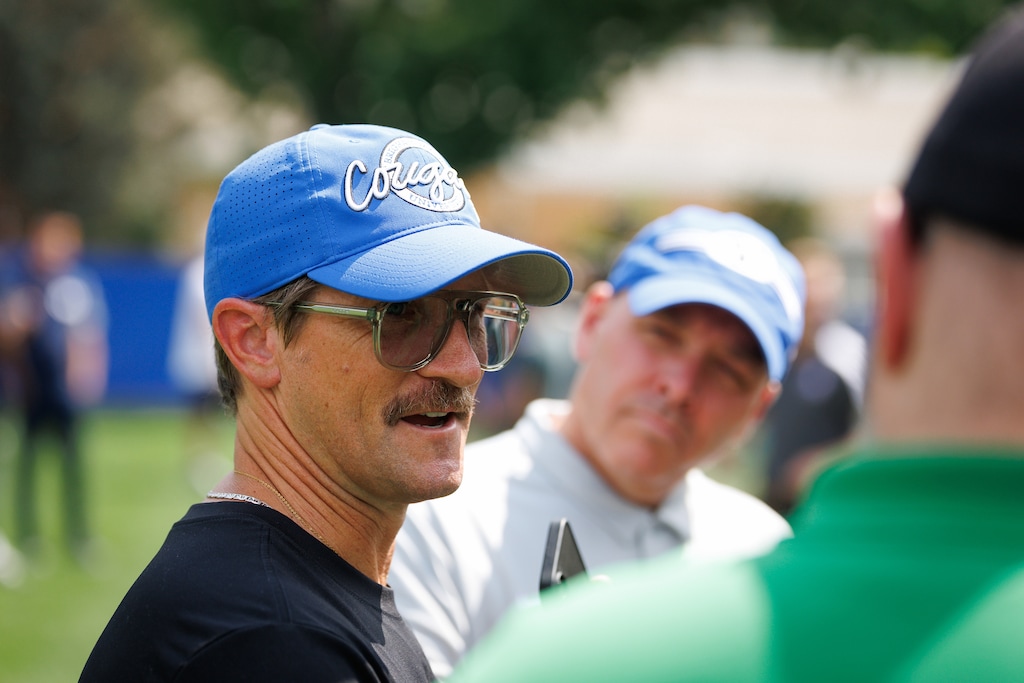
The idiot wearing the blue hat with the Cougars logo stitched on the front, the one who all those seasons ago played receiver at BYU, who drives from his rooted residence in Salt Lake City down to Provo every day, happy to do so, that’s who. Calling plays, the right one at the right time that’s guaranteed to work, is a steep climb for every OC, seasoned or otherwise. “The play clock moves, it moves fast,” Roderick says. Football in a hurry.
(Trent Nelson | The Salt Lake Tribune) Aaron Roderick at BYU football practice in Provo on Monday, March 6, 2023.
But he has his reasons for darn near every play he calls, whether it gains the designed yardage or not, utilizing a mix of a well-prepared call sheet sketched out with other staff members through the week leading up to a game and his own acumen, harvested by way of years of learning and living in football’s trenches and in its skyboxes. The same guy who has earned not only a sizable annual paycheck — “I’m doing well,” he says — from the program for which he coaches, but also the trust of bossman Kalani Sitake and the regard of fellow coaches around the Big 12, particularly defensive coordinators who have to deal with Roderick’s concoctions.
He’s had opportunities to leave for other jobs at other schools, and wouldn’t mind being a head coach one day, someday, but he’s situated in and suited all snug at BYU, where Sitake does give him a free canvas to create on his own, sometimes opting for Picasso-type plays, sometimes going for the Monet, sometimes doing a little finger painting. Roderick loves all of that.
“I like solving problems,” he says. “I like staying up late at night, thinking about how I’m going to get that next first down, how I’m going to best use this player or this player’s skill set or that player or that player’s skill set. That’s what I enjoy the most about this profession.”
As for that aforementioned acclaim, he knows that football people know that he knows that they know the savvy he’s acquired as the big brain behind the BYU attack. And, yeah, they respect that.
His players respect it, too, especially his quarterbacks — players like Zach Wilson and Jaren Hall and Bear Bachmeier. And others in the program who haven’t necessarily been out front in the brightest spotlight.
Why?
It’s fairly basic to what appeals to the human condition. Roderick is an intelligent force who has witnessed other coaches who … well, let’s just say they didn’t have the sweetest bedside manner when it came to growing and grooming quarterbacks. Some coaches’ heads spin around their shoulders, projectile vomit flying out of their mouths when a QB makes a regrettable read, a bad throw, or even worse, hurls a pick.
Roderick isn’t that type of maniac.
He molds and massages his quarterbacks into the kinds of playmakers who don’t hesitate or double-clutch their way into trouble, worried that the coordinator will throw down the thunder if they throw a goofy ball.
One former BYU quarterback said Roderick was “one of the most positive influences” in his football life.
“All the quarterbacks we’ve had here know I’m pretty steady,” Roderick says. “I obviously don’t want turnovers. But I’m not going to freak out over them. If a mistake is made, if we have a bad play, or a bad series, I want our quarterbacks to know we believe in them, we have confidence in them. Just keep playing the next play.
“It’s like shooters in basketball. It doesn’t matter if Steph Curry misses some shots. If he misses a few, he knows the next one is going in. That’s the way I want our quarterbacks to feel.”
That’s the way he wants Bear Bachmeier to feel.
(Jaren Wilkey | BYU Photo) Quarterback Bear Bachmeier participates in BYU football practice in Provo, Monday, Aug. 10, 2026.
Roderick, who guided the quarterback through a surprisingly good but occasionally flawed freshman season, has studied Bachmeier’s strengths and weaknesses, fully aware of what needs improvement and what’s already rock-solid.
The offensive schoolmaster isn’t badgering his student with a battery of details heading into his second season, just feeding him what he discerns as most important. For instance, Roderick is holding off on swamping Bachmeier with too many numbers, too many goals.
“We’re not harping on stats every day, that we have to get this many yards, this many touchdown passes,” he says. “But we do want to be efficient with touchdown passes to interceptions, that’s a winning stat. We want to throw as close to 70% completions as possible. Bear’s an accurate passer and that’s a winning stat. We’re not worried about leading the league in passing yards. We want to take care of the ball. We want to be efficient in the red zone. If he does those things, we’ll win a lot of games.”
Roderick says he’ll aim to run Bachmeier less, avoiding, if possible, the multitude of hits he absorbed last season, without taking away what he says makes Bear, Bear.
“We want to run him less and have him grow in the passing game, in decision-making, in getting us into the right plays, in getting us into the right protections. He did a good job with that last year, and now, just do even more of it this year.”
He adds: “Time in the offense is huge. He’s growing. He’s a sharp guy.”
Roderick says what nearly every offensive coach says prior to the start of a season — that he intends to utilize a strong run game, in this case Martin, as well as Sione Moa and Preston Rex and Devaughn Eka, and an offensive front that can grade the road for the guys with the ball. He also is fully aware that at BYU the quarterback is king. “A good run game is a QB’s best friend,” he says, grinning at the cliché.
As for doubts about Bachmeier’s targets this season, what with the best Cougar receivers from a season ago gone, Roderick says it won’t be a problem, not for Bachmeier, not for him, not for the pass attack, not for fans.
He expresses trust in receivers firmly in the fold as he lists them off — Jojo Phillips, Kyler Kasper, Legend Glasker, Tiger Bachmeier, Reggie Frischknecht — and highlights the presence of tight ends Walker Lyons and Roger Saleapaga, calling them “two of our best players.”
“I believe in these guys,” he says.
Roderick also believes in his staff, in the plans being drawn up for an “explosive” offense in 2026, and certainly in himself.
“Explosive plays are a huge part of the game. It’s hard to go on a 12-, 14-, 16-play drive, over and over for touchdowns. Somewhere in the game, we need plays where we get 40 yards, 50 yards or 25 yards. We want to score touchdowns on five-play drives. You avoid mistakes that way. We had a really good year last year, but we weren’t as explosive down the field. That’s a big goal this year — get the explosives.”
Roderick remembers times during seasons of the past in his various roles at his various stops when that term might have indicated self-destructive bombs going off inside less talented offenses. And he appreciates what he’s directing now.
(Trent Nelson | The Salt Lake Tribune) Aaron Roderick at BYU football media day in Provo on Wednesday, June 22, 2022.
“I expect us to be better than last year,” he says, when the Cougars finished 12-2. “That’s my job, to make sure we are better than last year. I accept that challenge, and I think we have the players to do it. …”
He pauses, simultaneously relishing the glorious thought and recognizing the effort that will be required to go into realizing what might be, then continues.
“… I feel really confident. We have good players, and I feel confident in what we’re doing, in how I’ve grown as a coach. We ask our players to get better every year and I hold myself to the same standard. You keep working at it. Every year we look back and ask, what mistakes did we make? What mistakes did I make as a play-caller? What mistakes did we make as a staff?
“Just like we critique the players, we do the same thing with the coaches. Whatever deficiencies we find, we find ways to study them. If we need to learn about this phase of the game, we seek out the people who are the best in the business at this or that. We always are trying to get better.”
If that sounds like a nice blend of cockiness and humility, that’s exactly what it is.
“I don’t ever feel like I’ve arrived, but I am at the stage of my career where I have a lot of confidence,” he says. “I believe in what we’re doing as a staff, I believe in our players, and I believe in myself.
“In play-calling, it’s years of experience that help. Earlier in my career, there might have been times when it was more challenging to get the call out; you’re stumped. But the longer I’ve coached, the quicker I’ve become at having answers for things that come up. At this point, you’ve kind of seen it all.”
And in those moments smack dab in the middle of games, maybe in the fourth quarter against a conference opponent, when an unsuccessful play or series of plays is called, when what seems like idiocy emerges, he’d like everyone pointing fingers and muttering gosh-darn expletives to know that, “I’m more critical of myself than any fan could ever be. I’ve learned to manage that.”
To not just survive, but to thrive.
“I love what I do, what I’ve done,” he says. “I love being an offensive coordinator. Here at BYU, it’s been a great experience.”
That last sentence sounds as though it was purposely put in the past tense, but, even if the Cougars blow up and soar to the heights they’re aiming for this season, Roderick actually means moving forward, upward and onward right where he is.
He intends to go on making the drive, through the highs and lows, from his longtime home in Salt Lake to the practice fields at BYU.
Gordon Monson has been a columnist at The Salt Lake Tribune since 1993. Before coming to Utah, he was a sports and feature writer at the Los Angeles Times and the Los Angeles Daily News. He's hosted a sports-talk radio show in Salt Lake City for 22 years, the past 16 years at 1280 AM/97.5 FM The Zone.