 Addy Baird
I called Clyde Wright on a spring afternoon in 2024. I was writing about a curse that has tormented the Los Angeles Angels for decades, and Wright, who played for the team from 1965 to 1973, had been in there for its earliest days.
“You Mormon?” the retired Major League Baseball pitcher asked after answering the phone.
At the time, I was living in Washington, D.C., but I’d grown up in Utah County and still had my 801 area code. His late wife was a member, he told me, and I explained I had grown up in The Church of Jesus Christ of Latter-day Saints but was no longer active.
Wright, who’s now 85, told me about his time with the Angels and the series of traumatic player injuries and deaths that sparked talk of a curse.
He also talked about a magical no-hitter he pitched in 1970 against the Oakland Athletics. He threw 98 pitches that night and struck out just one batter: Hall of Famer Reggie Jackson.
“He’s still looking for a curveball,” Wright said of Jackson. “I threw three fastballs.”
In between his recollections of his time in the league, we discussed the church as Wright reflected on his own conversion and his daughter’s recent marriage in the temple. We talked about our relationships to the doctrine and the move by The Church of Jesus Christ of Latter-day Saints away from the use of the term “Mormon.”
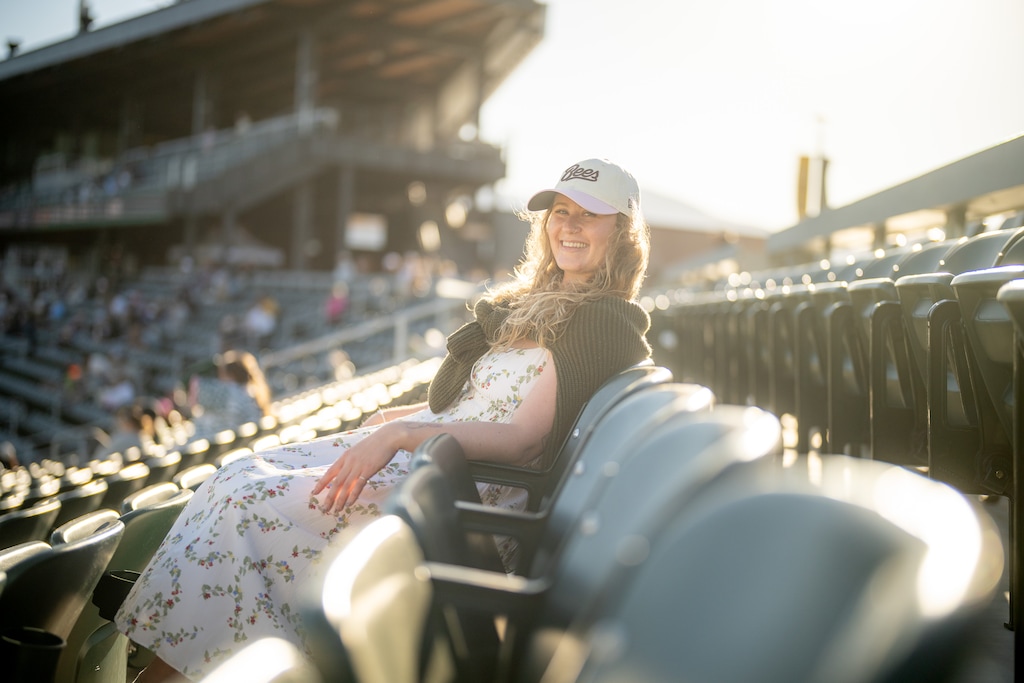
(Trent Nelson | The Salt Lake Tribune) Addy Baird poses with Bumble and some young baseball players at The Ballpark at America First Square in South Jordan on Thursday, May 21, 2026.
It was a winding and special conversation, and it became one of my favorites among the dozens of interviews I did for my new book, “The Magical Game: The Spirit and History of Baseball’s Superstitions, Rituals, and Curses,” out June 2 from MacMillan Publishers’ St. Martin’s Press.
The book is a history of baseball superstition, and of the magical culture that permeates the sport. In it, I explore the ancient roots of superstitious rituals and the way baseball cemented our idea of “jinxes,” consider the curses that afflict baseball teams both here and in Japan and make my case for what really makes baseball the most magical sport.
And while I lived on the East Coast during much of reporting and writing, there were research gems that always brought me home: While writing a chapter about baseball’s legacy of changing rules and fan attitudes, I was charmed to come across a 1901 article from The Ogden Standard noting that the Salt Lake area teams were fielding strong lineups and reporting an updated rule about what constituted the strike zone.
There were writer’s block breakthroughs in these homecomings. Almost exactly a year ago at a Memorial Day weekend Salt Lake Bees game, I broke through a late-stage manuscript struggle as I tried describe the sense of timeless presence baseball offers me: “The quiet, serene, present feeling I can find through meditation was exactly the way I felt on a recent evening at a minor league ball game with friends,” I write of the game in the book’s final chapter.
“It is a sense of awe and wonder commingled with the total devotion to what is happening right in front of me. I tasted it as I watched a home run sail over the fence and toward the Rocky Mountains that defined my childhood landscapes. It was magical in the most ineffable, generalized sense.”
And as my conversation with Wright helped me realize, it was growing up LDS that initially sparked my love for the mystical. I never expected to later explore that love via baseball.
Baseball has been nothing short of a portal to a magical realm for me.
“There is something so special about the grand ritual of the daily game,” I write in the book, “and the micro rituals within the game itself — the national anthem, the pre-batting superstitions, the seventh inning stretch — serve to remind me that, at least for these nine innings, the universe is a magical place.”
Note to readers • Join Addy at The King’s English Bookshop on Wednesday, June 3 at 6:30 p.m. to hear her discuss the book and her reporting on the magic of baseball.