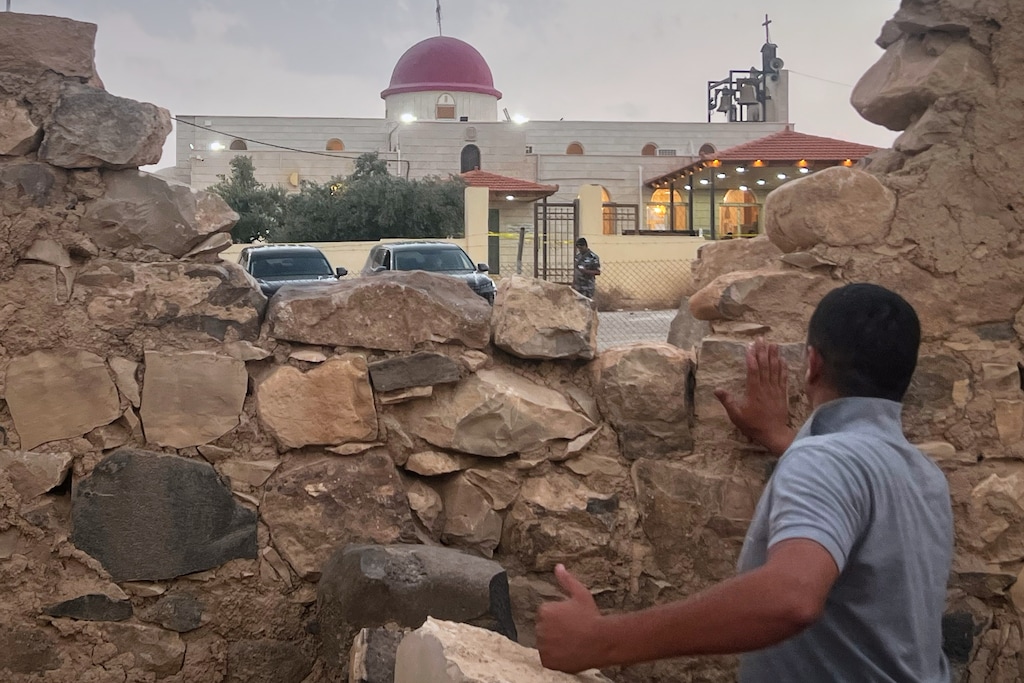
Gunmen opened fire at a Greek Orthodox church in southern Jordan on Friday, killing at least seven people and wounding nearly three dozen others, in what Jordanian officials called a terrorist attack.
Prime Minister Jafar Hassan said at a news conference the attack was “the result of terrorist takfiri ideology,” referring to a view that effectively allows one Muslim to declare another an apostate. How that figured into an attack on a Christian church was not immediately clear.
By Friday night, a hunt for the attackers was still underway, and no group had claimed responsibility.
The shooting, one of the deadliest attacks in Jordan in years, took place during a funeral in Karak province, which is home to a sizable Christian community, Maj. Gen. Obaidallah Maaytah said at an earlier news conference.
The unidentified attackers emerged from a vehicle and opened fire in the village of Hamoud, according to Jordan’s state broadcaster, Al Mamlaka, which showed security camera footage that appeared to show three men firing toward the church from the street before running toward the building.
Jordan’s interior minister, Mazin Farrayeh, said that the attack had been carried out by “extremists.” He did not identify them or any affiliation they had, saying an investigation was underway.
King Abdullah II vowed the attack would be met with “the harshest retaliation.”
“Those who delude themselves into thinking that they can divide Jordanians with their bullets,” he said on social media, “have no chance in the face of our unity.”
Jordan has largely avoided the violence that has destabilized many of its neighbors, though it has faced sporadic militant attacks over the past decade, and at one time it hosted more than a million refugees from the Syrian civil war. In 2016, Islamic State militants killed 10 people in a shooting rampage in and around the city of Karak before taking shelter in a medieval castle there.
The Christian presence in Karak dates back more than 1,500 years, to a time when the Eastern Roman Empire ruled this part of the Middle East. Today, Christians make up about 2% of Jordan’s population, but they are guaranteed seats in Parliament and have long served as Cabinet ministers and ambassadors.
Note to readers • This article originally appeared in The New York Times.